

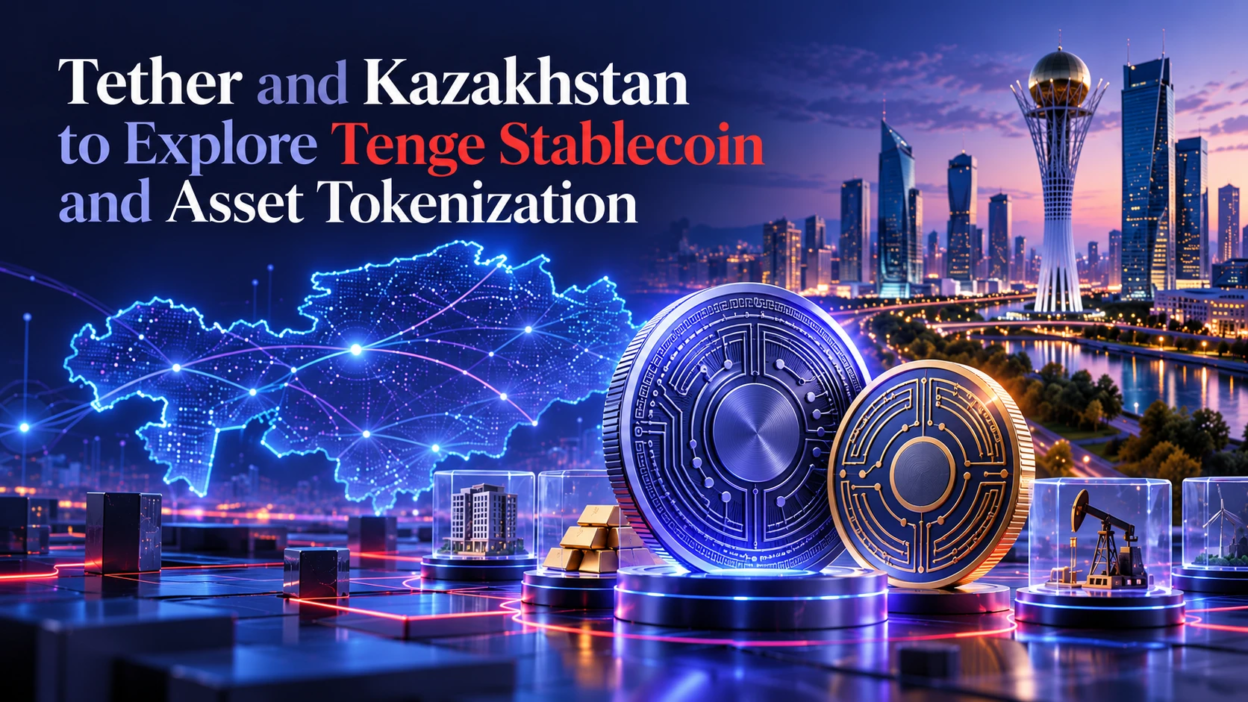
Tether, the company behind the USDT stablecoin, signed a memorandum of understanding (MoU) with the National Bank of Kazakhstan and the Alatau City Authority on October 7, 2026. The agreement will see the three parties explore a possible tenge-linked stablecoin, asset tokenization, and new uses for blockchain technology.
Under the MoU, the partners will study international models for issuing stablecoins and identify how the technology could be used in Kazakhstan. They also plan to prepare a concept and pilot proposal for a stablecoin linked to the country’s national currency, the tenge.
Unlike Bitcoin, stablecoins are designed to maintain a relatively steady value by tracking another asset, such as a national currency. A tenge-linked stablecoin would aim to follow the value of Kazakhstan’s currency. However, stablecoins can still lose their intended value if their backing or market conditions create problems.
The announcement does not identify who would issue the proposed stablecoin, which blockchain network it might use, or how its reserves would be managed. These details remain open as the partners examine possible technical and financial arrangements.
The partners will also work on a framework for asset tokenization, which means representing real-world assets with digital tokens recorded on a blockchain. The project will involve identifying suitable assets, designing a tokenization model, and preparing a pilot project within Alatau City.
Tether’s Hadron platform could be used to support this work. Hadron provides tools for creating and managing tokenized assets, including financial products. However, the platform’s use in the Kazakhstan project has not been confirmed.
The agreement also includes exploring decentralized finance (DeFi), which refers to financial services that use blockchain-based systems. The announcement does not provide details of any specific DeFi product or launch plan.
Tether, the National Bank of Kazakhstan, and the Alatau City Authority also plan to hold workshops, seminars, and training programs for financial and government specialists. These sessions will cover stablecoin issuance, reserve management, digital asset markets, and the use of blockchain technology for real-world assets.
The National Bank of Kazakhstan oversees the country’s monetary policy and payment systems, while the Alatau City Authority handles administration and regulatory development within the city’s special legal framework. Alatau is expected to host the proposed asset-tokenization pilot as part of the partnership.
The agreement remains at an exploratory stage. It does not announce regulatory approval, the issuance of a new tenge stablecoin, or a date when such a token might become available. Further technical and regulatory decisions would be needed before any public launch.
Tether is already widely known for USDT, a stablecoin designed to maintain a value close to one US dollar. USDT is commonly used for cryptocurrency trading, digital payments, and transferring funds between blockchain networks.
The next steps include preparing the tenge stablecoin concept, developing a tokenization framework, identifying assets for a possible pilot, and conducting training programs. The agreement shows Kazakhstan’s interest in blockchain-based financial systems, although the proposed projects still need further work before their practical results can be assessed.