

Search that understands meaning works differently from search that only matches exact words. A vector database stores and retrieves meaning as numbers so AI systems can find the closest match even when phrasing changes. This guide explains how vector databases work, why they matter for smarter AI search, and how to choose one for real workloads.
What A Vector Database Is?
A vector database is built to store vectors, which are numeric representations of data. These vectors usually come from machine learning models that turn text, images, audio, or code into a fixed-length list of numbers.
Unlike traditional databases that focus on exact matches and rigid schemas, a vector database is optimized for similarity search. It answers queries like which items are most similar to this input based on distance between vectors.
How Vectors Represent Meaning?
 A vector is an embedding, a compact numeric fingerprint of an item. Items that are semantically close end up near each other in vector space.
Embeddings are created by an embedding model. The model learns patterns so similar sentences, related images, or comparable products map to nearby points without relying on exact keyword overlap.
Common Data Types Stored As Vectors
Vector databases support many modalities, but the workflow stays consistent. Raw content is converted into embeddings and stored with metadata for filtering and governance.
- Text: documents, support tickets, chat logs, knowledge base pages, and policies.
- Images: product photos, medical scans, diagrams, and brand assets.
- Audio: call recordings, meeting transcripts, and voice notes after embedding or transcription.
- Code: repositories, snippets, and API references for code-aware search.
Once vectors and metadata are stored, retrieval becomes a math problem rather than a string matching problem.
Similarity Search And Nearest Neighbor Retrieval
The core capability is nearest neighbor search. The database compares the query embedding to stored embeddings and returns the closest ones.
Closeness is measured with a distance metric such as cosine similarity, dot product, or Euclidean distance. The best metric depends on the embedding model and how it was trained.
Why Approximate Search Matters?
Exact nearest neighbor search is expensive at scale. Many vector databases use approximate nearest neighbor indexing so results stay fast even with millions or billions of vectors.
Index structures such as HNSW and IVF reduce the search space while keeping high recall. This tradeoff is what makes vector search practical for production systems.
Vector Database Vs Traditional Database And Keyword Search
Keyword search tools excel at literal matches, boolean logic, and exact phrases. They struggle when the query uses different wording, synonyms, or indirect intent.
Traditional relational databases are excellent for structured transactions and integrity constraints. They are not designed for high-dimensional similarity search across dense vectors.
| Capability | Keyword Search | Vector Database |
|---|---|---|
| Best Match Type | Exact terms and phrases | Semantic similarity |
| Query Flexibility | Lower with paraphrases | High across rewording |
| Typical Index | Inverted index | ANN vector index |
| Core Use Case | Exact search and filtering | Similarity retrieval and ranking |
Many modern systems combine both approaches with hybrid search, where keyword matching and vector similarity work together for stronger relevance.
Why Vector Databases Matter For Smarter AI Search?
 Smarter AI search is about retrieving the right context, not just matching keywords. Vector databases improve relevance by aligning retrieval with meaning and intent.
This matters for chatbots, internal knowledge search, and recommendation engines where user queries are often short, ambiguous, or phrased differently from stored content.
Key Benefits You Can Expect
Vector search changes how systems handle recall and precision. It also improves user experience by reducing the need for exact phrasing.
- Better relevance: results match intent even with synonyms, paraphrasing, or incomplete queries.
- Fast retrieval at scale: indexing keeps latency low as data grows.
- Multimodal support: a single approach can search across text, images, and other data types.
- Personalization: user behavior embeddings can tailor results without hard-coded rules.
These benefits are most noticeable when content is large, unstructured, and frequently updated.
Vector Databases In Retrieval Augmented Generation
Retrieval augmented generation, often called RAG, uses a vector database to fetch relevant context and pass it to a language model. This reduces hallucinations and improves answer grounding.
A RAG pipeline typically embeds documents, stores vectors, embeds the user query, retrieves top matches, and then generates an answer using the retrieved passages.
What Makes RAG Work Well?
Quality depends on chunking, embedding choice, indexing strategy, and filters. Consistent metadata also helps the system enforce access control and business rules.
- Good chunking: splits content so retrieved context is precise and not diluted.
- Strong embeddings: improves semantic alignment between queries and documents.
- Metadata filters: narrows results by tenant, region, language, product, or permissions.
- Evaluation loops: measures recall, precision, and answer quality over time.
When RAG is deployed for internal teams, governance and permissions become as important as relevance.
Core Features To Look For In A Vector Database
Not all vector databases behave the same under real traffic. The right choice depends on data size, query patterns, latency targets, and operational constraints.
Look beyond benchmark claims and verify how the system performs with your embedding dimensions, filters, and update frequency.
Operational And Search Capabilities
- Index options: supports algorithms suited to your scale and recall goals.
- Filtering and metadata: combines similarity scoring with structured filters efficiently.
- Upserts and deletes: handles frequent updates without heavy reindexing downtime.
- Scaling model: offers sharding, replication, and predictable performance as data grows.
- Security controls: supports authentication, encryption, and role-based access needs.
- Observability: provides metrics for latency, recall proxies, index health, and resource usage.
These features determine whether a proof of concept can become a stable production system.
Implementation Basics For A Reliable Setup
A vector database project often fails due to weak data preparation, unclear evaluation, or missing governance. A small amount of upfront design reduces rework later.
The goal is to ensure retrieval is accurate, fast, and safe for the intended users.
- Define the retrieval objective: Decide whether the system should prioritize high recall, high precision, or balanced relevance for your search use case.
- Prepare and chunk content: Clean, normalize, and segment documents so each vector represents a useful unit of information.
- Select an embedding model: Choose a model aligned with your domain language, data modality, and latency constraints.
- Design metadata and permissions: Store fields needed for filtering, auditing, and access control alongside vectors.
- Choose an index and tune it: Configure ANN settings that meet your latency target without sacrificing too much recall.
- Evaluate and monitor: Track search quality with curated queries, measure drift, and adjust chunking or embeddings when content changes.
If your team needs help with this end-to-end flow, Tech Bonafide can support data engineering, model selection, and production hardening for AI search and RAG systems.
Common Challenges And How To Avoid Them?
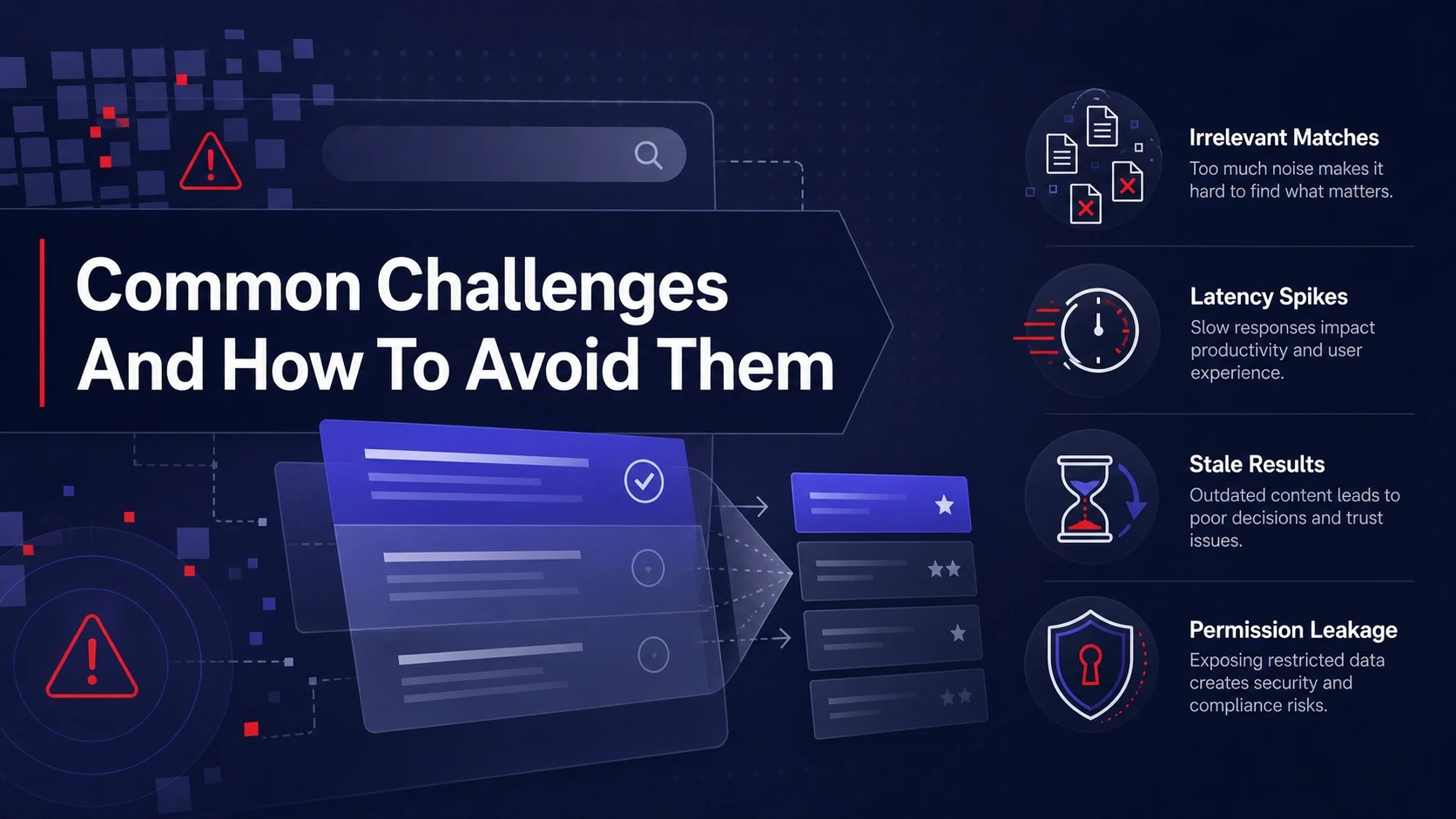 Vector search adds new failure modes that traditional search teams may not expect. Most issues come from data quality, embedding mismatch, or insufficient filtering.
Clear evaluation and disciplined content management keep results stable as you scale.
- Irrelevant matches: improve chunking and add metadata filters to reduce broad semantic hits.
- Latency spikes: tune the index, limit candidate counts, and plan capacity for peak traffic.
- Stale results: implement re-embedding policies when content changes or the embedding model is upgraded.
- Permission leakage: enforce access rules at query time, not only in the application layer.
Addressing these early protects trust and prevents teams from reverting to brittle keyword-only search.
Conclusion
A vector database makes AI search smarter by retrieving information based on meaning, not exact wording. It enables fast similarity search at scale and supports modern patterns like RAG that require high-quality context retrieval.
The best outcomes come from solid content preparation, careful embedding choices, and strong filtering and governance. When those pieces are in place, a vector database becomes a reliable foundation for semantic search and AI assistants.
Frequently Asked Questions
What is the difference between embeddings and a vector database?
Embeddings are vectors created by a model that represent meaning numerically. A vector database stores those vectors and retrieves the most similar ones efficiently using specialized indexes. In practice, embeddings are the data, while the vector database is the retrieval system.
Do I need a vector database if I already use Elasticsearch?
If your use case is mainly exact keyword matching and structured filtering, a traditional search engine can be enough. If you need semantic similarity, paraphrase handling, or RAG-style retrieval, a vector database or a hybrid setup often performs better. Many teams use both, depending on how critical meaning-based retrieval is.
How do I choose the right distance metric for vector search?
The best metric depends on the embedding model and how its vectors are normalized. Cosine similarity is common for text embeddings, while dot product can work well when the model is trained for it. The safest approach is to test metrics with a small evaluation set and pick the one that improves relevance without increasing latency too much.