

Multimodal AI is a type of artificial intelligence that can understand and generate information across more than one data type such as text, images, audio, and video. Instead of treating each format as separate, it connects signals into one shared understanding so responses can be more grounded and useful.
What Is Multimodal AI?
Multimodal AI refers to models and systems that process multiple modalities in a single workflow. A modality is a way information is represented, including language, visual pixels, sound waves, and motion over time.
The key idea is alignment. The system learns relationships between modalities so that meaning in one format can guide interpretation in another format.
Why Multimodal Matters?
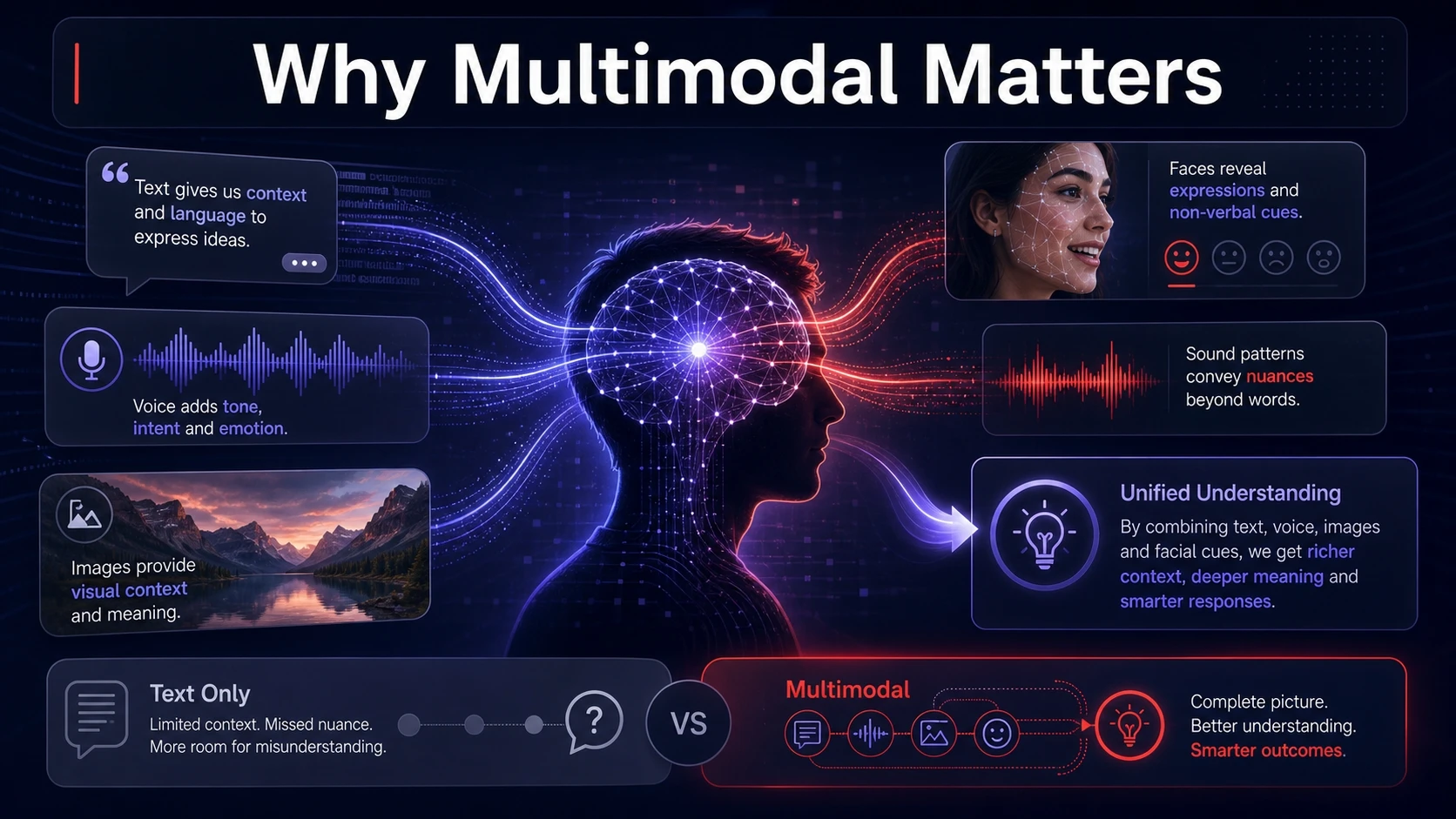
Human communication is naturally multimodal. Meaning comes from words, tone, facial cues, and context in the environment, not from text alone.
Multimodal AI aims to close that gap by combining complementary signals. This often improves robustness when one source is incomplete, noisy, or ambiguous.
- Richer context: Visual and audio cues can reduce misinterpretation that happens with text-only prompts.
- Better grounding: Images and video help anchor outputs to concrete details rather than generic patterns.
- More natural interfaces: Users can speak, show, and type, then get a single coherent response.
These benefits are strongest when the system is designed with clear constraints, strong data governance, and careful evaluation.
How Text And Images Work Together?
Text provides explicit intent while images provide dense contextual detail. When combined, the model can connect words to visual regions and extract meaning that is hard to express as plain language.
Common tasks include image captioning, visual question answering, and document understanding. In each case, the model maps image features and text tokens into compatible representations.
Cross-attention layers are often used to let text attend to image regions and image features attend to text. This enables fine-grained grounding such as linking a phrase to an object or part of a diagram.
How Audio Adds Meaning Beyond Words?
Audio carries information that text cannot fully represent, including prosody, emphasis, pace, and background sounds. It can also support accessibility by enabling speech input and speech output.
Multimodal systems may convert speech to text, but advanced setups also keep acoustic features so that tone and speaker cues remain available to the model. That helps with tasks like meeting analysis, call summarization, and keyword spotting.
How Video Expands Context Over Time?
Video adds temporal information. It combines visual frames with motion cues and often audio, which makes it useful for understanding actions, sequences, and changes in a scene.
Multimodal video understanding typically relies on frame encoders, temporal aggregation, and alignment between dialogue or narration and what is happening visually. The result can be stronger comprehension of processes, demonstrations, and events.
Core Building Blocks Of Multimodal Systems
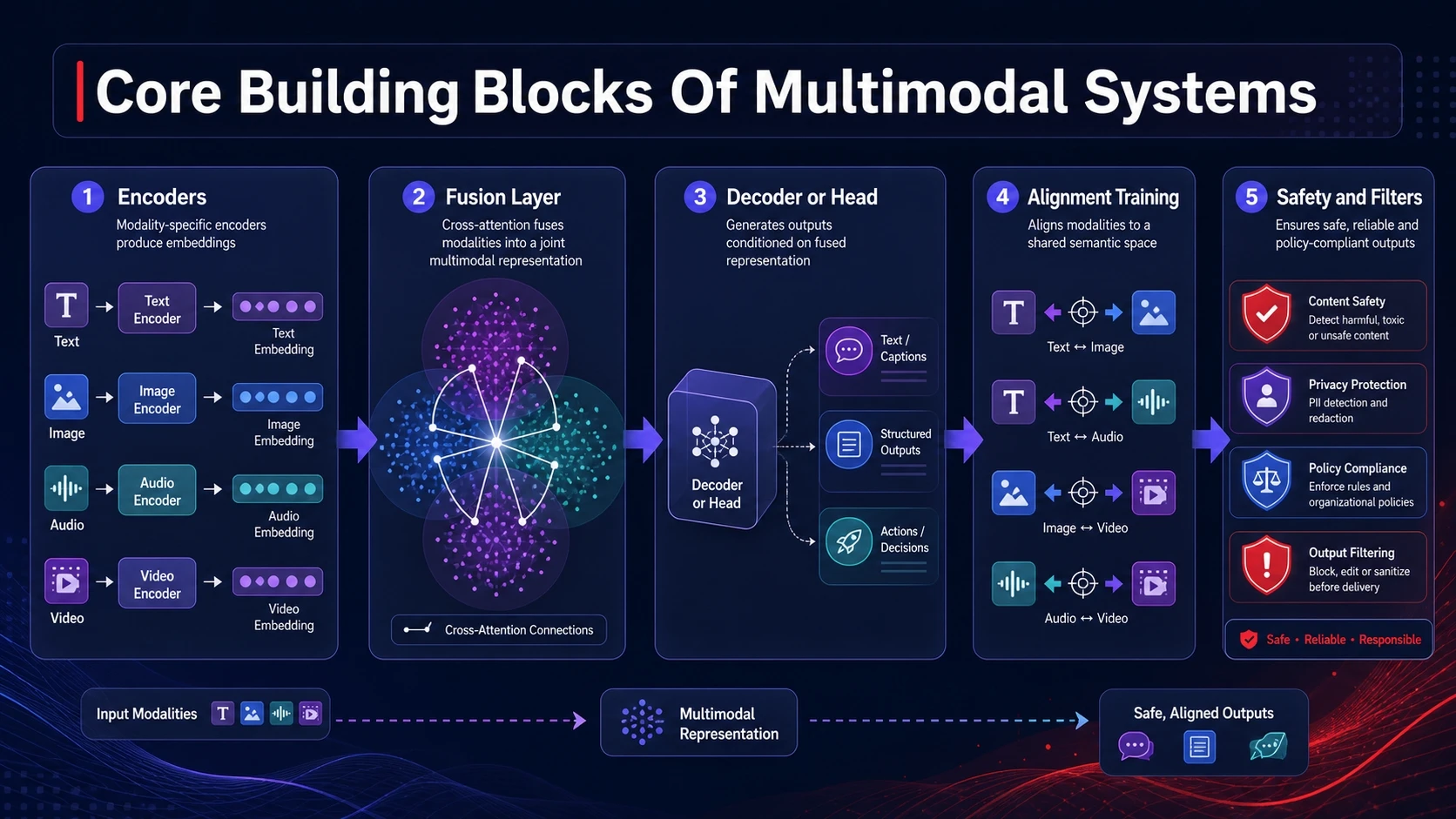
Most multimodal AI stacks use a few repeated components, even though implementations vary. The goal is to represent each modality in a form that can be fused and reasoned over.
- Encoders: Specialized networks convert text, images, audio, and video into embeddings.
- Fusion Layer: Mechanisms combine embeddings through concatenation, cross-attention, or gated mixing.
- Decoder Or Head: A generation module produces text, captions, structured output, or actions.
- Alignment Training: Paired data teaches consistent meaning across modalities.
- Safety And Filters: Policy checks and modality-specific detectors reduce harmful content.
When these parts are tuned together, the system can answer questions about visuals, transcribe and summarize audio, and interpret video scenes using consistent reasoning.
Multimodal AI Model Training Approaches
Training multimodal models usually starts with large-scale pretraining. The model learns general associations such as matching images to captions or aligning audio with transcripts.
After pretraining, fine-tuning adapts the model to domain-specific tasks. Instruction tuning can also teach it to follow natural language requests while using images, audio clips, or video segments as context.
- Contrastive learning: The system learns which paired items belong together by pulling them closer in embedding space.
- Generative training: The model learns to predict text or other outputs conditioned on multimodal inputs.
- Multi-task tuning: Shared training across tasks improves generalization while reducing overfitting.
Evaluation must cover all modalities used in production, including edge cases such as noisy audio, low light images, or rapid motion video.
Multimodal AI Versus Single Modality AI
Single modality AI focuses on one data type, such as a language model that only reads text. Multimodal AI expands the input and output space, which increases capability but also adds complexity in engineering, quality control, and privacy.
| Area | Single Modality AI | Multimodal AI |
|---|---|---|
| Inputs | Text or one signal type | Text plus images, audio, video, or mixed signals |
| Strengths | Lower complexity and faster iteration | Better context and stronger grounding across formats |
| Typical Use | Chat, classification, summarization | Assistants, analysis of media, accessibility tools |
| Risks | Hallucinations from missing context | Privacy exposure and harder safety coverage across modalities |
The right choice depends on the task. If the job is purely textual, multimodal capability may be unnecessary overhead.
Common Use Cases In Products And Workflows
Multimodal AI is used when decisions depend on more than one signal. It supports workflows that combine documentation, media, and human communication.
- Document intelligence: Understanding PDFs, forms, screenshots, and charts together with text instructions.
- Media moderation: Detecting policy issues across captions, visuals, and audio signals in one pass.
- Customer support: Interpreting screenshots, error logs, and spoken descriptions to speed resolution.
- Healthcare support: Combining notes and imaging context for triage support with strict governance.
- Manufacturing inspection: Using images and sensor audio to flag defects and anomalies.
To operationalize these uses, teams typically need a clear data pipeline, strong QA, and monitoring for drift in each modality.
Key Challenges And Limitations
Multimodal AI can fail in subtle ways. Errors often come from misalignment between modalities, missing context, or models over-trusting one signal.
- Data quality: Noisy labels, weak pairs, and biased datasets reduce reliability.
- Latency and cost: Processing images, audio, and video increases compute and memory needs.
- Privacy and compliance: Media inputs may contain sensitive data that requires redaction and strict access control.
- Evaluation gaps: Benchmarks may not reflect real operational conditions, especially for long videos.
Mitigation usually combines model tuning with system design, including input constraints, audit logs, and human review where needed.
How To Implement Multimodal AI Safely?
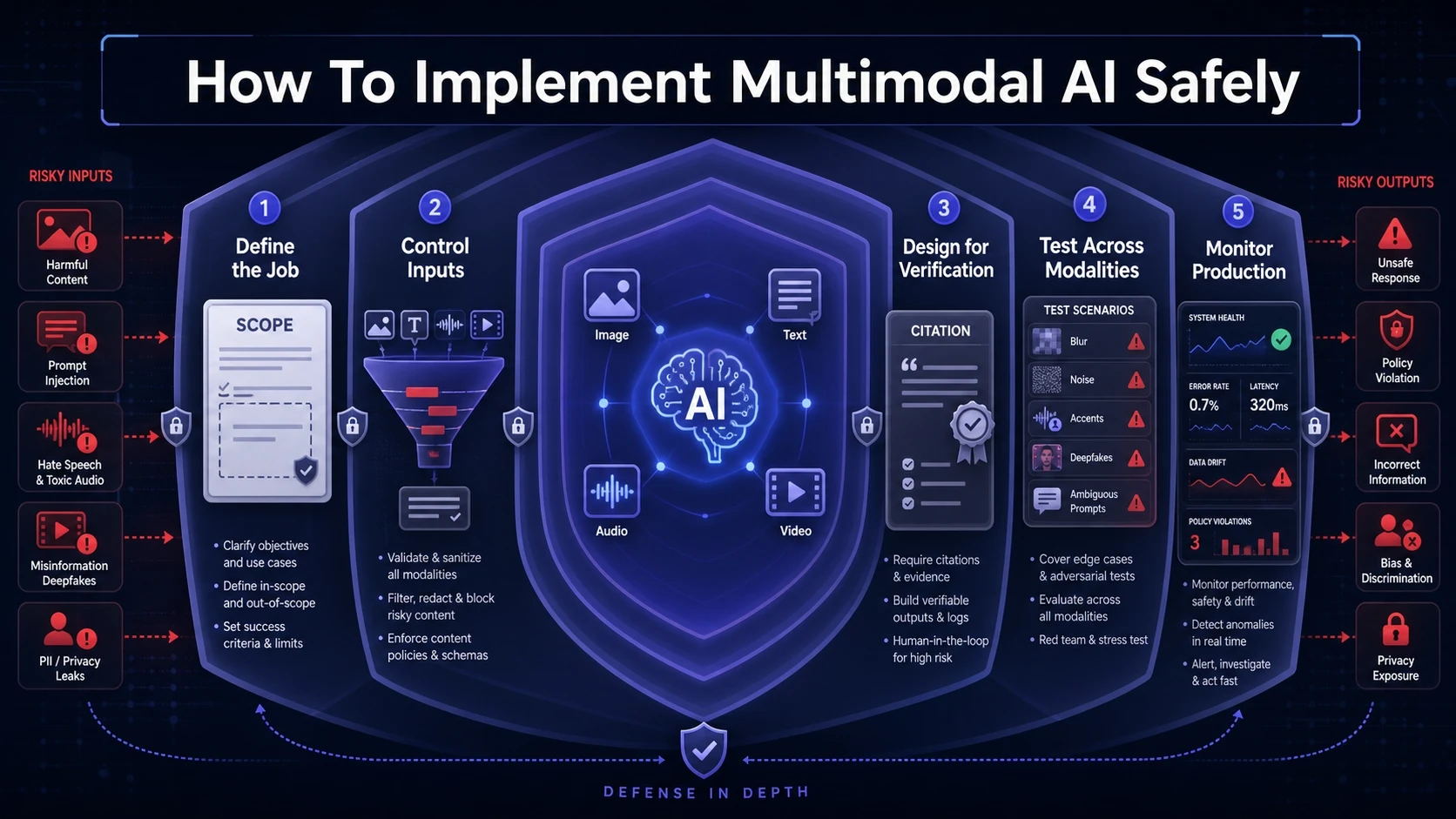
Safe deployment requires more than choosing a model. It needs guardrails around data handling, output policies, and ongoing measurement.
- Define the job: Specify what the system must do and what it must not do, including high-risk scenarios.
- Control inputs: Limit acceptable file types, sizes, and sources, and apply redaction for sensitive content.
- Design for verification: Require citations to input regions when possible, and log key decisions for review.
- Test across modalities: Evaluate with realistic edge cases such as glare, accents, background noise, and motion blur.
- Monitor in production: Track quality metrics, drift, and safety triggers, then retrain or roll back when needed.
Teams that need help choosing architectures, defining guardrails, or building reliable AI workflows often work with technical partners. Tech Bonafide typically focuses on practical AI implementations, including solution planning, integration, and performance tuning for real business environments.
Conclusion
Multimodal AI brings text, images, audio, and video into a unified system that can understand context more like people do. It enables stronger grounding, more natural interfaces, and broader automation across media-heavy workflows.
Success depends on alignment, data quality, safety controls, and evaluation that reflects real usage. With the right design, multimodal systems can deliver high utility without sacrificing trust and reliability.
Frequently Asked Questions
What Makes An AI System Truly Multimodal?
A system is truly multimodal when it can jointly process and relate at least two modalities, not just convert one into another. The model should use cross-modal context to improve understanding or generation.
Does Multimodal AI Always Improve Accuracy?
Not always. It can improve accuracy when additional modalities add relevant context, but it can also introduce noise and increase failure modes. Strong input controls and evaluation are essential.
What Data Do You Need To Build Multimodal AI?
You typically need paired datasets that link modalities, such as images with captions or audio with transcripts. Domain-specific tuning also benefits from curated examples that match your real inputs and compliance requirements.