The 2026 Ford Mustang GT delivers strong V8 acceleration, but its 0–60 mph performance depends on the transmission, tire grip, and testing conditions. In Car and Driver’s 2026 Mustang GT acceleration test, a 10-speed automatic GT reached 60 mph in 3.7 seconds. Earlier tests of manual-equipped GT models recorded approximately 4.2–4.3 seconds, although those results came from 2024 vehicles rather than a directly comparable 2026 test. This guide compares the available performance evidence, explains why the automatic often accelerates faster, and shows how launch technique, tires, and test methods affect the results.
2026 Mustang GT Engine and Transmission Specifications
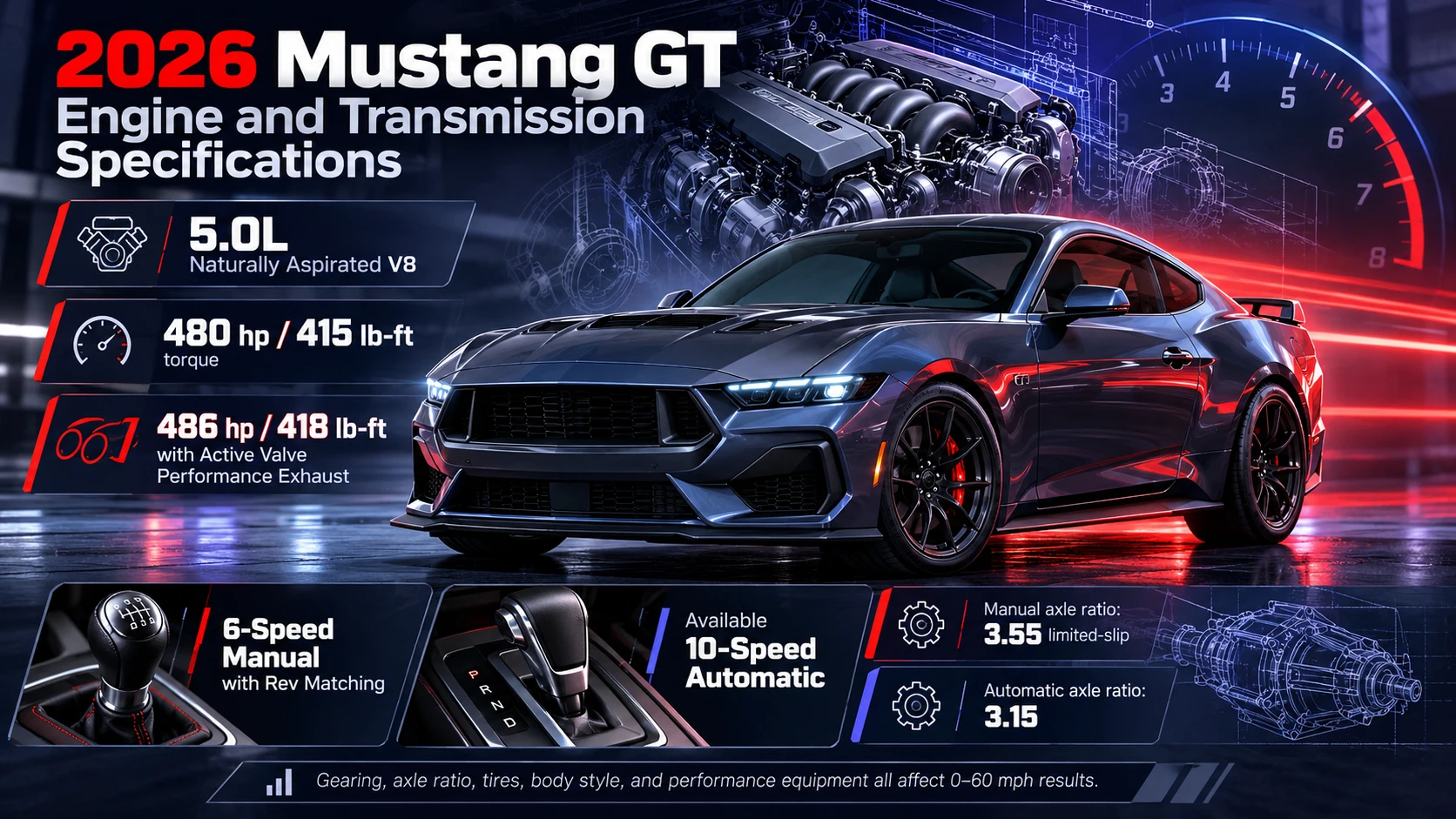
The 2026 Mustang GT uses a naturally aspirated 5.0-liter V8 producing 480 horsepower and 415 lb-ft of torque. With the available active valve performance exhaust, output increases to 486 horsepower and 418 lb-ft of torque. These specifications are listed in Ford’s official 2026 Mustang specifications.
Buyers can choose a standard six-speed manual transmission with rev matching or an available 10-speed automatic. The manual GT has a standard 3.55 limited-slip rear axle, while the automatic GT normally uses a 3.15 ratio, with other axle configurations available depending on equipment.
These details matter because the engine’s output is only one part of acceleration performance. Transmission gearing, axle ratio, tire specification, body style, and optional performance equipment can all affect the time required to reach 60 mph.
What 0–60 Time Really Measures?
0–60 is a short sprint that highlights launch traction, shift speed, gearing, and how consistently the powertrain can repeat runs. It is not a pure engine test because the first second is often limited by tire grip and torque management. Small differences in surface, tire temperature, and driver technique can swing results more than many owners expect.
Acceleration tests do not always begin timing in exactly the same way. Some publications use a one-foot rollout, meaning the car moves approximately one foot before the measured 0–60 mph interval begins. This method can produce a quicker published time than measuring from the first moment of movement. For example, Car and Driver reported a 0.2-second rollout adjustment for its tested 2026 Mustang GT automatic. Its explanation of one-foot rollout describes how this approach improves consistency with common drag-strip measurement practices. Readers should check the testing method before comparing acceleration figures from different publications.
A car’s 0–60 mph time and top speed describe different aspects of its performance. Acceleration highlights the ability to gain speed quickly, while top speed depends on additional factors such as power, gearing, aerodynamics, and mechanical limits. For another sports-car example, explore TechBonafide’s Supra MK4 performance overview, which discusses the Toyota Supra’s engine specifications and top-speed characteristics.
Automatic Vs Manual Differences That Affect 0–60
Transmission choice changes how the car applies power, how fast it shifts, and how repeatable the run is. With the automatic, the car can keep the engine in the strongest part of the powerband with minimal interruption. With the manual, the driver has more control, but the run depends heavily on clutch work and shift quality.
- Shift interruption: The automatic can execute rapid shifts with consistent timing, while a manual introduces a longer power break during each gear change.
- Launch consistency: Automatics tend to repeat similar launches run after run, while manuals vary with clutch slip, throttle modulation, and driver confidence.
- Gearing behavior: The automatic may select shift points based on programming and mode, while the manual relies on the driver to hit the best rpm without overrev or bog.
- Traction Management: Both transmission versions can benefit from electronic traction aids and launch-control features. The automatic reduces the need for precise driver-controlled gear changes, while the manual still requires careful clutch engagement to avoid excessive wheelspin or engine bogging. Available settings and their operation should be checked against the specific vehicle’s equipment and owner’s manual.
Those differences explain why many instrumented tests show the automatic as the easier path to a quick number, even when the manual feels more engaging.
Why the Automatic is Often Quicker?
Modern performance automatics are designed to minimize lost time between gears. Fast shift execution and consistent torque delivery help the car keep accelerating rather than pausing for a driver input. That matters a lot in a 0–60 run where one shift can decide the result.
The 10-speed automatic also reduces some of the driver-dependent variables involved in acceleration. Its gear ratios and electronic transmission control help manage engine speed and shifting throughout the run. Launch-control settings, where used, can support more repeatable acceleration, but they do not eliminate traction limits. Excessive wheelspin, unsuitable tires, or a low-grip surface can still reduce performance. The automatic’s main advantage is therefore a combination of quick shifts, useful gearing, and consistency rather than guaranteed superior traction in every condition.
Why the Manual Can Still Be Competitive?
A manual can deliver an excellent 0–60 time when the driver nails the launch and hits a clean, quick shift. The best runs usually come from a balance of clutch slip and throttle that keeps the engine from falling out of the powerband. When done right, the car leaves hard without excessive wheelspin or bog.
The challenge is consistency. Many drivers either over-slip the clutch and lose time or release too quickly and spin the tires, triggering traction intervention. Manual results often improve with practice and a repeatable routine.
The 2026 Mustang GT’s standard manual gearbox also includes rev matching, which helps synchronize engine speed during downshifts. However, rev matching should not be confused with faster full-throttle upshifts or automatic clutch operation. During an acceleration run, the driver remains responsible for choosing shift points and engaging the clutch effectively. That human element helps explain why manual 0–60 results can vary more between drivers and attempts.
Launch Technique and Driving Modes
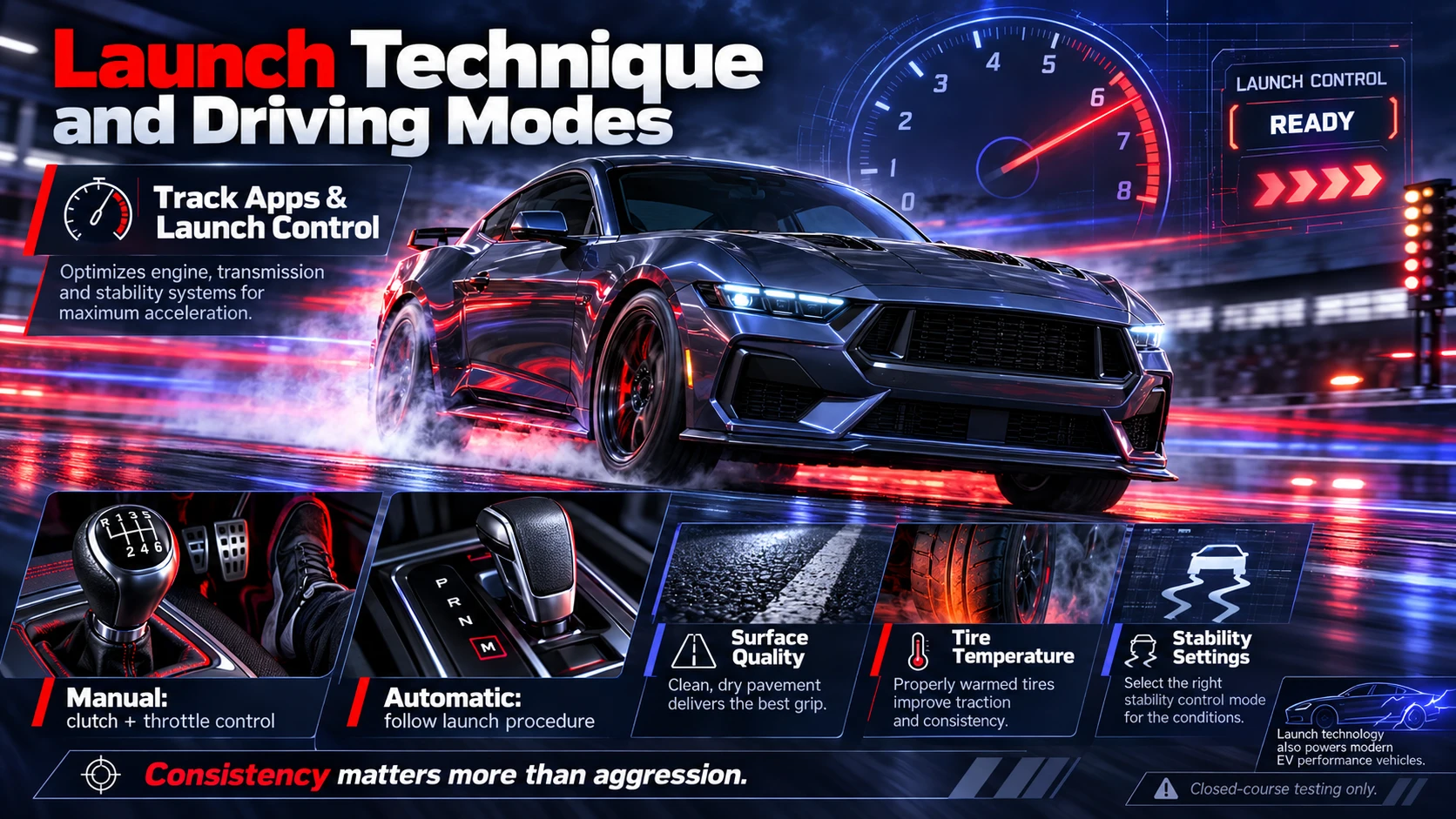
The Mustang GT’s acceleration depends on more than selecting the most aggressive driving mode. Ford provides performance-oriented settings and Track Apps features, including acceleration timing and launch-control functions on supported vehicles. Its Mustang Track Apps guide explains the purpose of these features and how launch settings relate to engine speed, traction, and vehicle conditions. The exact behavior depends on the model, transmission, and available equipment.
Launch techniques should be evaluated only in suitable, legally permitted closed-course environments. Manual drivers must manage clutch engagement and throttle application, while automatic drivers must follow their vehicle’s prescribed operating procedure. Warmed-up mechanical components, appropriate tires, and consistent conditions can improve repeatability, but disabling safety systems or using excessive throttle does not automatically produce a faster result. Always follow Ford’s operating and break-in guidance before using performance features.
- Surface quality: Clean, dry pavement usually beats dusty or cold asphalt even if the air is cooler.
- Tire temperature: Slightly warmed tires can improve grip, while cold rubber often spins and triggers intervention.
- Stability settings: Too much intervention can cut power early, while too little can allow excessive spin that also slows the run.
Consistency matters more than aggression. A run that feels slightly less dramatic often clocks faster.
Launch-control technology is not limited to traditional V8 performance cars. Electric vehicles can use different powertrain and traction-management strategies to achieve rapid acceleration. For comparison, TechBonafide’s Hummer EV acceleration and trim guide discusses the Watts to Freedom feature and its role in the Hummer EV’s acceleration performance.
Tires, Wheels, and Traction Limits
On many rear-wheel-drive performance cars, 0–60 is traction-limited rather than power-limited on street tires. Wider tires and a stickier compound can reduce wheelspin and help the car leave harder. Wheel and tire choices also affect rotational mass, which can influence how quickly the car accelerates through the first two gears.
Tire pressure affects grip, stability, and tire wear, but adjusting pressure simply to improve a 0–60 result can create safety problems. For normal driving, use the vehicle manufacturer’s recommended cold tire pressures shown on the driver’s door placard or in the owner’s manual. Check pressures with an accurate gauge when the tires are cold rather than relying on the maximum pressure printed on the tire sidewall. The NHTSA tire-pressure and safety guidance explains the importance of correct inflation, regular inspections, and proper tire maintenance. Track-specific settings should follow qualified guidance appropriate to the vehicle and tires.
Modern vehicles also use electronic monitoring systems to help drivers identify tire-related issues. Tire-pressure monitoring systems use sensor technology to monitor tire inflation conditions, although drivers should still check inflation manually. TechBonafide’s guide to sensors and transducers explains the broader technology used by automotive monitoring systems.
2026 Mustang GT 0–60 Times: Published Test Results
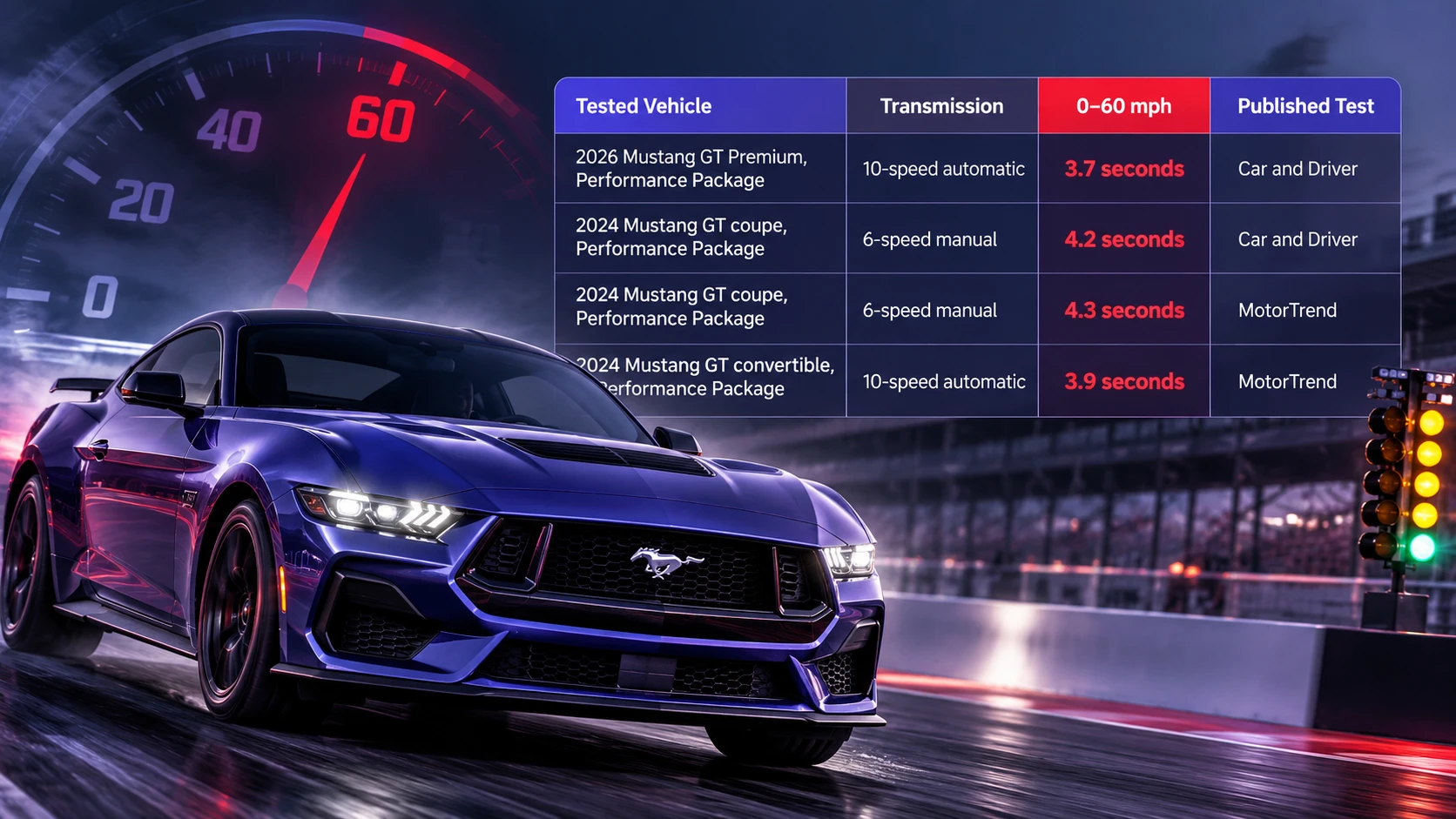
Published acceleration tests provide a more useful benchmark than broad estimated ranges. However, not every test uses the same model year, body style, tire configuration, or timing method. The following results identify the tested vehicles so readers can distinguish an actual 2026 automatic test from earlier manual and automatic Mustang GT results.
| Tested Vehicle | Transmission | 0–60 mph | Published Test |
|---|---|---|---|
| 2026 Mustang GT Premium, Performance Package | 10-speed automatic | 3.7 seconds | Car and Driver |
| 2024 Mustang GT coupe, Performance Package | 6-speed manual | 4.2 seconds | Car and Driver |
| 2024 Mustang GT coupe, Performance Package | 6-speed manual | 4.3 seconds | MotorTrend |
| 2024 Mustang GT convertible, Performance Package | 10-speed automatic | 3.9 seconds | MotorTrend |
These figures are measured results from specific test vehicles, not guaranteed acceleration times for every 2026 Mustang GT configuration. The 2026 automatic result comes from Car and Driver, while the manual results shown here are from 2024 tests. The body styles, equipment, environmental conditions, and testing methods are not identical. A direct, same-condition comparison of a 2026 GT manual and 2026 GT automatic would provide a more controlled measurement of their performance difference.
Sources: Car and Driver — 2026 GT automatic test, Car and Driver — 2024 GT manual test, and MotorTrend – 2024 Mustang acceleration comparison.
Common Reasons Your Runs are Slower Than Expected
Acceleration measurements frequently differ because vehicles are tested under different conditions. A Mustang GT may record a slower time when tire grip is limited, the road surface is inconsistent, or the vehicle carries additional weight. Atmospheric conditions, transmission behavior, and electronic traction intervention can also influence results. Rather than treating published performance figures as targets for public-road driving, compare measurements collected using consistent equipment and safe, controlled testing conditions.
- Cold tires and road: Reduced grip increases wheelspin and triggers power reduction.
- Overactive intervention: Stability control can cut torque early and extend the time.
- Manual shift delay: A slow 1–2 shift adds a noticeable chunk to a short sprint.
- Too much wheelspin: Spinning feels fast but often produces a slower clock.
- Inconsistent launch rpm: Varying throttle and clutch release changes the entire first second.
A tighter routine and better grip usually improve results more than chasing a perfect number once.
Automatic or Manual: Which Should You Choose?
If the goal is the quickest and most repeatable 0–60 time, the automatic is often the practical choice. It reduces driver variables and tends to deliver consistent acceleration with minimal shift interruption. It is also easier to reproduce strong launches without abusing the drivetrain.
If the priority is involvement and control, the manual remains rewarding. A well-driven manual can be very quick, but it asks more from the driver and is more sensitive to conditions. Choosing based on how you want to drive is usually smarter than choosing based on a single sprint metric.
Conclusion
The 2026 Mustang GT offers two distinct driving experiences through its six-speed manual and 10-speed automatic transmissions. A published 2026 automatic test recorded a 3.7-second 0–60 mph run, while earlier manual GT tests produced results around 4.2–4.3 seconds. Those measurements support the automatic’s potential performance advantage, although different test vehicles and conditions limit direct comparisons. Buyers prioritizing quick, repeatable acceleration may prefer the automatic, while drivers seeking greater involvement may prefer the manual. Ultimately, the best choice depends on driving preferences, vehicle equipment, and how much importance the buyer places on acceleration figures.
Frequently Asked Questions
Does Rollout Affect a Mustang GT’s 0–60 Time?
Yes. A one-foot rollout excludes the initial distance before acceleration timing begins, which makes the published result quicker than a true standing-start measurement. The difference depends on the vehicle and testing method. For example, Car and Driver listed a 0.2-second rollout adjustment for its 2026 Mustang GT automatic test. Check whether rollout was used before comparing times from different publications.
Do Better Tires Improve a Mustang GT’s 0–60 Time?
For 0–60, traction is often the limiting factor, so tire compound can have a bigger impact than a modest power gain. Better grip reduces wheelspin and keeps the car accelerating instead of intervening. The benefit is usually most noticeable on the first 30 feet.
Does the Manual Mustang GT Have Less Power Than the Automatic?
No. The 2026 Mustang GT offers the same basic 5.0-liter V8 engine output with either transmission, assuming equivalent engine and exhaust equipment. Differences in acceleration generally come from gearing, shift timing, launch control, traction, and driver input. The manual’s clutch-operated gear changes introduce additional variables that the automatic handles electronically.
Is the 2026 Mustang GT Automatic Faster Than the Manual?
Published testing suggests the automatic has an advantage in achieving quick, repeatable acceleration. Car and Driver recorded 3.7 seconds for a 2026 automatic GT, while its earlier manual GT test recorded 4.2 seconds. Because those vehicles were tested in different model years, the figures should be treated as useful benchmarks rather than proof of a fixed performance gap between every 2026 manual and automatic configuration.