


5G-Advanced is the next major evolution of 5G that upgrades performance, efficiency, and reliability without requiring a brand-new mobile generation. It builds on 5G Standalone foundations and tightens the gap between what networks can deliver in labs and what users see day to day.
What 5G-Advanced Means in Simple Terms
5G-Advanced begins with 3GPP Release 18, the first release officially branded as 5G-Advanced, and continues through later releases. It enhances the radio interface, core network, device capabilities, network automation, positioning, energy efficiency, and support for emerging services while building on the existing 5G architecture.
Rather than one headline feature, it is a package of upgrades that operators roll out over time. Devices and networks need compatible support, so benefits appear gradually as coverage and handset adoption grow.
How it Differs From Today’s 5G?
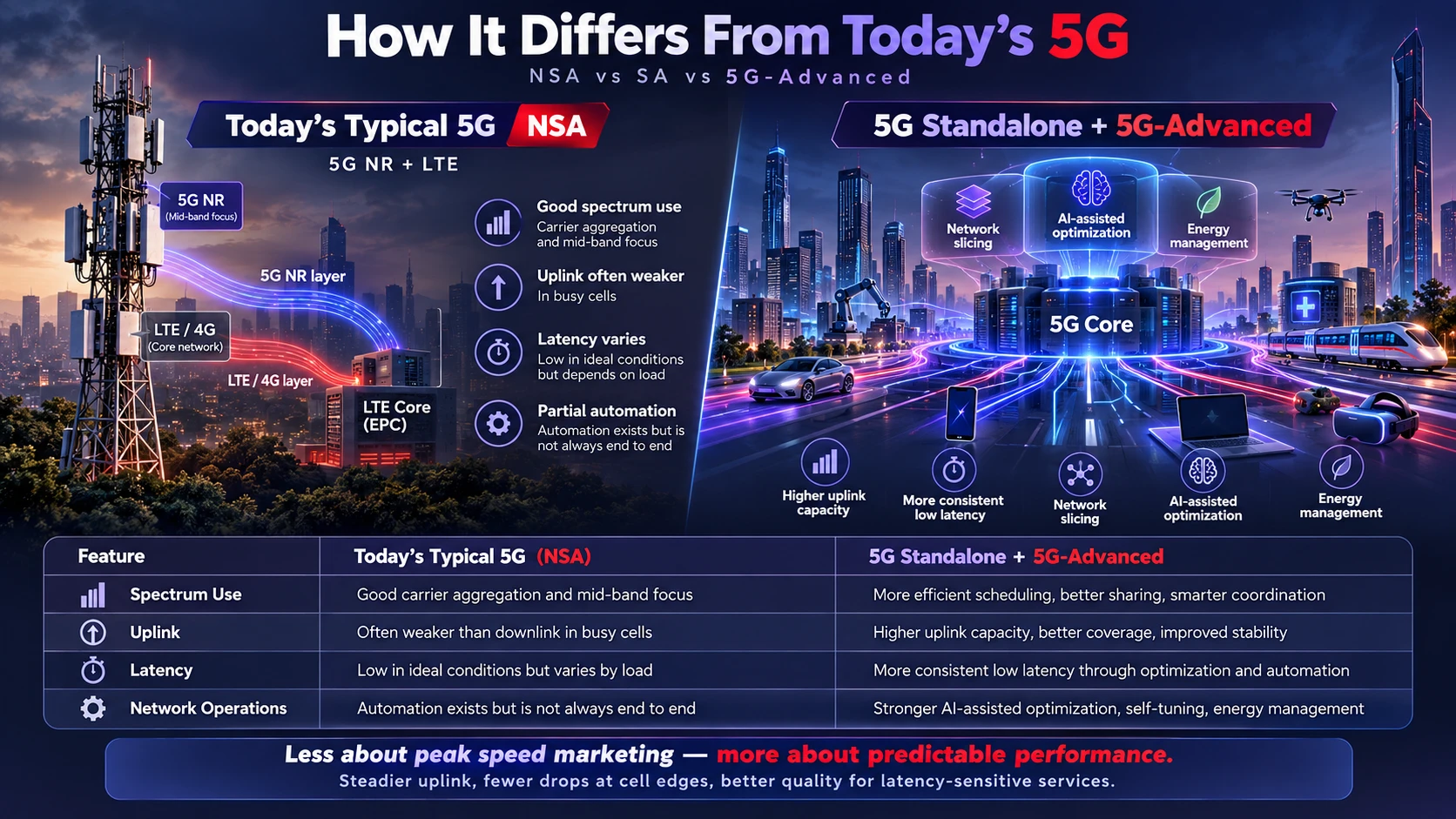
Many 5G deployments still use Non-Standalone (NSA) architecture, where 5G New Radio works alongside existing LTE infrastructure. 5G Standalone (SA), by contrast, uses a 5G core and provides a stronger foundation for capabilities such as network slicing, lower-latency services, automation, and other advanced 5G features. 5G-Advanced builds further on this more mature 5G architecture.
The result is less about peak speed marketing and more about predictable performance. That includes steadier uplink, fewer drops at cell edges, and improved quality for latency-sensitive services.
| Area | Today’s Typical 5G | What 5G-Advanced Improves |
|---|---|---|
| Spectrum Use | Good carrier aggregation and mid-band focus | More efficient scheduling, better sharing, smarter coordination |
| Uplink | Often weaker than downlink in busy cells | Higher uplink capacity, better coverage, improved stability |
| Latency | Low in ideal conditions but varies by load | More consistent low latency through optimization and automation |
| Network Operations | Automation exists but is not always end to end | Stronger AI-assisted optimization, self-tuning, energy management |
These shifts matter most when networks are crowded, users are moving, or signal conditions are imperfect. That is where 5G-Advanced aims to make performance feel more uniform.
Key Release 18 Features Beyond Speed
5G-Advanced is broader than faster download and upload speeds. Release 18 includes work across enhanced MIMO, uplink coverage, AI and machine learning for radio networks, RedCap evolution, improved positioning, network energy savings, extended reality (XR), mobility enhancements, and non-terrestrial networks.
These capabilities target different use cases, from smartphones and industrial networks to lower-complexity IoT devices and satellite-connected services. Their real-world availability depends on operator deployment, spectrum, network architecture, and compatible devices.
Coverage and Capacity Upgrades That Matter Most
5G-Advanced places strong emphasis on improving cell edge experience and total network capacity. Better coordination across cells and more advanced antenna processing help users stay connected with fewer speed swings.
It also expands how networks blend different spectrum layers such as low-band coverage, mid-band capacity, and mmWave hotspots. The practical goal is to deliver a smoother experience across neighborhoods, transit corridors, and indoor spaces.
Smarter Use Of Spectrum
As operators juggle multiple frequency bands, efficiency becomes as important as raw bandwidth. 5G-Advanced refines scheduling, interference control, and multi-band coordination so each MHz does more work.
This supports higher capacity without always requiring new spectrum purchases. It also improves reliability when many users share the same cell resources.
Better Performance At the Cell Edge
Users at the edge of a cell often suffer from interference and weaker signal quality, especially indoors. 5G-Advanced enhances how the network steers beams and manages interference, which can improve signal robustness.
That translates into fewer stalls, fewer retransmissions, and steadier throughput in challenging locations.
Latency and Reliability Improvements
Latency is not only about the fastest possible round trip time, it is also about avoiding spikes. 5G-Advanced aims to reduce jitter and improve scheduling behavior under load, which matters for real-time interactions.
Reliability also improves when networks can predict congestion earlier and adjust resource allocation automatically. This supports services that rely on consistent timing and stable radio conditions.
More Predictable Quality Of Service
5G already supports quality of service frameworks, but execution can vary by implementation and network maturity. 5G-Advanced further improves traffic handling and prioritization so critical traffic is less affected by background load.
That can help collaboration tools, industrial control, and time-sensitive monitoring operate with fewer interruptions.
Uplink Gets A Bigger Share of the Spotlight
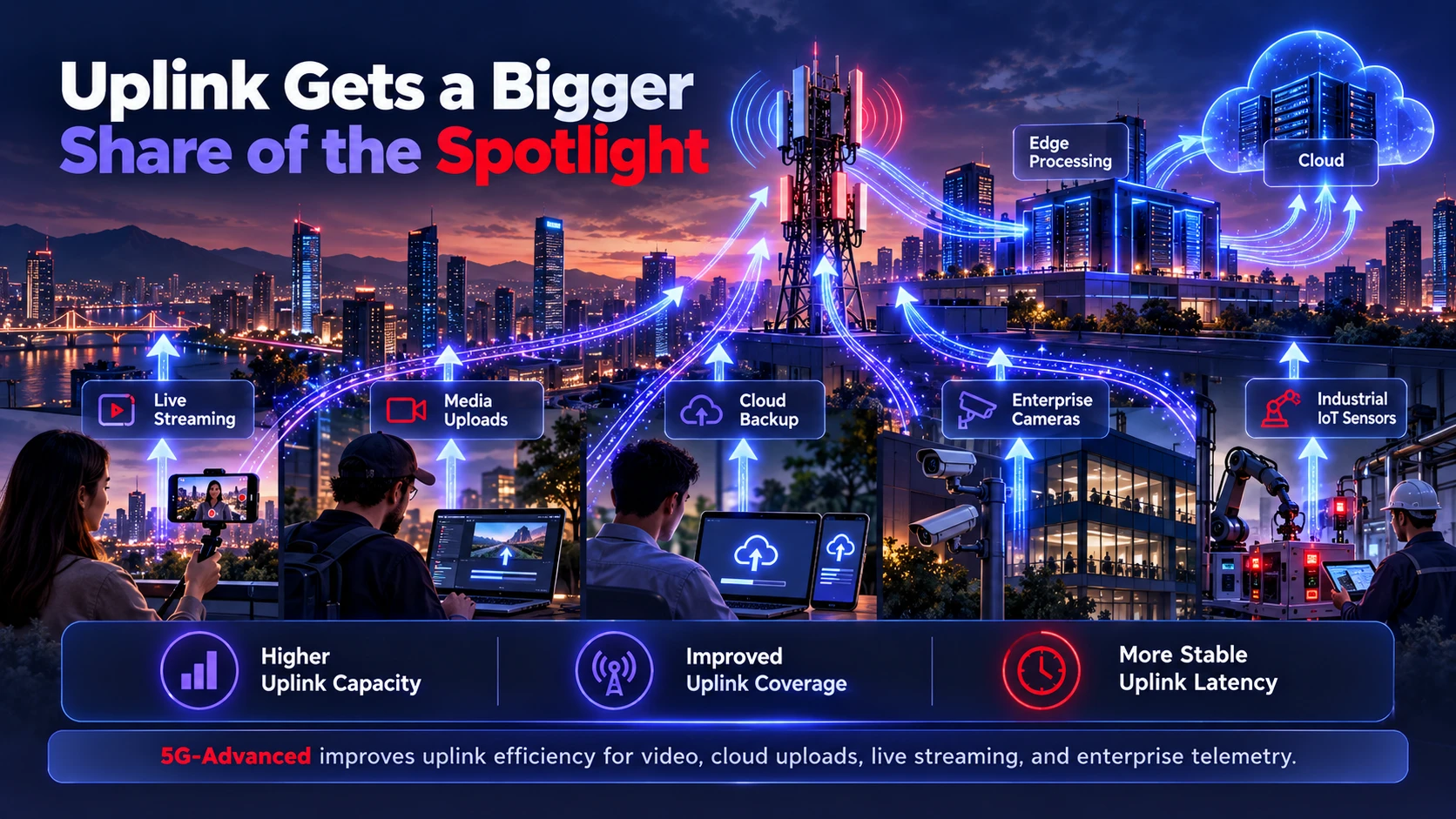
Many modern applications are uplink-heavy due to cloud backups, video sharing, live streaming, and sensor data. Traditional mobile networks have often favored downlink, which can create bottlenecks when many users are uploading at once.
5G-Advanced improves uplink efficiency through refined radio procedures and better resource allocation. This also benefits enterprise deployments where devices send high volumes of telemetry and video to the edge or cloud.
- Higher Uplink Capacity: Better scheduling and radio features help more devices upload simultaneously without severe slowdowns.
- Improved Uplink Coverage: Refinements can reduce the number of failed uploads in weak signal areas.
- More Stable Uplink Latency: Reduced jitter supports real-time interactive uploads such as live video.
Stronger uplink performance could become one of the more noticeable 5G-Advanced improvements, particularly for users uploading video, live streaming, or using cloud-based applications in busy network conditions.
Energy Efficiency and Sustainability Gains
Operators face rising energy costs as traffic grows and networks densify. 5G-Advanced puts more attention on energy-aware operation, helping networks scale capacity without scaling power consumption at the same rate.
Energy efficiency also affects device battery life, particularly for IoT endpoints that may run for years. Improvements in signaling and sleep behavior help reduce unnecessary wakeups and overhead.
Network Energy Optimization
Modern radio units can adjust power, carrier activation, and processing based on load. 5G-Advanced strengthens the control loops and automation so energy saving modes can be used more aggressively without harming user experience.
This can help reduce the carbon footprint of mobile networks while still meeting performance targets.
AI and Automation in 5G-Advanced Networks
A major development in 5G-Advanced is the expanded use of AI and machine learning for network optimization. AI/ML-assisted systems can support areas such as beam management, positioning, performance analysis, mobility optimization, and network automation, while operators still retain control over how these capabilities are deployed.
Automation is not only about performance, it also improves consistency. Fewer manual changes reduce configuration drift and help operators maintain stable service across thousands of sites.
- Proactive Congestion Control: Models can detect early signs of overload and rebalance resources before users feel it.
- AI-Assisted Radio Optimization: Automated analysis and optimization can support mobility, coverage, beam management, and interference handling as networks become more software-driven.
- Faster Fault Isolation: Correlation across radio, transport, and core telemetry reduces mean time to repair.
For organizations evaluating private 5G, automation also reduces the skill barrier for operating a high performance network.
What it Means for Devices and Compatibility
5G-Advanced capabilities depend on support across the network, chipset, modem, radio hardware, and software stack. Some improvements can be introduced through network-side software upgrades, while others require compatible devices to support features such as enhanced MIMO, carrier aggregation, uplink improvements, positioning, or evolved RedCap capabilities.
Adoption tends to follow a familiar pattern where flagship and premium mid-range devices support the newest capabilities first. Over time, the ecosystem spreads across more price tiers as chipsets mature.
Why Some Users Will Notice Changes Faster
Users in areas with mature 5G Standalone coverage typically see improvements sooner because more features can be activated end to end. Users on older devices or in areas where 5G is anchored to LTE may see fewer immediate benefits.
That does not mean nothing changes, but the biggest gains depend on both coverage and compatibility.
Impact On Private 5G and Enterprise Networks
Enterprises care about determinism, security, and manageability as much as speed. 5G-Advanced strengthens the toolset for managing performance under strict requirements, especially when combined with edge computing and local core deployments.
Teams planning private 5G can benefit from better uplink, improved mobility handling for devices moving across zones, and more automation in operations. Organizations planning private 5G should also evaluate spectrum availability, device compatibility, edge infrastructure, security controls, core-network architecture, and operational requirements before deciding which 5G-Advanced capabilities provide practical value.
Security and Trust Considerations
As networks become more software-driven, security depends on strong configuration practices and continuous monitoring. 5G-Advanced does not eliminate risk, but it fits into a broader industry push toward zero trust principles, better segmentation, and more telemetry for threat detection.
Operators and enterprises should focus on secure lifecycle management for network functions, consistent patching, and careful policy control. Strong identity and access management remains essential when automation increases the number of systems that can trigger changes.
How Operators Roll It Out in Practice?
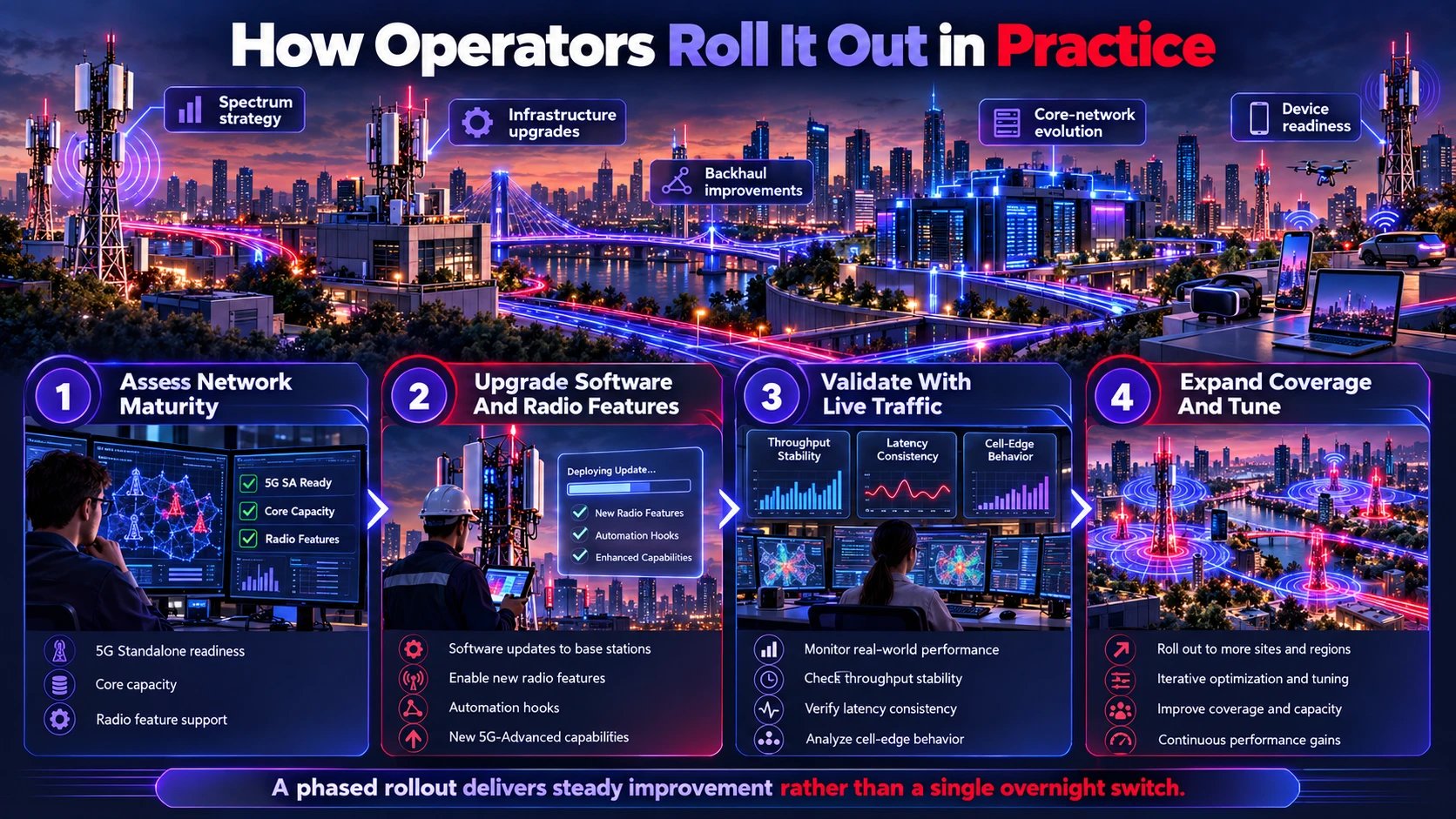
5G-Advanced can be introduced through a combination of software upgrades, new radio capabilities, compatible devices, core-network evolution, backhaul improvements, and other infrastructure upgrades. Rollout priorities vary by operator, but deployment may focus first on locations where additional capacity, coverage, or advanced services provide the greatest value.
Deployment also depends on spectrum strategy and device readiness. Some enhancements deliver value quickly, while others require broader ecosystem support.
- Assess Network Maturity: Operators evaluate 5G Standalone readiness, core capacity, and radio feature support.
- Upgrade Software And Radio Features: Sites receive updated feature sets, scheduling behavior, and automation hooks.
- Validate With Live Traffic: Performance is monitored for throughput stability, latency consistency, and cell edge behavior.
- Expand Coverage And Tune: Rollout continues across clusters with iterative optimization based on telemetry.
This phased approach is why 5G-Advanced feels like a steady improvement rather than a single overnight switch.
Conclusion
5G-Advanced is the stage where 5G becomes more consistent, more uplink capable, and easier to operate at scale. The most meaningful changes show up in crowded networks, indoor and edge coverage, latency stability, and automation driven optimization.
As operators deploy these enhancements and devices catch up, everyday connectivity should feel less variable and more dependable. Tracking these shifts is also useful for enterprise teams planning private 5G, edge workloads, and modern wireless strategies as demand for stronger mobile infrastructure continues to grow.
Frequently Asked Questions
Is 5G-Advanced the Same as 6G?
No, 5G-Advanced is an evolution of 5G that extends the current standard with additional features and refinements. It is designed to improve real-world performance and operations without changing to a new generation name.
Do I Need a New Phone to Benefit From 5G-Advanced?
Some benefits come from network-side upgrades and can improve service broadly, but advanced features require compatible device hardware and modem support. Users with newer devices on mature 5G Standalone networks typically see improvements sooner.
Will 5G-Advanced Improve Fixed Wireless Access And Home Broadband?
It can, particularly through better spectrum efficiency, improved cell edge performance, and stronger uplink behavior. Results depend on local network upgrades, available spectrum, and how the operator manages capacity at peak times. For a broader comparison of wireless and wired broadband, see how fiber internet and 5G differ in speed, latency, reliability, and availability.