

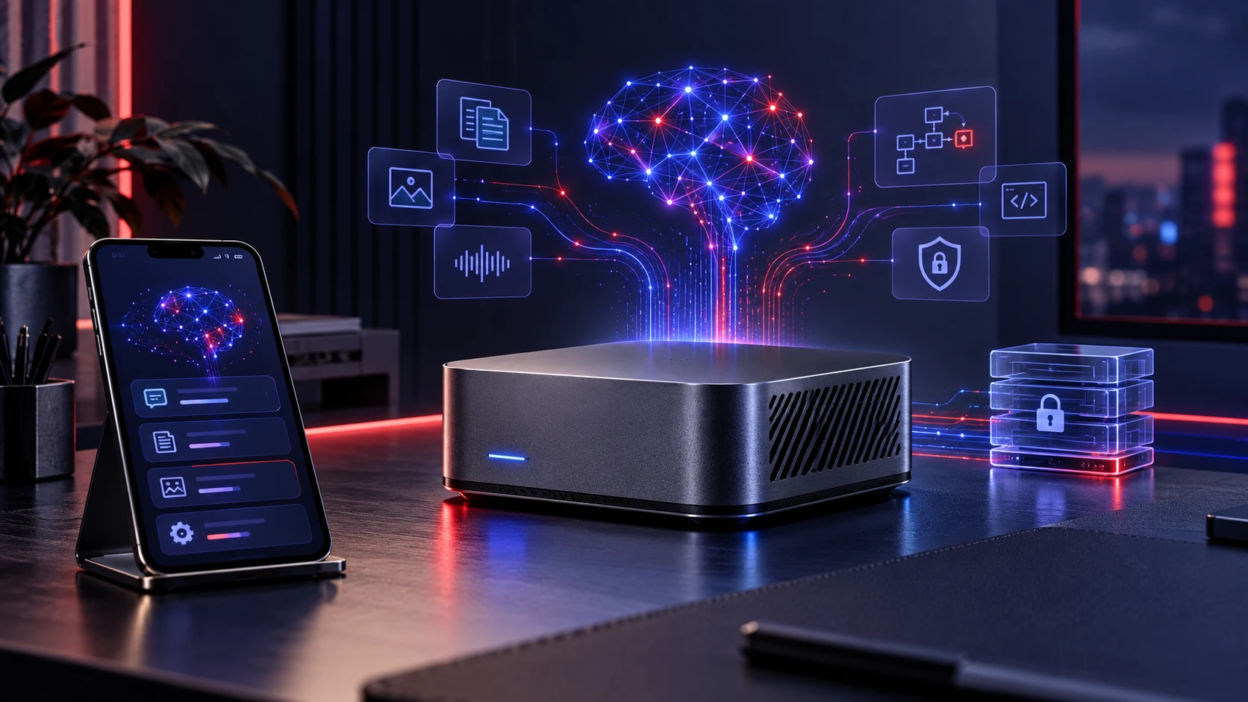
AI startup Ghost has emerged from stealth with Core, a $3,499 personal AI computer built to run AI models and agents locally on dedicated hardware. The screenless system is designed to remain active throughout the day, build context from connected apps and devices, and help users complete tasks without relying primarily on cloud-based AI processing.
Unlike a conventional desktop computer, Core is designed around personal AI agents. Ghost says the system can connect with apps, files, browser activity, wearables and smart-home devices, allowing it to build context about a user over time and provide more personalized assistance.
Core does not include a built-in display. Users access the system through Ghost’s app on another device, including a phone, while voice interaction is also handled through the app rather than directly through the Core hardware.
Ghost has also built its own software layer, browser and file system around the hardware. The goal is to provide a ready-to-use AI computer rather than requiring buyers to configure a conventional desktop themselves for local model inference.
A major part of Ghost’s pitch is local processing, reflecting the broader debate over local AI and cloud AI for privacy, performance and cost. The company says Core runs its AI models and personal memory on the device and keeps personal information encrypted, reducing dependence on remote AI infrastructure. Ghost also says users retain control over how much autonomy they give the system’s AI agents.
The company is developing additional security controls for those agents, including a firewall intended to monitor outgoing network requests and restrict unauthorized use of sensitive credentials. These protections will be especially important if Core is given access to personal files, accounts and connected devices.
Core is powered by an NVIDIA RTX PRO 4000 Blackwell SFF Edition GPU with 24GB of GDDR7 ECC memory, paired with an AMD Ryzen 5 7600 six-core processor, 64GB of DDR5 system memory and a 1TB NVMe SSD. NVIDIA rates the compact GPU at up to 770 AI TOPS and 432GB/s of memory bandwidth.
That hardware is designed to support demanding AI inference locally. Instead of sending every request to a remote data center, supported models can run directly on Core’s GPU and use information stored on the machine.
Ghost currently lists Qwen 3.8-Next, Qwen 3.8-27B, Gemma 4-31B and Muse-Glimmer-30B among the models available on Core. Users can also install other compatible models, including models distributed through Hugging Face, or load their own trained models.
Core also reflects the wider shift from chatbots to AI agents. Instead of responding only when a user enters a prompt, Ghost wants Core to maintain context over time and proactively suggest or perform approved actions
For example, an agent could use information from a calendar, computer activity or connected wearable to surface reminders or identify patterns without waiting for the user to begin a new conversation. How much access and autonomy an agent receives is intended to remain under the user’s control.
Ghost says Core itself does not require a monthly subscription. Buyers pay $3,499 for the hardware and can run supported AI models locally, avoiding the recurring platform fee common with many hosted AI services.
The company emerged from stealth with an $11 million seed funding round led by Andreessen Horowitz. Other investors include Abstract, Audacious Ventures, SV Angel and Nova. Ghost is led by 19-year-old founder and CEO Zain Javaid.
Preorders opened alongside the product announcement, with the first systems scheduled to ship in the final week of October 2026. Ghost says its Core computers are being assembled at the company’s San Francisco facility.
The $3,499 price puts Core well above ordinary consumer desktops, making its initial audience more likely to include AI enthusiasts, developers and early adopters who specifically want dedicated hardware for local models and autonomous agents.
Core represents a different approach to personal AI: instead of treating an assistant mainly as a cloud service or application, Ghost is betting that some users will want dedicated hardware that stores context, runs models and operates continuously in their own environment.
Whether that approach reaches mainstream users will depend on more than AI capability. The price, real-world performance, security, power use and usefulness of always-on agents will all matter. For now, Core is an early example of how local AI and autonomous agents could reshape the idea of a personal computer.