

Choosing between local AI and cloud AI is less about hype and more about constraints. Privacy exposure, response time, and total cost behave very differently depending on where inference runs and where data lives. This guide breaks down the tradeoffs in plain terms and helps you pick an approach that fits your workloads and risk tolerance.
What Local AI And Cloud AI Mean?
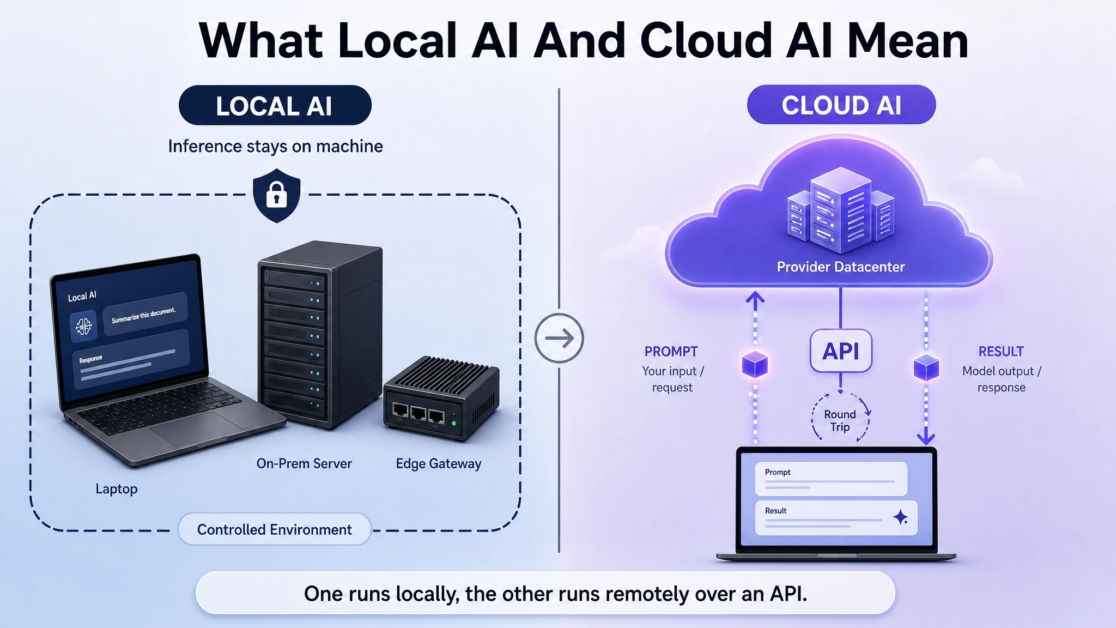 Local AI runs models on a device you control such as a laptop, workstation, on premises server, or edge gateway. Data can stay on the same machine, and inference happens without a round trip to the internet.
Cloud AI runs models in a provider environment accessed over an API or hosted service. Data and prompts travel to the provider, inference happens remotely, and results are returned to your app.
Privacy And Data Control
Privacy is usually the first deciding factor because it is hard to retrofit later. Local AI reduces data movement, which shrinks the surface area for interception, logging, or unintended retention.
Cloud AI can still be privacy aware, but it requires careful vendor review and configuration. The main question becomes who can access inputs, outputs, and metadata and how long any of it persists.
- Data Residency: Local AI keeps sensitive content on controlled storage, while cloud AI may process it in specific regions depending on provider options.
- Access Path: Local AI primarily relies on your internal identity controls, while cloud AI adds provider side IAM, API keys, and network policy as additional layers.
- Logging Risk: Local AI logging is fully under your control, while cloud AI may log requests for debugging, abuse prevention, or billing unless explicitly disabled.
- Compliance Scope: Local AI tends to simplify scoping for regulated data, while cloud AI may require extra reviews for HIPAA, PCI, or GDPR obligations.
Privacy decisions also depend on data classification. If inputs include customer PII, health data, trade secrets, or regulated documents, local inference is often the safest baseline.
Speed And Latency Performance
Speed comes from two places, network latency and compute throughput. Cloud AI can be fast at raw model throughput, but every request adds network delay and can suffer from internet variability.
Local AI avoids network round trips, so interactive workloads can feel snappier. The limit is your hardware, model size, and whether you can keep the model loaded in memory.
- Interactive Use: Local AI often wins for low latency responses on stable hardware, especially for short prompts and frequent calls.
- Batch Jobs: Cloud AI often wins when you need to process large volumes quickly using scalable compute.
- Offline Needs: Local AI is the practical choice when connectivity is limited or disallowed.
- Consistency: Local AI performance is predictable once tuned, while cloud AI can vary with provider load and rate limits.
If you need real time assistance inside a desktop tool or on an edge device, local inference is usually the simplest path to consistent latency.
Total Cost Ownership And Budget Predictability
Cost is not only per token pricing or GPU purchase. It includes setup, monitoring, security, scaling, and the operational effort required to keep systems stable.
Cloud AI typically has low upfront cost and fast time to value. Local AI tends to require higher initial spend on GPUs or capable CPUs, but can become cheaper at high usage.
- Upfront Spend: Local AI requires hardware and setup, while cloud AI spreads cost over usage.
- Variable Billing: Cloud AI costs rise with volume and context length, while local AI costs are mostly fixed once infrastructure is in place.
- Ops And Maintenance: Local AI adds responsibility for updates, drivers, and model management, while cloud AI pushes much of that to the provider.
- Scaling: Cloud AI scales quickly for spikes, while local AI scaling requires capacity planning and procurement.
When budgets need predictability, local AI can be easier to forecast. When you need rapid experimentation, cloud AI can reduce friction.
Security Model And Attack Surface
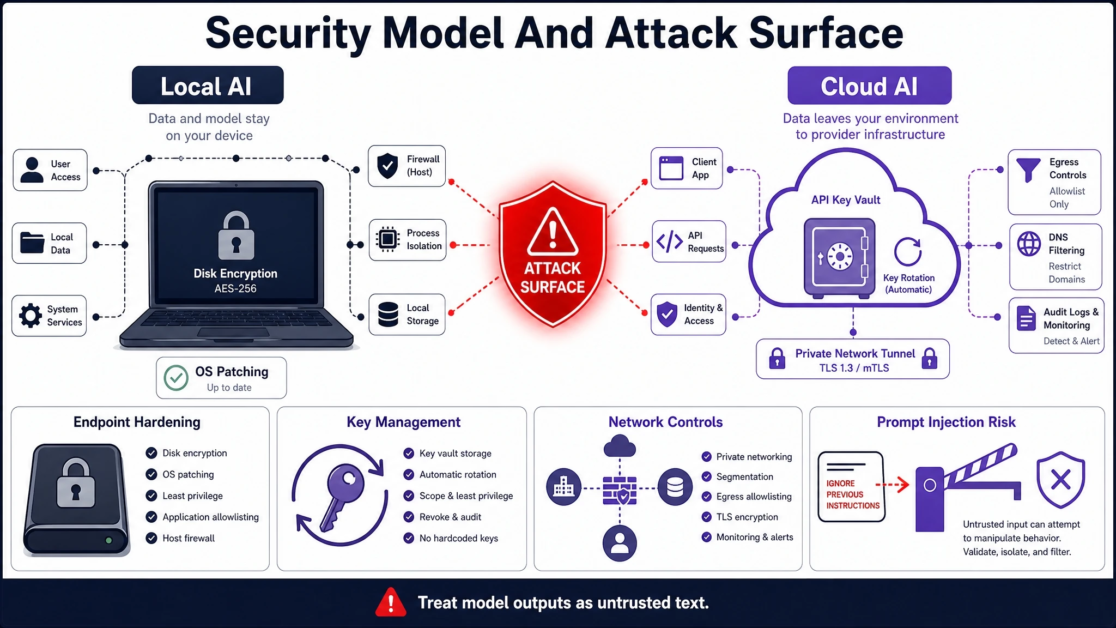 Security depends on where secrets live and how data moves. Local AI concentrates risk in your endpoints and internal network, while cloud AI adds external dependencies and API exposure.
Both approaches need strong controls. A misconfigured local workstation can leak as easily as a poorly managed API key.
- Endpoint Hardening: Local AI requires disk encryption, OS patching, and least privilege on machines that host models and data.
- Key Management: Cloud AI requires secure storage of API keys, rotation policies, and strict per service permissions.
- Network Controls: Local AI benefits from segmentation, while cloud AI benefits from private networking options and egress controls where available.
- Prompt Injection Risk: Both local and cloud setups need input validation and tool permission boundaries if the model can call actions.
A good rule is to treat model outputs as untrusted text. Apply the same discipline you would use for user generated content before triggering automation.
Reliability And Availability
Cloud AI offers managed uptime targets, global infrastructure, and failover options. It can also introduce outages you cannot directly fix and rate limits that slow production traffic.
Local AI gives independence from provider incidents, but you must handle redundancy yourself. Hardware failures, driver issues, or thermal limits can cause downtime if there is no backup node.
Customization And Model Choice
Local AI is attractive when you want control over model versions, quantization, and fine tuning workflows. It can also support strict reproducibility because you can freeze the exact environment.
Cloud AI is attractive when you want immediate access to the latest managed models without worrying about deployment. However, some platforms limit deep customization or restrict certain model weights.
Local AI Vs Cloud AI Comparison Table
| Decision Area | Local AI | Cloud AI |
|---|---|---|
| Privacy And Data Control | Data stays on owned devices and storage with minimal sharing | Data is transmitted to a provider and governed by vendor policies |
| Speed And Latency | Low latency without network dependency but limited by local hardware | Fast scaling compute but network latency and rate limits can apply |
| Cost Profile | Higher upfront hardware cost with predictable ongoing spend | Low upfront cost with usage based billing that can fluctuate |
| Operations | Requires updates, monitoring, capacity planning, and troubleshooting | Managed infrastructure with simpler deployment and maintenance |
When Local AI Is The Better Choice?
Local AI is a strong fit when privacy and control are non negotiable. It also works well when you need consistent performance in a constrained environment.
- Regulated Or Sensitive Data: Keeping inference on controlled devices reduces exposure for PII, contracts, medical notes, and internal research.
- Offline Or Limited Connectivity: Local inference continues to work without stable internet access.
- Predictable High Volume Usage: Fixed hardware costs can be cheaper than recurring API spend once usage crosses a threshold.
- Strict Version Control: Freezing model weights and dependencies can reduce unexpected behavior changes.
If you deploy local AI across teams, standardizing machines and security baselines becomes essential for consistency.
When Cloud AI Is The Better Choice?
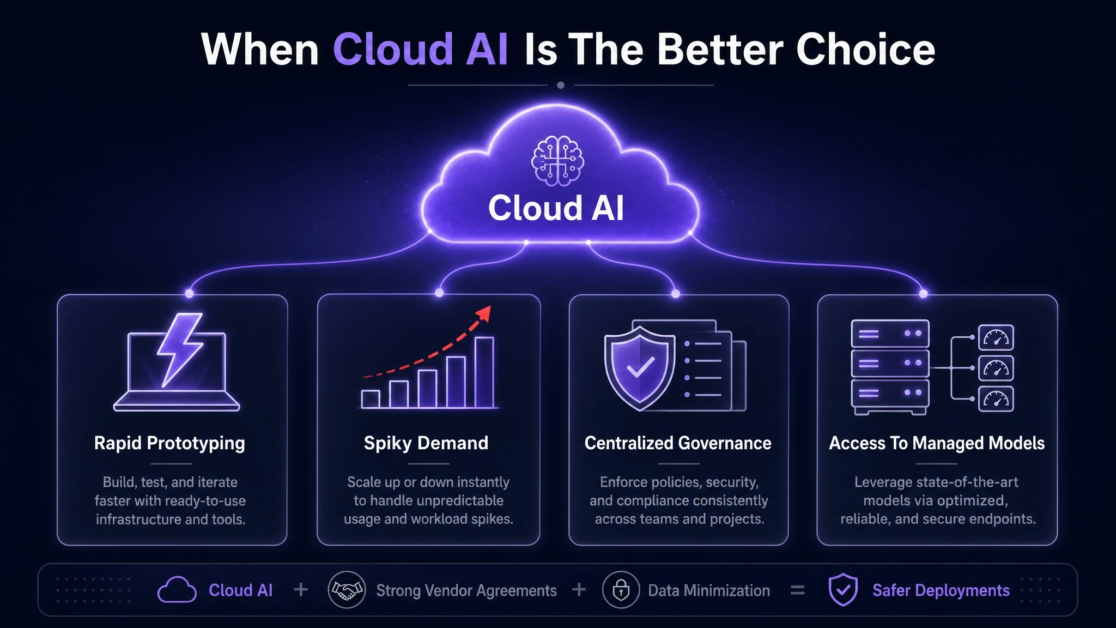 Cloud AI is a strong fit when speed of delivery matters and workloads are variable. It also supports advanced capabilities through managed features and larger models.
- Rapid Prototyping: You can start quickly without hardware procurement or driver setup.
- Spiky Demand: Scaling up for peak traffic is easier when compute is elastic.
- Centralized Governance: Policies can be applied at the API layer with monitoring, quotas, and auditing.
- Access To Managed Models: Providers can offer optimized serving, upgrades, and specialized endpoints.
Cloud AI becomes safer when combined with strong vendor agreements, strict retention settings, and careful data minimization.
Hybrid Approach For Balanced Privacy Speed And Cost
A hybrid pattern combines local AI for sensitive or real time tasks with cloud AI for heavy lifting. This reduces risk while preserving access to scalable compute.
Common hybrid designs include local inference for redaction, classification, or drafting, followed by cloud inference for large context analysis on sanitized text. Another pattern keeps embeddings local while using cloud generation for non sensitive outputs.
Decision Checklist
Use a short checklist to pick the right deployment model. The best answer is usually the one that fits your data risk and operational maturity.
- Data Sensitivity: If the input or output includes regulated or proprietary material, lean local or hybrid with strong redaction.
- Latency Needs: If response time must be consistent under poor connectivity, lean local.
- Usage Volume: If usage is steady and high, local can reduce long term spend.
- Team Capacity: If you cannot support GPU ops and monitoring, cloud reduces operational load.
- Change Control: If stable behavior matters more than latest features, local version pinning helps.
Once you choose, document your threat model, retention rules, and monitoring plan before scaling beyond a pilot.
Conclusion
Local AI generally leads on privacy and predictable latency, while cloud AI often leads on scalability and time to deploy. Cost depends on usage patterns, model size, and the operational effort you can sustain.
A hybrid setup often delivers the best balance by keeping sensitive processing local and using cloud AI where elasticity provides clear value. Start with your data classification and reliability needs, then validate performance and cost with a small controlled rollout.