


AI can sound confident while being wrong, and that mismatch is what people call AI hallucinations. Understanding why hallucinations happen makes it easier to build workflows that reduce wrong answers and protect trust in AI outputs.
What AI Hallucinations Mean?
AI hallucinations are outputs that look fluent but are not supported by reliable evidence. They can include made-up facts, incorrect citations, or confident statements that do not match the provided context.
This is not usually a system trying to deceive. It is a natural side effect of how many language models generate text by predicting likely sequences rather than checking reality.
Why AI Hallucinations Happen?
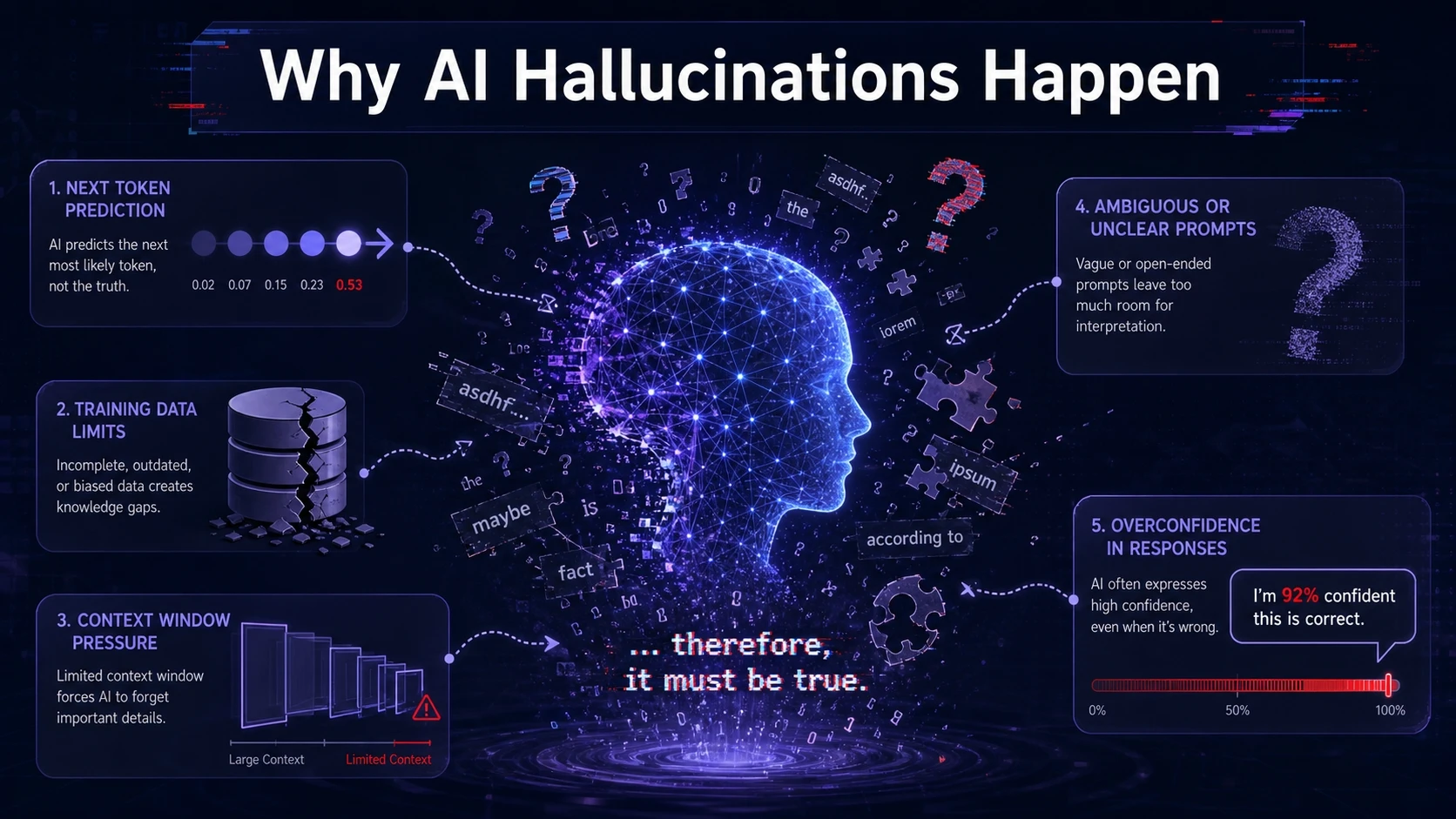
Most generative models optimize for helpful-sounding completions based on patterns in training data. When a prompt has gaps, conflicts, or missing constraints, the model may fill in details that seem plausible.
Hallucinations also rise when the model is pushed beyond its knowledge boundaries, asked for exact numbers from memory, or required to cite sources it cannot access. A lack of grounding signals can turn uncertainty into invented details.
- Next Token Prediction: The model selects probable word sequences, which can favor coherence over correctness.
- Training Data Limits: If the training set lacks a niche topic or has inconsistent claims, the model may generalize poorly.
- Context Window Pressure: When critical details fall outside the available context, the model may infer missing parts.
- Ambiguous Prompts: Vague instructions increase the chance of unsupported assumptions.
- Overconfidence In Tone: Fluent language can mask uncertainty unless the model is guided to express it.
These causes point to a practical truth. Reducing wrong answers is less about one trick and more about designing guardrails across prompts, data, and review.
Common Patterns Of Wrong Answers
Hallucinations often follow repeatable patterns. Recognizing them helps you detect issues earlier and tailor mitigations to the failure mode.
- Fabricated Facts: The model asserts details that were never provided and are not verifiable.
- Source And Citation Errors: References look real but do not exist or do not support the claim.
- Misread Instructions: The output follows a guessed intent rather than the explicit request.
- Math And Counting Mistakes: The model gives plausible arithmetic that fails basic checks.
- Outdated Or Conflicting Claims: The answer mixes older information with newer terms and creates contradictions.
Once you know the pattern, you can choose the right reduction strategy instead of applying generic prompt tweaks.
Prompting Practices That Reduce Wrong Answers
Prompt quality is one of the fastest levers to reduce hallucinations. Clear constraints and explicit expectations can shift the model toward cautious, verifiable responses.
- Define The Output Boundary: Tell the model to use only the provided context or to state that it lacks enough information.
- Ask For Assumptions First: Require a short list of assumptions and allow only those that are explicitly confirmed.
- Require Evidence Marking: Instruct it to label which lines are directly supported and which are uncertain.
- Constrain Format: Use a fixed structure such as bullets, short paragraphs, or a table when precision matters.
- Request Verification Checks: Ask it to run a quick consistency check before finalizing the answer.
These prompt rules work best when paired with good context and a system that can validate key claims.
Grounding With Trusted Data
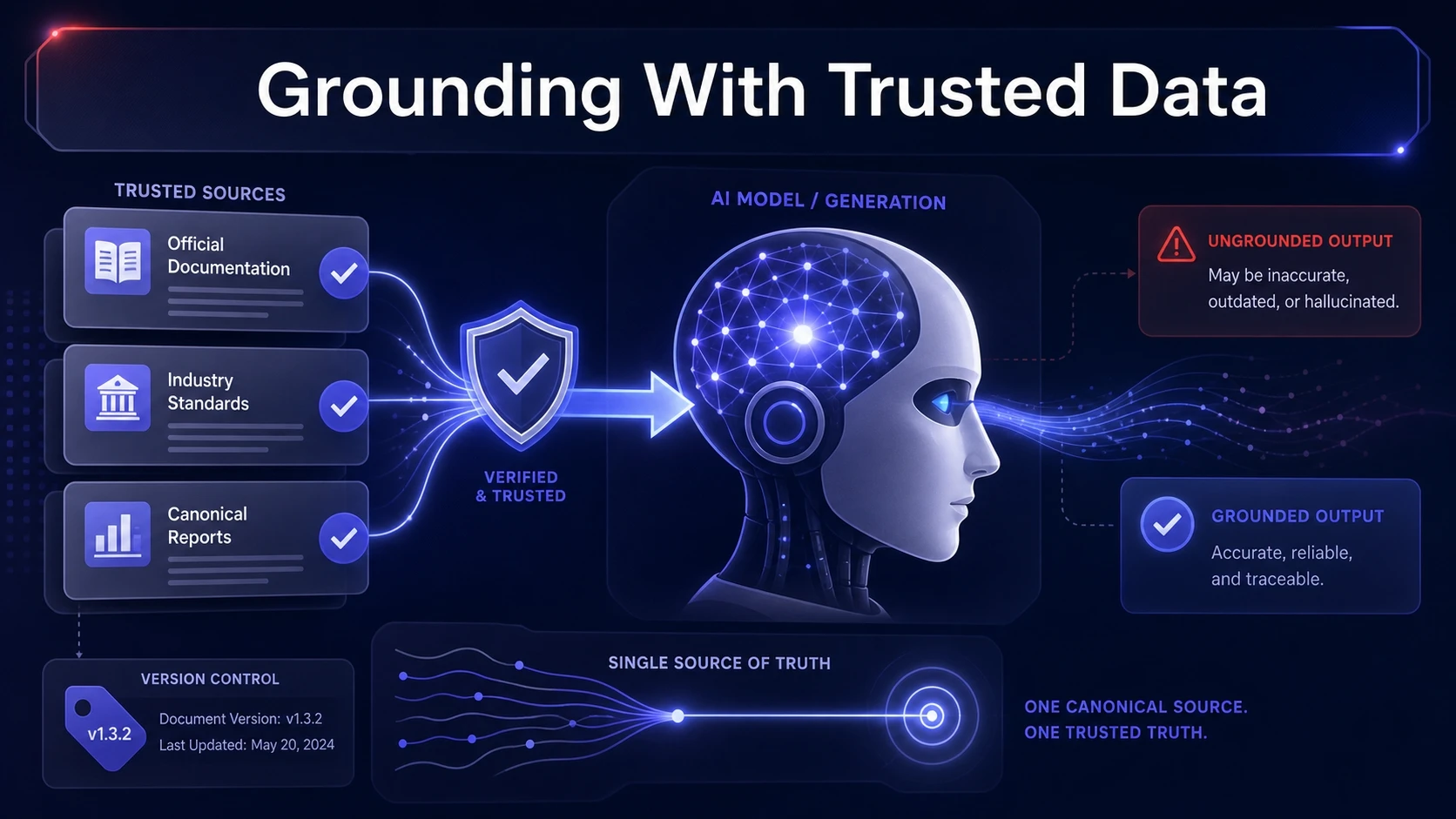
Hallucinations drop when the model is grounded in a trusted knowledge base. Grounding means providing authoritative context that the model can quote, summarize, or transform without guessing.
In practice, this often looks like retrieval augmented generation, where relevant documents are retrieved and inserted into the prompt. It can also mean supplying a curated policy document, product docs, or internal SOPs as the only allowed sources.
- Use Canonical Sources: Keep a single source of truth for definitions, pricing, policy, and specifications.
- Limit The Source Set: Fewer, higher quality documents reduce contradictions inside the context.
- Track Document Versions: A model grounded on outdated text can still produce wrong answers.
If your team maintains a knowledge base for AI assistants, Tech Bonafide-style implementation work typically focuses on content structure, retrieval quality, and safe generation rules so answers stay aligned with your actual documentation.
Model Settings And Decoding Controls
Some hallucinations are amplified by creative decoding settings. When temperature is high, the model explores more diverse outputs, which can increase unsupported statements in factual tasks.
Lower temperature and nucleus sampling can improve determinism, but they do not guarantee correctness. Use them as stability tools alongside grounding and validation.
| Control | What It Changes | Impact On Hallucinations |
|---|---|---|
| Temperature | Randomness in token selection | Lower values often reduce creative but unsupported details |
| Top p | Token pool size based on probability mass | Tighter pools can improve consistency on constrained answers |
| Max Tokens | Length limit for output | Shorter limits can reduce drift and late answer fabrication |
| Stop Sequences | Early termination rules | Can prevent the model from continuing into speculative sections |
Use these controls to match the task. Factual support and compliance responses usually need conservative settings and strict constraints.
Validation And Review Workflows
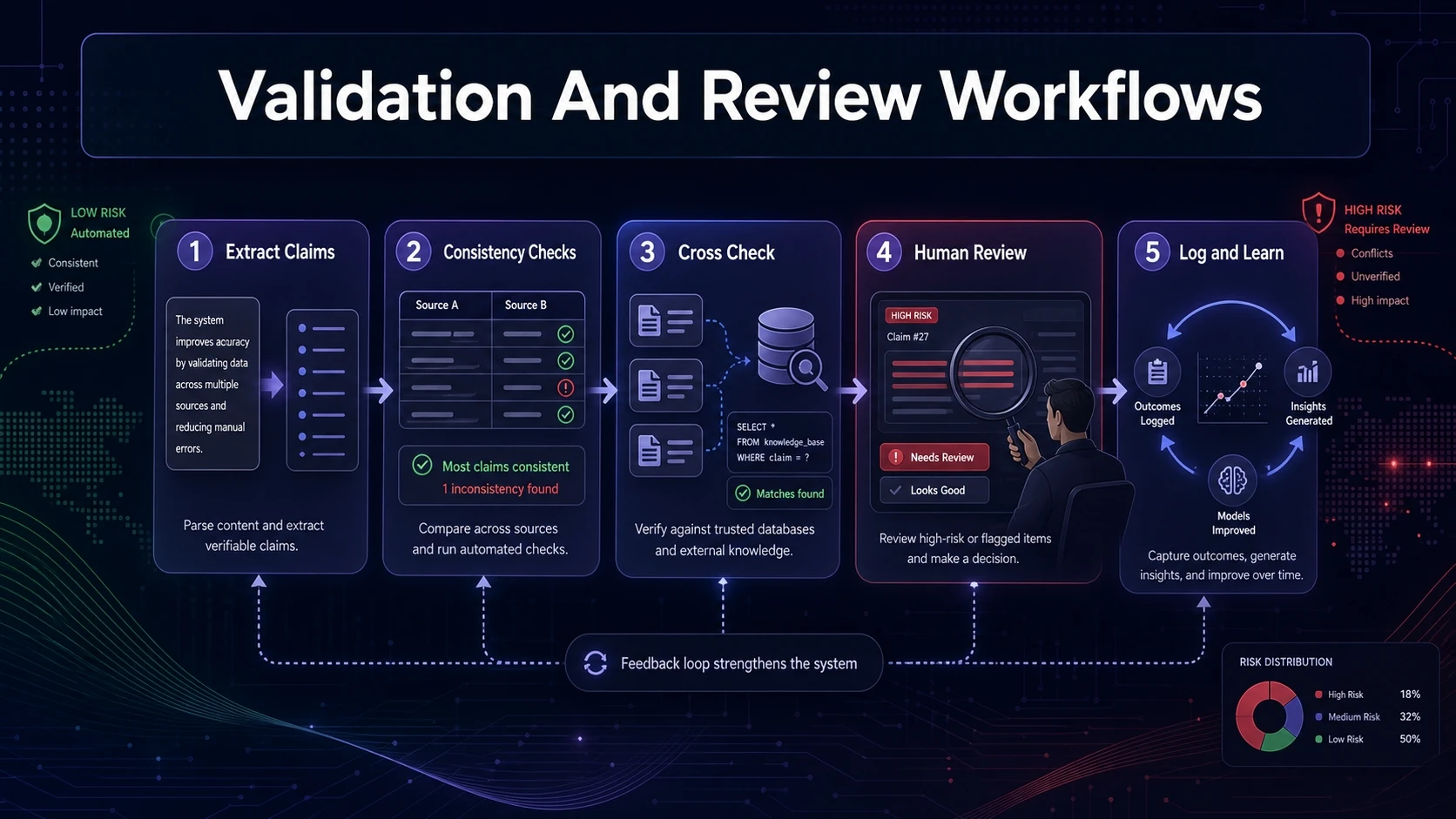
If wrong answers have a real cost, do not rely on prompting alone. Add verification steps that catch errors before they reach users.
- Extract Claims: Pull key factual statements into a short list for checking.
- Run Consistency Checks: Verify that the answer matches the provided context and does not contradict itself.
- Cross Check Against A Source: Compare claims with your trusted documents or structured database.
- Apply Human Review On High Risk: Route sensitive categories like legal, medical, finance, or security to an expert.
- Log And Learn: Store failures, prompts, and contexts so you can fix root causes and reduce repeats.
Teams implementing AI assistants at scale often set risk tiers. Low risk answers can be automated, while high risk answers require citations, review, or refusal behavior.
Refusal, Uncertainty, And Safe Output Design
Many systems fail because they force an answer even when inputs are incomplete. A safer design allows the model to say it does not know and to ask targeted follow-up questions.
Encourage calibrated uncertainty. It should express limits clearly and avoid filling gaps with invented specifics, especially around numbers, dates, and policy language.
- Allow Refusal: Permit a concise refusal when the request requires inaccessible data or expert judgment.
- Ask For Missing Inputs: Request the minimum additional details needed to answer correctly.
- Require Source Backing: When sources are required, instruct it to answer only from the provided texts.
These patterns improve trust because they prevent confident wrong answers from reaching the user.
Monitoring And Continuous Improvement
Hallucination reduction is an ongoing process. You need monitoring that measures answer quality over time, not only during initial testing.
Track metrics such as factual accuracy rate, citation validity, refusal rate, and user correction frequency. Review drift after model updates, prompt changes, or knowledge base revisions.
- Use Regression Sets: Maintain a fixed set of prompts that represent your critical tasks.
- Review Failure Clusters: Group errors by cause such as retrieval gaps, prompt ambiguity, or outdated documents.
- Update Guardrails: Improve prompts, retrieval filters, and refusal rules based on what monitoring reveals.
When organizations need a structured approach, Tech Bonafide typically helps by aligning AI behavior with business rules, building evaluation sets, and tightening retrieval and governance so production answers remain stable.
Conclusion
AI hallucinations happen because generative models prioritize fluent completion and may lack grounding, constraints, or verification. You can reduce wrong answers by improving prompts, grounding responses in trusted data, using conservative decoding settings, and adding validation workflows.
The most reliable systems combine technical controls with clear policies and monitoring. That combination turns AI from a clever text generator into a dependable assistant for real work.
Frequently Asked Questions
Can AI hallucinations be eliminated completely?
Not fully, because generative models can still produce plausible text when context is missing or ambiguous. You can reduce hallucinations sharply with grounding, verification, and refusal behavior. Treat accuracy as a system property, not a single setting.
Do lower temperature settings guarantee correct answers?
No, lower temperature mainly reduces randomness and makes outputs more consistent. If the context is wrong or incomplete, the model can still be consistently wrong. Pair conservative settings with trusted sources and checks.
What is the fastest way to reduce wrong answers in a support chatbot?
Limit responses to a curated knowledge base and require that answers stay within retrieved passages. Add a rule that missing information triggers a clarifying question or refusal. Monitor conversations to find the topics that cause the most drift and fix the source content first.