

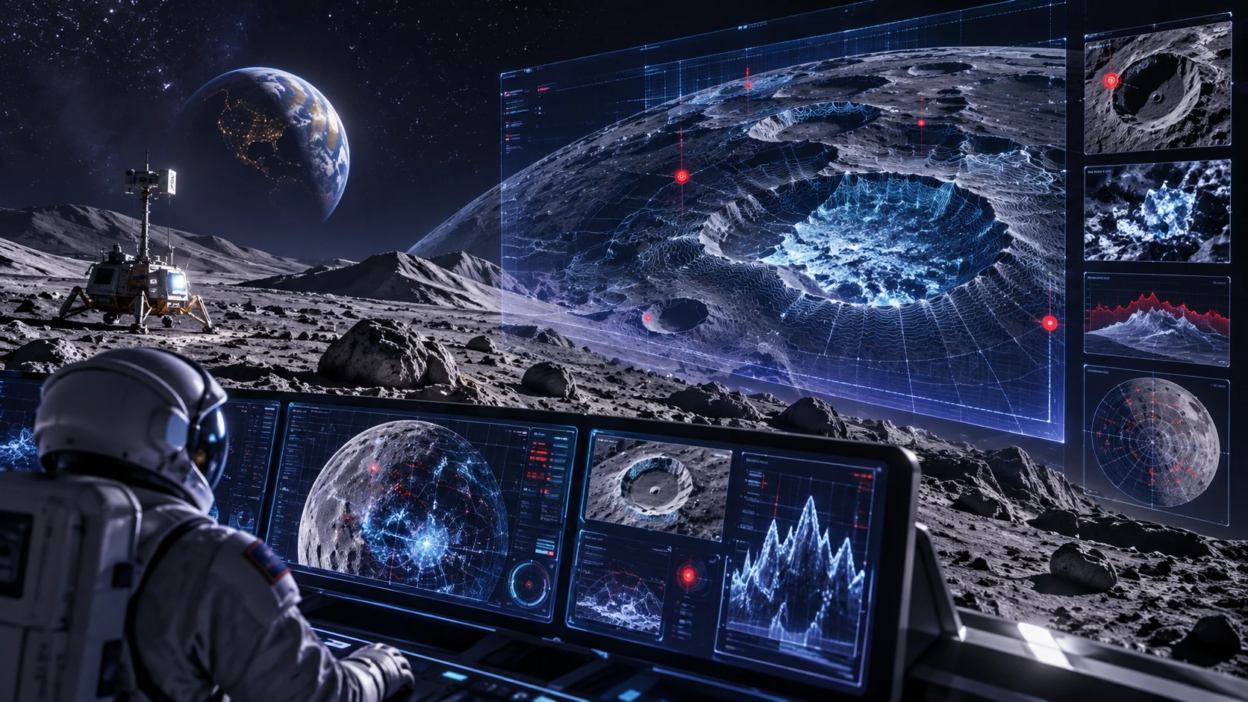
IBM and NASA have launched a new open-source artificial intelligence model designed to help scientists study the Moon more quickly and accurately. Called the NASA-IBM Lunar Foundation Model, the technology can analyze large amounts of lunar data and identify important features such as ice deposits, craters and volcanic areas.
The AI model was trained using more than 30 layers of data collected by nine instruments across four NASA missions. This includes information from NASA’s Lunar Reconnaissance Orbiter, which has been observing and mapping the Moon for many years.
Instead of scientists manually checking huge numbers of images and maps, the AI system can process lunar information and find important patterns automatically. This could make research faster while helping scientists understand parts of the Moon that are difficult to study using traditional methods.
One of the model’s most important uses is searching for possible ice deposits in permanently shadowed areas of the Moon. These regions receive little or no sunlight and may contain frozen water.
Finding lunar ice is important for future space missions. Water could potentially be used by astronauts, while its hydrogen and oxygen components could also support life-support systems or eventually help produce rocket fuel. These resources could reduce the amount of material that future missions need to carry from Earth.
The model can also identify and map lunar craters. Accurate crater maps could help researchers understand the Moon’s history and assist mission planners in finding safer areas for spacecraft and astronauts to land.
According to benchmark testing, the new model was able to identify important lunar surface features with up to 23% better accuracy than commonly used methods. This improvement could become increasingly useful as space agencies collect even larger amounts of Moon data.
The Lunar Foundation Model joins the Prithvi family of open AI foundation models developed through IBM and NASA’s ongoing collaboration. Their earlier projects have applied similar AI technology to areas including Earth observation, weather and climate research.
Making the lunar model open source also allows researchers and developers to build on the technology. Scientists can adapt the model for different lunar research tasks instead of creating an AI system from the beginning for every project.
The development comes as NASA prepares for future Artemis missions aimed at returning astronauts to the Moon and building the technology needed for longer stays. Better information about landing areas, surface hazards and resources such as water ice could play an important role in those plans.
The project also shows how foundation models are moving beyond general-purpose AI applications and into specialized scientific research. By combining decades of space data with modern AI, IBM and NASA hope researchers will be able to study the Moon faster and prepare more effectively for future human exploration.