
5G RedCap is a streamlined form of 5G designed for smaller devices that need reliable connectivity without the cost and complexity of full 5G. It targets wearables and many IoT devices that care about battery life, compact radios, and predictable performance. The goal is to bring more of the 5G ecosystem to devices that previously had to choose between LTE IoT options and high end 5G modules.
RedCap stands for Reduced Capability and was introduced in 3GPP Release 17 as a simplified category of 5G New Radio (NR) devices. It reduces modem complexity through narrower supported bandwidth, fewer antenna requirements, and other optional radio simplifications. These changes can lower device cost, power consumption, and hardware size compared with conventional 5G NR designs. RedCap retains 5G connectivity while targeting devices that do not need the full performance capabilities of premium 5G smartphones.
The 3GPP RedCap standardization project documents the development of Reduced Capability NR devices under Release 17, providing the technical foundation for this category of 5G-connected products.
What 5G RedCap Means in Simple Terms
RedCap sits between full 5G and the most constrained cellular IoT technologies. It is built for devices that need more speed and responsiveness than NB-IoT or LTE-M can comfortably provide, but do not need multi gigabit throughput. That middle ground matters for wearables, smart industrial sensors, medical devices, and connected consumer electronics.
A RedCap device connects through a compatible 5G NR network using a simplified modem rather than the full radio capabilities of a flagship smartphone. In the commonly deployed sub-7 GHz frequency range, Release 17 RedCap limits supported channel bandwidth to 20 MHz and allows reduced receiver complexity. This helps manufacturers design smaller, potentially more power-efficient modules. However, a device also needs compatible network support, appropriate frequency bands, and carrier provisioning; an ordinary 5G coverage indicator does not guarantee RedCap availability.
Why RedCap Exists for Wearables and IoT Devices

Full 5G can be overkill for compact devices that transmit modest data volumes. More antennas, wider bandwidth, and advanced features raise power consumption and heat, which hurts small form factor designs. RedCap addresses those constraints while still allowing device makers to align with carrier 5G deployments.
Many product teams also want a longer support horizon than legacy LTE-only designs. RedCap offers a path that is natively compatible with 5G network evolution. It reduces the need to redesign around a completely different radio family later.
- Lower modem complexity: Simplified radio chains can reduce silicon area and total device cost.
- Better battery fit: Reduced capability targets lower power profiles than full 5G.
- Modern network alignment: Devices can remain on 5G cores as operators expand 5G coverage.
- Performance headroom: Higher throughput and responsiveness than many LTE IoT options when needed.
Those benefits create a practical option for devices that are too demanding for narrowband solutions and too constrained for premium 5G radios.
How RedCap Differs From Full 5G New Radio
RedCap keeps the essentials of 5G NR, but it limits capability to match constrained devices. Common reductions include fewer supported bandwidth options, fewer receive chains, and less aggressive peak rates. The exact profile depends on modem design and regional operator configurations.
Conventional 5G NR devices can support wider channels, more antenna layers, and higher peak throughput than RedCap devices. Release 17 RedCap reduces those requirements to make lower-complexity designs practical for wearables, industrial sensors, and other connected products. For manufacturers, fewer radio components and a simpler RF design can reduce development costs and power requirements. However, certification is not automatically easier: each module must still meet applicable regulatory, operator, and device requirements.
RedCap vs. eRedCap: What Changed in Release 18?
RedCap was introduced in 3GPP Release 17 to support lower-complexity 5G devices such as wearables and industrial sensors. Release 18 introduced enhanced RedCap, often written as eRedCap, as an additional device category with lower peak throughput requirements.
While Release 17 RedCap supports peak data rates below approximately 250 Mbps, Release 18 eRedCap limits peak data rates to around 10 Mbps. These are capability limits rather than guaranteed real-world download speeds.
eRedCap is intended for devices that can operate with more modest data requirements while benefiting from integration with the 5G ecosystem.
- Release 17 RedCap: Designed for wearables, industrial sensors, and connected devices needing moderate data rates with reduced radio complexity.
- Release 18 eRedCap: Extends the approach to lower-throughput devices where limiting peak performance can support simpler implementations.
- Network Compatibility: Both require compatible devices and network functionality. Support for standard 5G NR does not automatically mean that an operator supports every RedCap or eRedCap configuration.
Manufacturers should compare Release 17 and Release 18 module capabilities, actual power consumption, carrier certification, availability, and expected device lifespan before choosing a modem.
For a deeper technical explanation, Ericsson’s guide to RedCap and eRedCap explains the differences between the two device categories, their radio simplifications, and the IoT applications they are designed to support.
RedCap’s evolution also forms part of the broader 5G-Advanced roadmap. Our guide to 5G-Advanced and its new capabilities explains how Release 18 introduces improvements in device support, network efficiency, positioning, automation, and enterprise connectivity.
RedCap Compared With LTE-M and NB-IoT
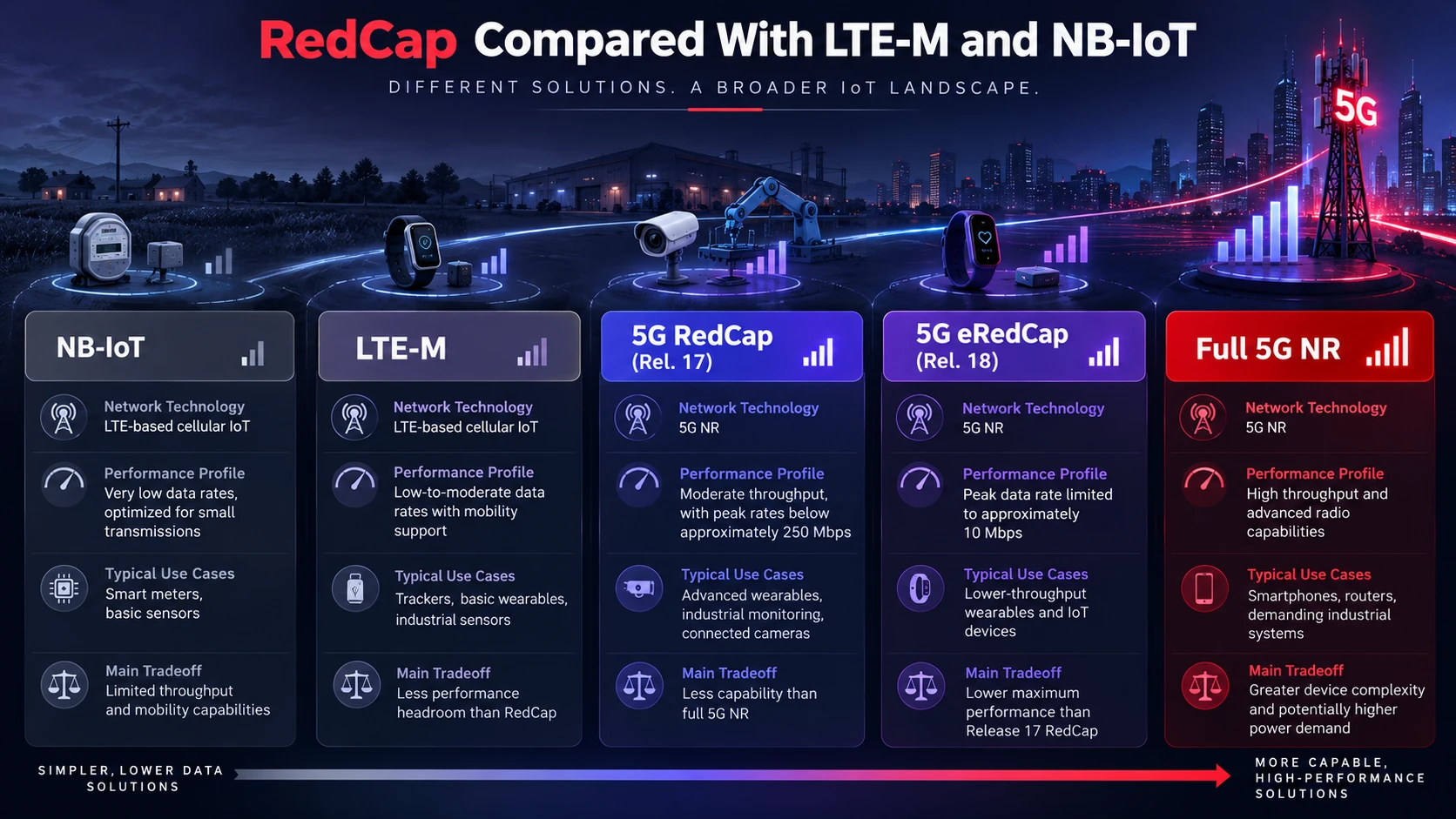
LTE-M and NB-IoT are optimized for low data rate IoT and long battery life. They work well for metering, simple sensors, and infrequent transmissions. RedCap is intended for devices that need more bandwidth, lower latency options, or richer device experiences while still controlling cost and power.
Another difference is the network direction. Some operators are investing heavily in 5G cores and 5G radio modernization, while keeping LTE for coverage. RedCap can align better with long term 5G strategies, especially where operators want more devices on 5G cores.
Understanding LTE’s continued role is important when comparing RedCap with older cellular IoT technologies. Our explanation of LTE’s role in the transition from 3G to 5G explores how LTE networks continue to support mobile connectivity while operators expand their 5G infrastructure.
| Technology | Network Technology | Performance Profile | Typical Use Cases | Main Tradeoff |
|---|---|---|---|---|
| NB-IoT | LTE-based cellular IoT | Very low data rates, optimized for small transmissions | Smart meters, basic sensors | Limited throughput and mobility capabilities |
| LTE-M | LTE-based cellular IoT | Low-to-moderate data rates with mobility support | Trackers, basic wearables, industrial sensors | Less performance headroom than RedCap |
| 5G RedCap (Rel. 17) | 5G NR | Moderate throughput, with peak rates below approximately 250 Mbps | Advanced wearables, industrial monitoring, connected cameras | Less capability than full 5G NR |
| 5G eRedCap (Rel. 18) | 5G NR | Peak data rate limited to approximately 10 Mbps | Lower-throughput wearables and IoT devices | Lower maximum performance than Release 17 RedCap |
| Full 5G NR | 5G NR | High throughput and advanced radio capabilities | Smartphones, routers, demanding industrial systems | Greater device complexity and potentially higher power demand |
Key Technical Features That Matter Most
RedCap is not a single fixed speed tier. It is a standard approach that allows vendors to build modems with reduced features while staying compliant. What matters most is how the feature set maps to the product requirements and the target operator bands.
Wearables and IoT devices typically prioritize steady uplink, efficient idle behavior, and robust mobility. Many deployments care more about consistent latency than about headline peak download rates. RedCap is designed to serve those priorities.
- Reduced antenna complexity: Fewer antenna paths can lower power and simplify industrial design.
- Moderate bandwidth support: Enough capacity for voice, telemetry, and periodic data bursts without extreme peaks.
- 5G Core Integration: RedCap can operate within compatible 5G networks and use supported core-network services. Features such as network slicing and advanced policy controls depend on operator deployment, subscriptions, device capabilities, and network configuration. They should not be assumed to be available on every RedCap connection.
- Mobility support: Better suited than many narrowband approaches for devices that move through cells regularly.
Device designers still need to validate specific band support, power modes, and operator acceptance requirements. That validation is where many RedCap projects succeed or fail.
Where RedCap Fits in Real Products
RedCap is a strong match for connected wearables that need more than basic messaging. It can also fit industrial IoT devices that require dependable performance and a path to 5G infrastructure. Devices that exchange firmware updates, support voice, or need steady uplink often benefit from RedCap.
Product categories that commonly map well include health monitoring wearables, asset trackers with richer telemetry, smart safety gear, connected cameras with constrained bitrate needs, and gateways that do not need full 5G throughput. The exact choice should be driven by payload size, update frequency, and expected roaming patterns.
Benefits for OEMs and Product Teams
RedCap changes the economics of building cellular connected devices. A simpler modem can reduce BOM pressure, and lower power can increase battery life or allow smaller batteries. Those benefits can help teams hit industrial design goals without sacrificing reliable cellular connectivity.
It also supports a cleaner product strategy for teams planning multiple device tiers. A brand can offer a premium full 5G device and a RedCap version with similar user experience but lower cost. That kind of lineup can be easier to support than mixing LTE-only designs with 5G devices across regions.
- Cost control: Reduced capability can lower modem and RF design costs compared with premium 5G.
- Thermal Design: Reduced radio complexity can lower power consumption compared with more capable 5G modem designs. However, actual heat generation depends on transmit power, signal quality, processing load, enclosure materials, and duty cycle. Manufacturers must validate thermal performance under realistic operating conditions.
- Design flexibility: Fewer antennas and simpler layouts can free space for sensors and larger batteries.
- Lifecycle alignment: Better fit for long support windows as networks transition further into 5G.
These gains still depend on module availability, certification paths, and operator support in target markets.
Deployment Considerations for Networks and Enterprises

Enterprises adopting RedCap should verify that their carrier or private network supports the relevant RedCap device categories. Coverage in the intended bands matters more than peak throughput. For industrial settings, RF planning and antenna placement remain important because many IoT devices are installed in challenging locations.
Security and device management also deserve attention. RedCap devices typically integrate with standard 5G authentication and can use modern SIM or eSIM approaches. Enterprises should plan for provisioning workflows, fleet monitoring, and firmware update channels before field rollout.
Device identity and connectivity provisioning are also important when managing RedCap deployments. Our comparison of eSIM vs. physical SIM explains the basic differences between embedded and removable SIM technologies, which can help readers understand the connectivity options available in compatible cellular devices.
- Band and carrier readiness: Confirm that target operators support RedCap profiles where devices will ship or roam.
- Module certification: Choose modules with strong regulatory and operator certification coverage to reduce delays.
- Power profiling: Measure real device power across idle, transmit, and mobility states, not just datasheet numbers.
- Device management: Ensure telemetry, remote configuration, and OTA update strategies are validated early.
RedCap Deployment Readiness Checklist
Before deploying RedCap devices at scale, enterprises should validate device compatibility, network support, and operational readiness.
- Confirm Operator Support: Check whether target mobile networks actively support the required RedCap device category, frequency bands, and deployment configuration.
- Verify Module Compatibility: Review chipset specifications, regional certifications, supported frequencies, firmware versions, and antenna requirements.
- Test Real-World Battery Performance: Measure power consumption during idle periods, transmissions, mobility events, and expected application workloads.
- Check Network Coverage: Validate connectivity inside buildings, factories, warehouses, and other areas where devices will operate.
- Evaluate Data Requirements: Compare application throughput, latency, payload sizes, transmission frequency, and reliability requirements with module capabilities.
- Plan Security and Provisioning: Establish SIM or eSIM management, device authentication, secure firmware updates, and remote monitoring.
- Validate Scalability: Test device registration, connection reliability, telemetry processing, and fleet-management workflows before a large rollout.
As RedCap device fleets grow, automated setup and configuration can reduce manual work. Our guide explaining zero-touch provisioning explores how supported networked devices can receive configurations and settings through automated deployment workflows. The same provisioning principles can inform IoT fleet planning, although actual RedCap onboarding depends on the device platform and connectivity management system.
Ericsson’s overview of RedCap for enterprise IoT connectivity offers additional context on how reduced-capability devices can be used in private 5G environments, including industrial monitoring and connected-device applications.
A pilot deployment using representative devices and locations can reveal coverage, performance, and integration problems before the organization commits to a full production rollout.
A disciplined validation plan helps avoid late stage redesigns when RF and power targets do not match early assumptions.
How to Plan a Successful RedCap Adoption Strategy
Organizations adopting RedCap should begin by translating business and application requirements into measurable technical targets. These include acceptable battery life, device cost, data throughput, mobility support, coverage, and expected service life. Once those targets are documented, teams can compare available RedCap modules and verify compatibility with the networks where devices will operate.
A successful implementation also requires coordination between hardware, firmware, cloud infrastructure, and device management teams. Early testing should cover network registration, power consumption, application performance, secure provisioning, and remote firmware updates. As deployments expand, teams should monitor device health, connectivity failures, and operating costs to identify problems before they affect the entire device fleet.
Conclusion
5G RedCap extends the 5G ecosystem to connected devices that do not require the complexity or peak performance of conventional 5G smartphones. Introduced in 3GPP Release 17 and expanded through Release 18 eRedCap, the technology provides options for wearables, industrial sensors, monitoring equipment, and other IoT applications with moderate or lower data requirements.
RedCap is not automatically the best choice for every connected device. LTE-M and NB-IoT remain relevant for applications prioritizing low data rates and long battery life, while full 5G NR serves more demanding workloads. The right decision depends on application performance, module availability, power requirements, certification, and operator support. Testing these factors in realistic conditions is essential before deploying RedCap at scale.
Frequently Asked Questions
Is 5G RedCap the Same as LTE-M or NB-IoT?
No. LTE-M and NB-IoT are LTE-based IoT technologies, while RedCap is part of 5G NR and works with 5G core networks. RedCap generally targets higher capability devices than NB-IoT, and it can offer more performance headroom than LTE-M depending on the implementation.
Will RedCap Improve Battery Life for Wearables?
It can, mainly because the radio is simpler than full 5G and is designed with constrained devices in mind. Actual battery life depends on antenna design, network conditions, transmission frequency, and power management in firmware. Measuring power in realistic mobility and idle scenarios is essential.
What Should I Check Before Choosing a RedCap Module?
Start with band support and carrier certification coverage for your target markets. Then validate power profiles, antenna requirements, and firmware support for provisioning and OTA updates. Also confirm your backend can securely handle device identity, telemetry, and lifecycle operations.
Does 5G RedCap Work on Every 5G Network?
No. RedCap requires compatible network support, and not every operator or 5G deployment enables the necessary device features. Availability depends on the operator’s network configuration, frequency bands, RedCap implementation, and certified devices. Before selecting a RedCap module, manufacturers should confirm support with their target carriers and test connectivity in the intended deployment areas.