

Cloud egress fees are charges for transferring data from cloud services to external destinations or across certain billable network boundaries. These costs can increase when applications serve large files, transfer data between regions, or exchange information across multiple cloud providers. Understanding cloud egress pricing helps businesses avoid unexpected bills, improve network efficiency, and control cloud spending. This guide explains why cloud egress fees can be expensive, how providers charge for data transfers, and the practical ways to reduce costs without affecting performance or reliability.
What are Cloud Egress Fees?
Cloud egress refers to data transferred out of a cloud service, region, or network boundary. It commonly includes data sent to internet users, on-premises data centers, third-party platforms, or another cloud provider. Some transfers between regions or availability zones within the same cloud provider can also generate data transfer charges. The exact costs depend on the provider, service, source region, destination, and applicable pricing rules.
Cloud ingress, which means data entering a cloud environment, is generally free for many common services, although processing and related service charges may still apply. Egress pricing reflects network delivery costs and provider-specific commercial pricing policies. Outbound transfers may use private backbone infrastructure, peering connections, or internet transit routes. Charges can therefore vary significantly by destination, service, and transfer volume. Readers who are new to cloud infrastructure can also explore our guide to cloud computing basics, which introduces common cloud services, storage, and infrastructure concepts before moving into more specialized topics such as networking charges.
Why are Cloud Egress Fees so Expensive?
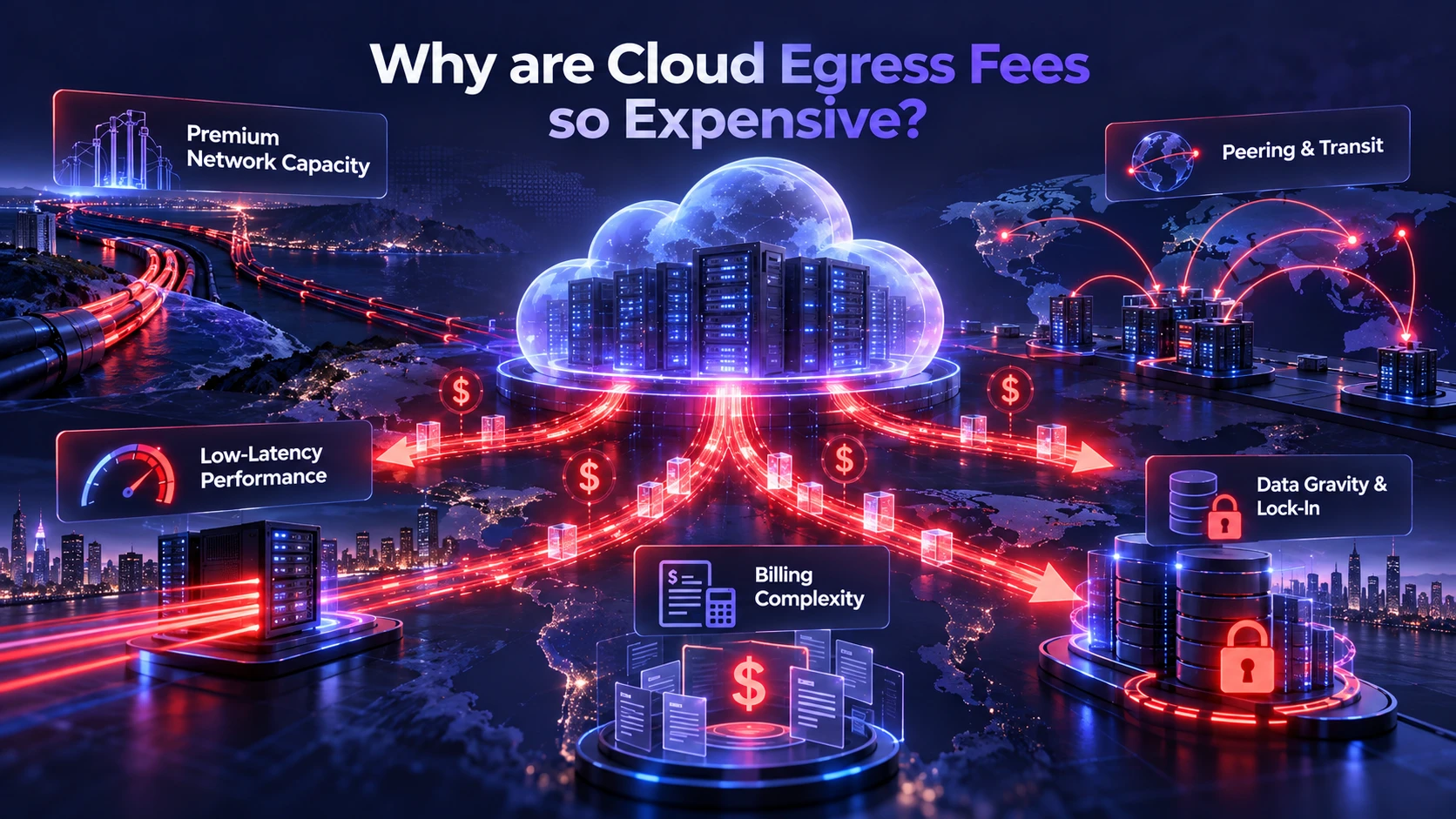
Egress pricing is shaped by infrastructure realities and by the way cloud markets work. Costs rise fast when large volumes move frequently or when workloads are designed without considering data gravity.
- Premium Network Capacity: Providers operate global backbones, edge locations, and high-throughput routers that are costly to build and maintain.
- Peering and Transit Economics: When traffic leaves the provider’s private backbone, it may require paid transit or negotiated peering to reach external networks.
- Hot Path Performance Requirements: Low latency, high availability routes require redundancy and headroom, which increases the unit economics of outbound delivery.
- Billing and Metering Complexity: Providers measure bytes across regions, services, and network boundaries, then apply pricing tiers and exceptions that add administrative overhead.
- Data Gravity and Vendor Lock-In: Large datasets can be costly and time-consuming to transfer between cloud environments. Data transfer fees may increase migration expenses, while dependencies on provider-specific services can make switching platforms more complex. Organizations should evaluate these costs when designing multi-cloud environments or planning migrations.
Those drivers do not mean egress is “unfair,” but they do explain why it rarely matches what you pay for storage. Storage pricing is optimized for volume and durability, while egress pricing reflects scarce network resources and commercial routing.
Common Triggers that Increase Egress Bills
Egress bills often spike after architectural changes, not during steady-state operation. A small change in where users or systems sit can shift traffic from cheap internal paths to expensive outbound routes.
- Cross Region Reads: Applications pulling objects or database replicas from another region can generate outbound traffic that is easy to miss in dashboards.
- Multi Cloud Replication: Sending backups or mirrored datasets to a second cloud creates recurring outbound transfer at scale. Organizations using multiple cloud platforms should also consider how their deployment strategy affects data movement. Hybrid and multi-cloud architectures can introduce different networking, replication, and cost management requirements. Our comparison of hybrid cloud vs. multi-cloud explains these differences and the factors businesses should evaluate before selecting an approach.
- Content Delivery Without Proper Caching: Misconfigured cache headers or low cache hit rates can cause repeated origin fetches and higher outbound volume.
- Analytics Data Exports: Regular extracts to external warehouses or BI tools can move large files daily.
- Third Party Integrations: Security scanners, observability pipelines, and SaaS connectors can pull logs and telemetry out of your cloud continuously.
After identifying the trigger, the biggest savings usually come from changing data flows rather than negotiating a lower per-GB rate.
How do Cloud Providers Charge for Data Egress?
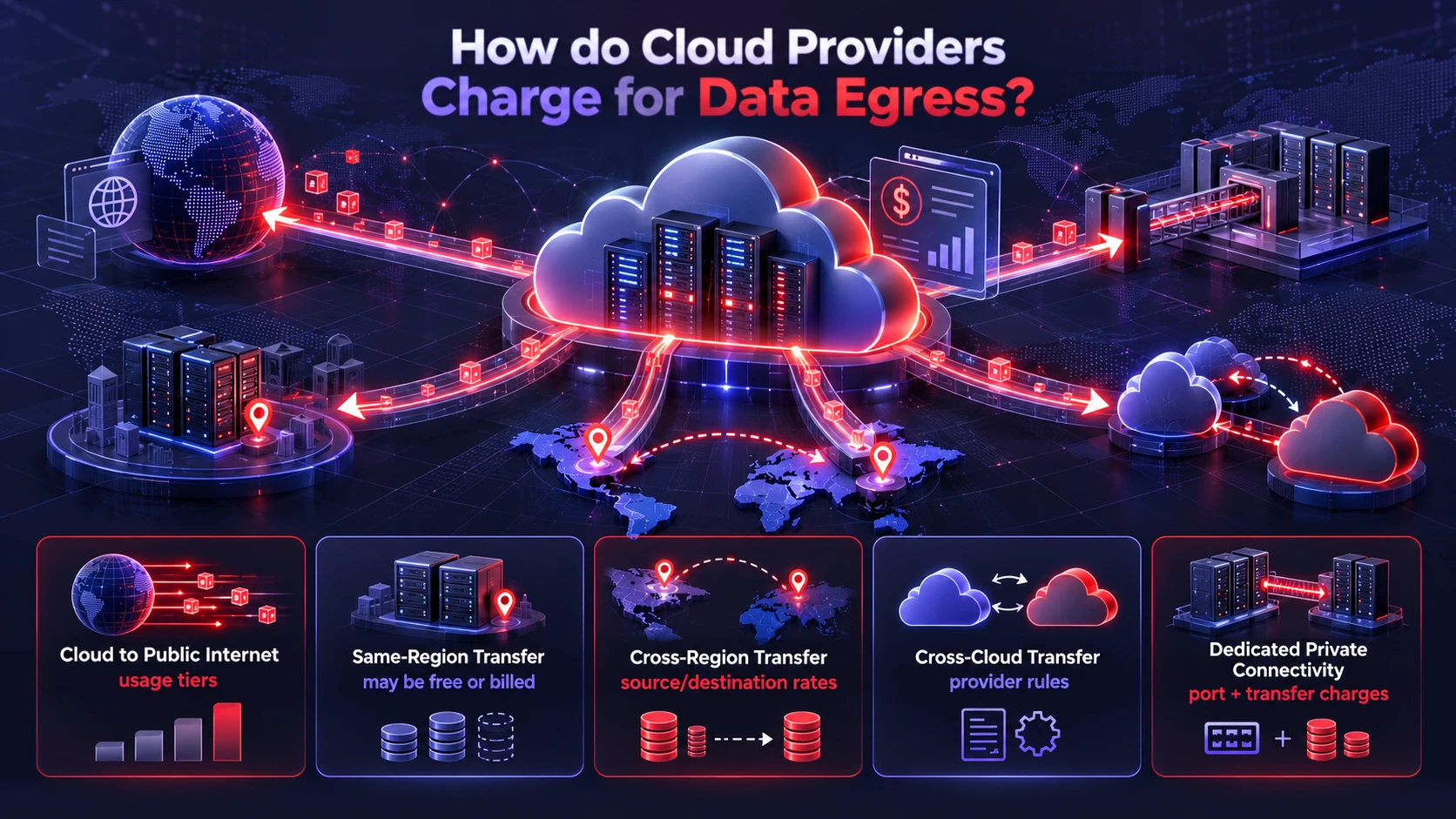
Cloud providers commonly charge for outbound data transfers based on the amount of data transferred, its source and destination, and the cloud services involved. Some internet egress services use volume-based pricing tiers, while cross-region transfers, private connectivity, and content delivery services can follow different pricing models. Free usage allowances and service-specific exceptions may also apply. For example, businesses using Amazon EC2 can review the official AWS data transfer pricing to understand the applicable billing rules.
Cloud providers may apply different charges to internet traffic, cross-region transfers, and certain transfers between availability zones or services. Some internal data transfers are free, while others are billed depending on the network path. Google Cloud’s official network pricing documentation explains how these distinctions can affect costs. Teams should check their provider’s pricing rules for every important transfer path.
| Data Transfer Type | Typical Billing Treatment | What to Check |
|---|---|---|
| Cloud to Public Internet | Often billed by transferred data volume, sometimes with usage tiers | Destination, region, free allowances, service |
| Same-Region Transfer | May be free or billed depending on the service and network path | Availability zone, service-specific transfer rules |
| Cross-Region Transfer | Often charged according to the source, destination, and transfer direction | Regional rates and traffic volume |
| Cross-Cloud Transfer | May involve egress charges from the sending provider and receiving-side processing costs | Both providers’ pricing rules |
| Dedicated Private Connectivity | May include connection, port-hour, and data transfer charges | Capacity, utilization, and contract terms |
This kind of matrix is useful when reviewing architectures because it forces clarity on what counts as “outbound” and where the expensive edges are.
How to Calculate Cloud Egress Fees?
Cloud egress costs can be estimated by multiplying the billable data transfer volume by the applicable transfer rate. However, the final bill may include multiple pricing tiers, free allowances, and additional network service charges.
Basic formula:
Cloud Egress Cost = Billable Data Transferred × Applicable Rate per GB
For example, suppose an application transfers 2,000 GB of billable outbound data in one month at an illustrative rate of $0.09 per GB.
| Calculation Component | Example Value |
|---|---|
| Monthly Billable Data Transfer | 2,000 GB |
| Assumed Egress Rate | $0.09 per GB |
| Estimated Monthly Egress Cost | $180 |
| Estimated Annual Egress Cost | $2,160 |
Common Mistakes When Calculating Cloud Egress Costs
Most miscalculations come from focusing on peak bandwidth instead of total monthly volume. A workload with moderate throughput can still be expensive if it runs all day and serves lots of small downloads.
Another common mistake is overlooking multiple chargeable network paths within a single application request. For example, data may move from object storage to a compute service and then from the compute service to an internet user. Depending on the services, regions, and network configuration, one or more transfer stages may generate charges. Teams should review each transfer path separately instead of assuming that every movement of data is billed or that only the final outbound transfer matters.
Hidden Multipliers
- Retries and Timeouts: Unstable clients can repeatedly re-download the same payload, inflating outbound totals.
- Chatty APIs: Excessive response sizes, verbose JSON, and uncompressed payloads increase transfer without improving outcomes.
- Log Export Fan Out: Shipping the same logs to multiple destinations multiplies egress quickly.
- Backup Restore Testing: Frequent restore drills to external environments can create bursts of outbound traffic.
Once you map these multipliers, it becomes easier to prioritize changes with measurable savings.
How to Reduce Cloud Egress Fees Without Breaking Reliability?
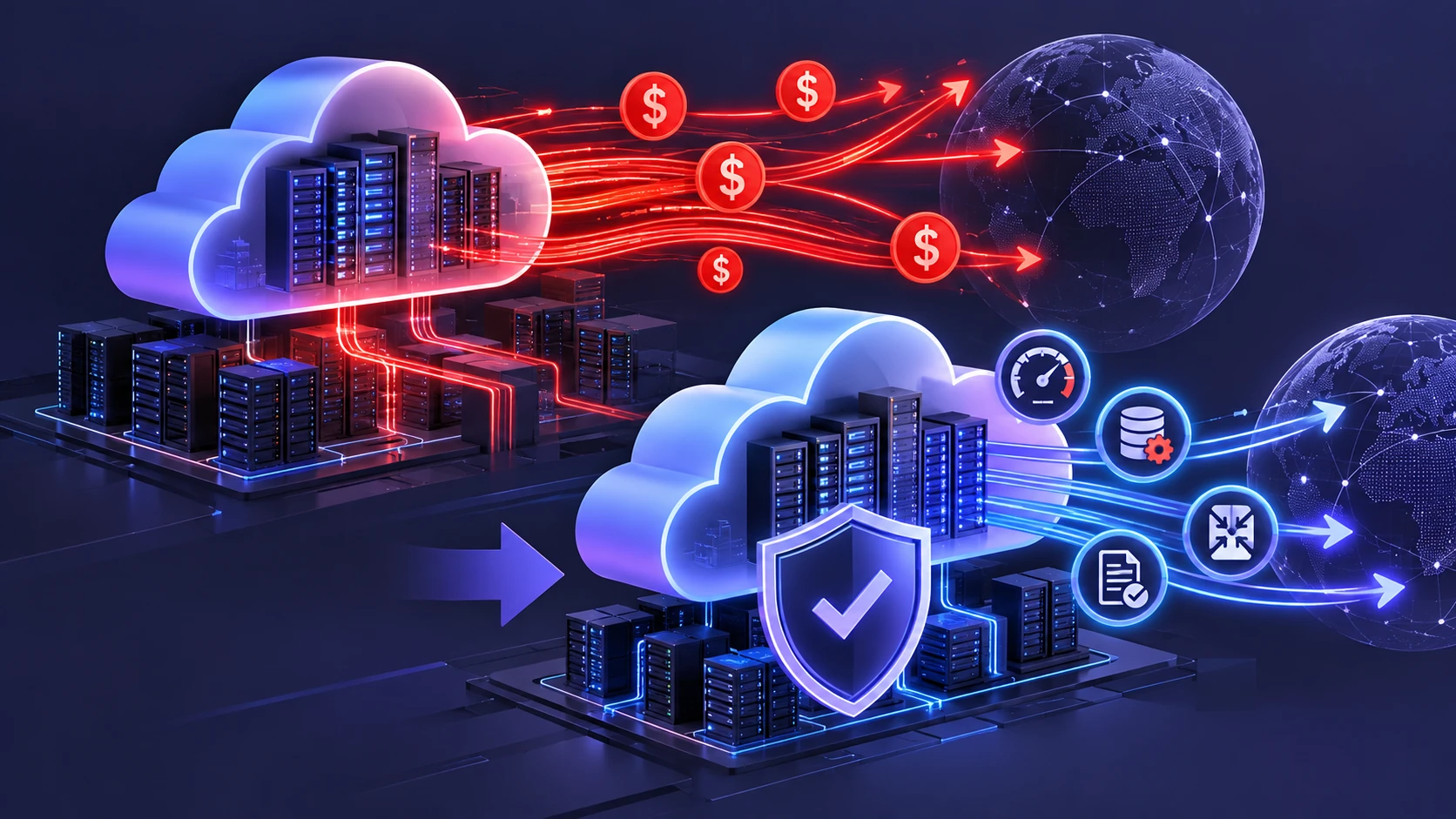
Cost control works best when it is paired with performance goals and clear data ownership. The aim is not to block egress, but to make outbound transfer intentional and efficient.
- Measure at the Right Boundary: Confirm which services emit billable bytes and separate internet egress from internal traffic in reporting.
- Fix Caching and Content Headers: Increase cache hit rates and set sane TTLs to reduce repeated origin delivery.
- Compress and Right Size Payloads: Enable gzip or brotli where appropriate and remove unused fields in API responses.
- Keep Compute Close to Data: Run analytics, transforms, and batch jobs in the same region as the source data to avoid cross-region pulls.
- Evaluate Private Connectivity Costs: Dedicated network connections may offer predictable performance and different transfer rates for suitable workloads. However, they can include fixed connection fees, port charges, and data transfer costs. Review official resources such as Cloud Interconnect pricing and compare the total monthly expense with standard internet egress before choosing private connectivity.
- Consolidate Log and Telemetry Pipelines: Aggregate once, filter early, and export only what is needed at the destination.
These actions generally lower both egress fees and operational noise because they remove unnecessary movement and reduce failure points.
How Data Architecture Affects Cloud Egress Costs
Cloud architecture can have a greater impact on long-term data transfer costs than small differences in provider rates. Keeping compute resources close to frequently accessed data can reduce unnecessary cross-region transfers. Content delivery networks and regional caching can also reduce repeated requests to origin servers. However, caching, replication, and storage services may introduce their own charges, so teams should compare total costs before making architectural changes.
It also helps to classify datasets by access patterns. Frequently accessed public content benefits from strong caching, while internal datasets may be better served by moving compute to the data rather than exporting the data to compute elsewhere.
FinOps and Governance Controls that Keep Egress Predictable
Egress is easier to manage when organizations treat data transfer spending as a governed resource. Teams can establish budgets, monitor outbound network charges, and investigate changes linked to deployments or traffic patterns. The FinOps Foundation’s cloud cost allocation guidance also explains how organizations can assign technology costs to responsible teams using accounts, tags, labels, and other metadata.
Managing data transfer expenses is one part of a broader cloud financial management strategy. Organizations can use FinOps practices to connect cloud spending with business value, improve cost visibility, and assign responsibility to different teams. For more information, explore our guide to controlling cloud costs with FinOps.
- Tagging and Cost Allocation: Use cloud accounts, projects, resource labels, and cost allocation tags to associate network spending with responsible teams and workloads. Some shared or service-level transfer charges cannot be attributed directly through resource tags, so organizations may also need billing reports and usage-based allocation rules.
- Guardrails in CI CD: Require reviews for changes that introduce cross-region replication or external data exports.
- Dashboards With Unit Metrics: Track cost per user, cost per GB served, and cache hit rate alongside egress spend.
- Periodic Architecture Reviews: Revalidate assumptions after product changes, new regions, or new compliance requirements.
If you need help operationalizing these practices, TechBonafide’s cloud consulting and architecture support can help you set up cost observability, design efficient network paths, and build FinOps-friendly governance that fits your workload.
Vendor Contracts and Negotiation Considerations
At higher spend levels, some organizations negotiate committed use discounts or custom pricing that includes outbound transfer considerations. Negotiation works best when you bring clean measurements, a forecast, and a clear understanding of which workloads drive the traffic.
Even with better rates, strong architecture still matters. Poor caching or unnecessary exports can consume any discount quickly.
Conclusion
Cloud egress fees can become a significant part of cloud infrastructure spending when applications transfer large amounts of data to internet users, other regions, or external cloud environments. Pricing depends on the provider, service, destination, and transfer volume, making it important to understand which data movements generate charges.
Businesses can reduce unnecessary egress costs by monitoring transfer patterns, improving caching, compressing responses, reviewing cross-region traffic, and keeping compute resources close to frequently accessed data. Combining these practices with accurate billing analysis and FinOps governance helps organizations manage costs while maintaining application performance, reliability, and security.
Frequently Asked Questions
Are Cloud Egress Fees the Same as Bandwidth Costs?
They are related, but not identical. Egress fees are cloud billing charges for outbound transfer, while bandwidth cost is the underlying network capacity and transit economics. Your bill reflects both the provider’s network strategy and where your traffic exits their boundary.
Do Internal Cloud Transfers Always Avoid Egress Charges?
Not always. Some intra-region traffic is free, but certain paths between services, zones, or regions can be billed. The safest approach is to verify the specific billing category for each data path and monitor it after deployment.
What is the Fastest Way to Lower Egress Without Redesigning Everything?
Start by reviewing cloud billing reports to identify the services and network paths generating the highest data transfer charges. Improve caching where appropriate, compress large responses, reduce unnecessary API data, and investigate repeated downloads. These changes can reduce avoidable outbound traffic without requiring a complete infrastructure redesign. Then evaluate cross-region transfers and external data exports for additional savings.
Do Cloud Providers Offer Free Data Egress?
Some cloud providers offer monthly free data transfer allowances, service-specific exceptions, or eligible migration-related waivers. However, free transfer limits and qualifying conditions vary by provider, region, and service. Organizations should review their provider’s current pricing and eligibility requirements before assuming outbound data transfers are free.