Banao Technologies is a software engineering company offering web development, mobile app development, AI integration, and machine learning solutions. Its publicly listed capabilities include generative AI, intelligent automation, and enterprise software, alongside products developed for specific business needs. This guide explores Banao Technologies’ AI services, software products, and published project examples while explaining how businesses can evaluate its technical capabilities, development process, and long-term support options.
Company Overview and What It is Known for
Banao Technologies describes itself as a software development and AI engineering company serving businesses that need custom digital products and enterprise technology solutions. Its published service areas include web and mobile applications, machine learning, generative AI, intelligent automation, and software integration.
What makes this combination important is the connection between AI capabilities and traditional software engineering. A machine learning model or AI assistant must work reliably with databases, application interfaces, security controls, and existing business systems to be useful in production.
Businesses evaluating Banao Technologies should distinguish between its advertised services, named products, and documented client projects. They should also confirm the technologies, project deliverables, maintenance responsibilities, and support commitments that apply to their own requirements.
Understanding the basics of artificial intelligence can also help businesses evaluate technical proposals more confidently. TechBonafide’s guide explaining how AI works introduces machine learning, data processing, and model development concepts that commonly appear in AI projects.
AI Services Offered By Banao Technologies
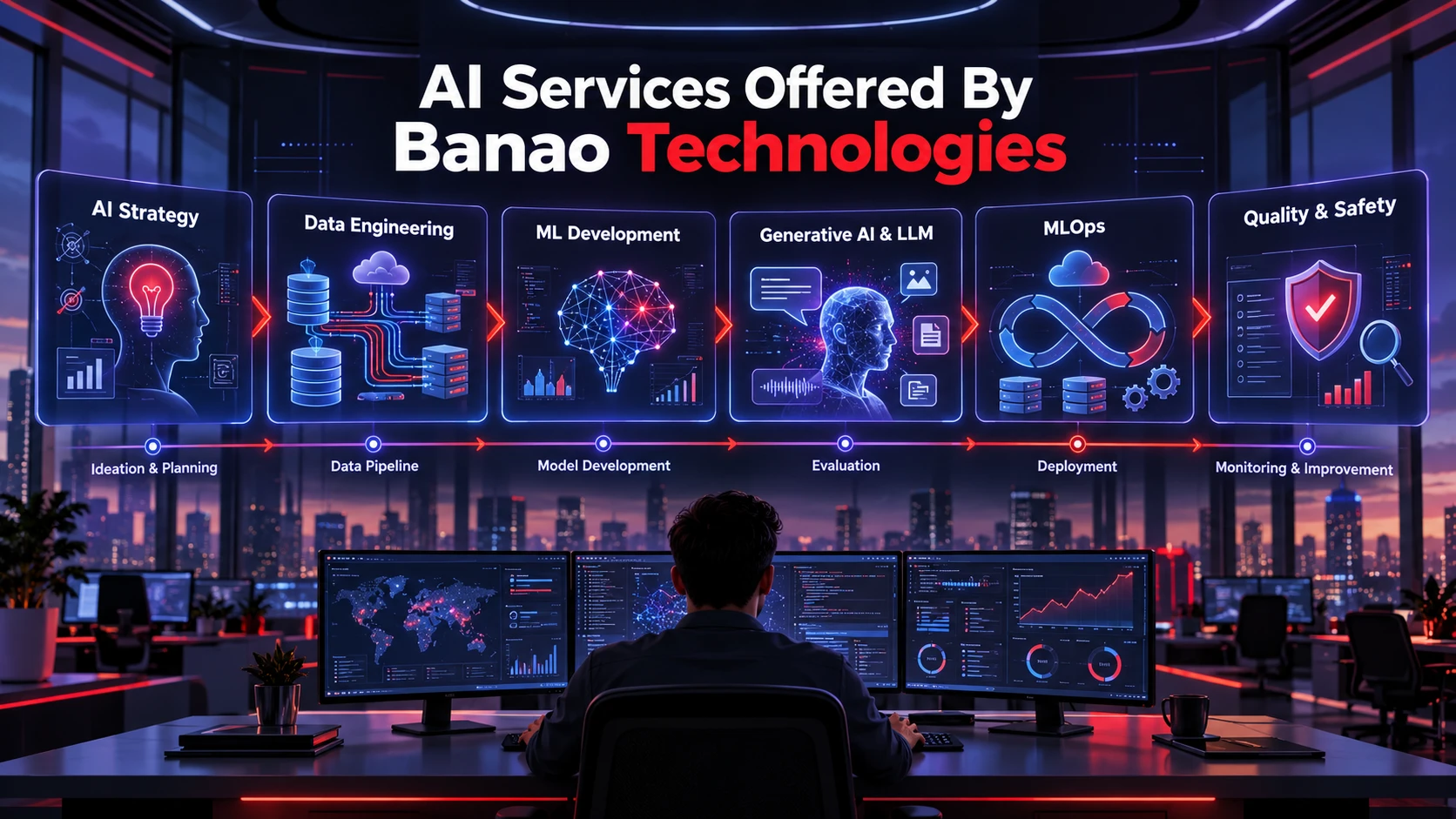
Banao Technologies publicly describes AI consulting, machine learning development, generative AI, and business automation among its service offerings. These capabilities can support different stages of an AI project, including opportunity assessment, data preparation, model development, application integration, and deployment planning. However, the exact services included in a client engagement depend on its agreed project scope, available data, technical requirements, and ongoing support arrangement.
- AI Strategy and Use Case Discovery: Helps identify where AI can reduce cost, increase speed, or improve quality, then defines success metrics and constraints.
- Data Engineering and Pipelines: Involves data ingestion, cleaning, labeling, validation, and dataset management to support analytics and model training. When real datasets are limited or sensitive, teams may also evaluate synthetic data for AI training, provided they validate its quality, usefulness, and privacy risks.
- Machine Learning Model Development: Covers supervised learning, forecasting, recommendations, anomaly detection, and model evaluation with clear benchmarks.
- Generative AI and LLM Integrations: Adds retrieval-augmented generation, enterprise search, content workflows, and guardrails like policy filters and human review.
- MLOps and Production Deployment: May include CI/CD pipelines, model versioning, performance monitoring, drift detection, A/B testing, and rollback planning, depending on the project’s requirements and agreed scope.
- AI Quality and Safety Reviews: Should consider data privacy, model bias, prompt injection risks, access controls, and human review procedures. Buyers should confirm which testing and security protections are included in the project.
When these services are combined, the result is a production-ready AI feature that can be measured, monitored, and improved without disrupting users.
Banao Technologies explains its approach to opportunity discovery, organizational readiness, and strategic planning through its AI consulting services. Businesses can review these published service descriptions to understand the company’s stated capabilities before discussing a specific project scope or agreement.
Products and Solution Areas At Banao Technologies
Banao Technologies commonly delivers solutions that sit at the intersection of business workflows and modern platforms. These solutions may be built as dedicated products, reusable modules, or accelerators that shorten delivery time.
Many organizations seek AI capabilities inside existing systems, not as standalone demos. That often includes intelligent search, document understanding, automated support, personalization, and decision support within CRM, ERP, or internal portals.
Banao Technologies also presents several named products on its official website. These examples help distinguish the company’s own software initiatives from the broader types of applications it offers to build for clients.
- InterviewGod: An AI-assisted recruitment platform designed for structured interviews, technical assessments, candidate screening, and evaluation workflows.
- Vikaas: A company-listed product associated with business pipeline activities. Its published descriptions cover different functions, so its exact current offering should be confirmed directly.
- Vidya: An AI-based personalized learning product that Banao currently describes as being in development.
- Axon: A delivery visibility and reporting product intended to compare reported project progress with actual work completed. Banao lists it as a pre-launch offering.
These products have different functions and development stages. Readers should check the official Banao Technologies product directory for current availability, supported features, and documentation before assuming that every offering is commercially available.
- AI Enabled Web Applications: Customer portals, dashboards, and workflow tools with role-based access and embedded AI actions.
- Mobile App Development With AI Features: On-device experiences, smart recommendations, and conversational flows optimized for latency.
- Conversational AI and Support Automation: Assistants for FAQs, ticket triage, and agent support with secure knowledge retrieval.
- Document Intelligence: Extraction and classification for invoices, forms, and PDFs with validation and human-in-the-loop review.
- Analytics and BI Foundations: Data models, reporting layers, and KPI tracking that align with ML monitoring.
These solution areas reduce manual effort and make knowledge easier to access, while keeping the underlying software stable and testable.
Businesses planning conversational AI or automated workflow tools should understand that answering questions and performing actions are different technical requirements. TechBonafide’s explanation of the differences between AI agents and chatbots can help readers compare these approaches before choosing the type of solution their organization needs.
Technology Stack and Delivery Approach
Banao Technologies advertises custom web and mobile development alongside AI and machine learning services. Its published website references technologies such as React, Node.js, and the MERN stack. However, the technology choices for an individual project will depend on application requirements, existing systems, deployment environments, data availability, and maintenance expectations.
A typical production AI solution requires more than model development. Teams must consider data pipelines, model evaluation, application interfaces, security, deployment automation, and ongoing monitoring. The following table provides an illustrative architecture for evaluating these requirements; it should not be treated as a verified description of Banao Technologies’ internal engineering systems.
| Area | What Gets Built | Why It Matters |
|---|---|---|
| Data Layer | Pipelines, storage, validation rules | Reliable inputs reduce model errors and rework |
| Model Layer | Training, evaluation, model registry | Repeatable experiments and measurable performance |
| Application Layer | APIs, UI flows, integrations | AI becomes usable inside real workflows |
| Operations | Monitoring, alerts, incident playbooks | Production stability and faster troubleshooting |
This structure helps buyers evaluate whether an AI initiative is supported end-to-end, not only at the experimentation stage.
For a deeper understanding of production AI systems, Google’s MLOps pipeline guidance explains how model testing, continuous integration, deployment automation, and monitoring fit into machine learning operations. These principles can help businesses evaluate an AI development proposal, although they do not establish which practices a particular vendor uses.
How Real Projects Typically Run End to End?
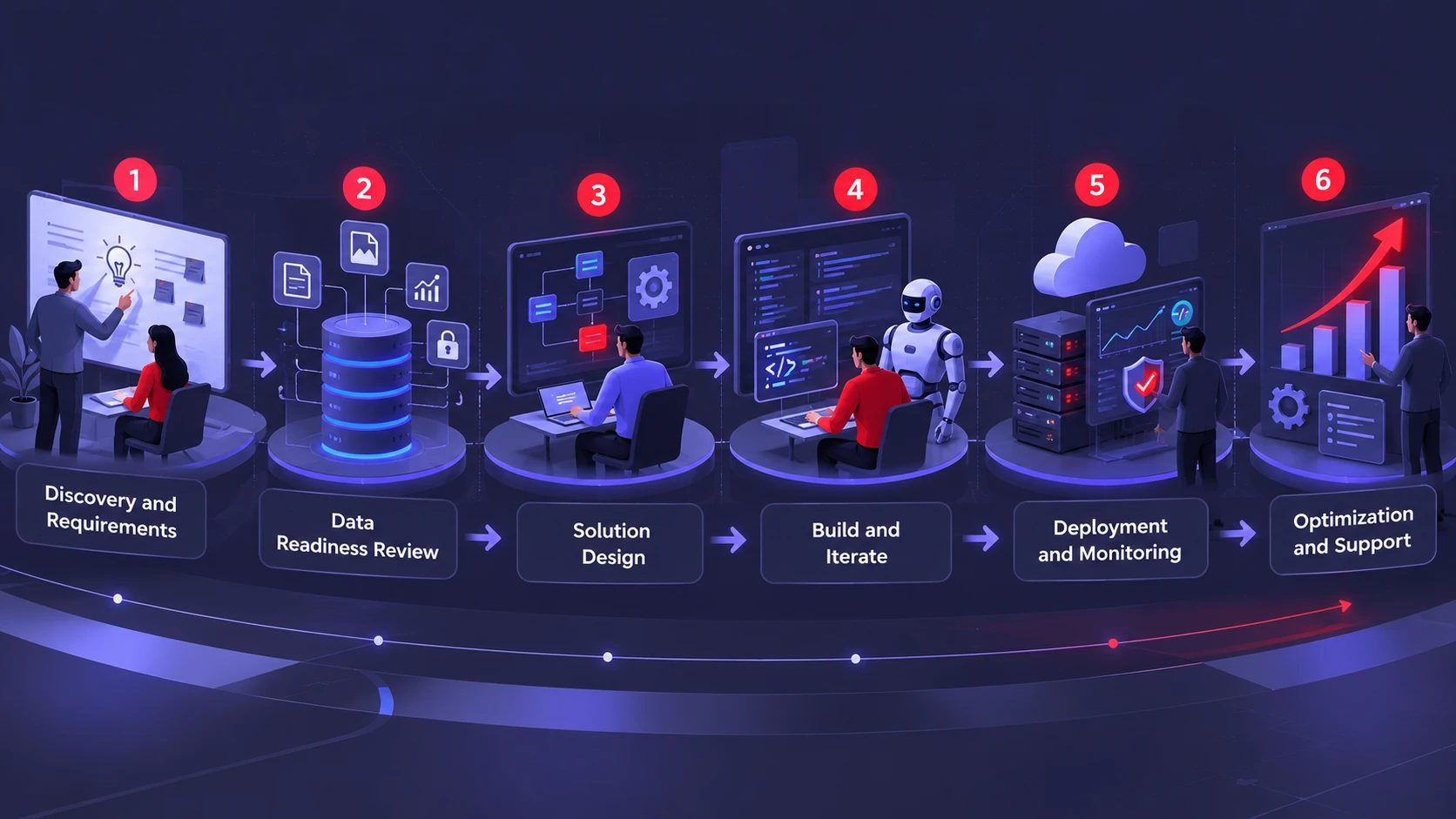
A structured AI development project generally starts with clearly defined requirements and measurable success criteria. The following six stages represent an illustrative software and AI delivery workflow rather than a verified account of Banao Technologies’ internal project methodology. Businesses considering the company should ask how it handles each stage, which deliverables are included, and when testing, approval, and handover take place.
- Discovery and Requirements: Confirms business goals, user journeys, constraints, and measurable KPIs tied to cost, speed, quality, or revenue.
- Data Readiness Review: Assesses availability, quality, access controls, and labeling needs, then defines the minimum dataset required.
- Solution Design: Finalizes architecture, integration points, security controls, and what will be automated versus reviewed by humans.
- Build and Iterate: Delivers working increments, validates with stakeholders, and adjusts based on feedback and monitored results.
- Deployment and Monitoring: Sets up model and app observability, reliability targets, and alerts for drift or unexpected behavior.
- Optimization and Support: Improves performance, reduces cost, and evolves features while maintaining documentation and operational runbooks.
This flow protects timelines and budgets by catching data and integration issues before they reach production.
Real World Project Types and Deliverables
Project deliverables are usually a combination of user-facing product changes and internal platform components. The most valuable outputs are the ones that remain useful after launch, such as repeatable pipelines, test suites, and monitoring dashboards.
Typical deliverables include model evaluation reports, API contracts, UX flows, admin tooling, and deployment automation. Teams also benefit from clear handover artifacts so internal engineers can maintain and extend the solution.
Banao Technologies’ published project portfolio provides examples of the kinds of digital systems it has worked on. These include Interview God, an AI-assisted hiring and assessment platform; an Indian Oil dashboard described as supporting distribution monitoring, predictive risk analysis, and operational insights; and Procurpal, a procurement intelligence solution involving supplier workflows and business reporting. These are project descriptions published by Banao Technologies itself, rather than independently verified performance assessments.
Such examples are useful starting points for evaluating a development partner, but prospective clients should also request relevant demonstrations, technical architecture details, implementation responsibilities, and evidence of measurable outcomes.
- AI Search and Knowledge Retrieval: Enterprise search over documents with relevance tuning, access control, and audit-friendly query logs.
- Automated Classification and Routing: Tagging and prioritization of incoming items such as tickets, claims, or emails to reduce manual triage.
- Forecasting and Capacity Planning: Time series models that support staffing, inventory, or infrastructure decisions with confidence intervals.
- Risk and Anomaly Detection: Alerts that flag unusual patterns and provide explainability signals to support review workflows.
Each deliverable type can be implemented with different techniques, but quality depends on consistent measurement and feedback loops.
Security, Privacy, and Compliance Considerations
AI projects often touch sensitive data and must be designed with safeguards from day one. This includes access control, encryption, data minimization, and strong audit trails across both the application and model layers.
Generative AI applications introduce security risks beyond those found in conventional software. These include prompt injection, sensitive information exposure, excessive system permissions, and unsafe or misleading model outputs. Developers should evaluate these risks through appropriate access controls, secure integration practices, input and output validation, and human review for sensitive operations. Security controls should be tested against the application’s actual users, data, and deployment environment rather than assumed to be effective by default.
- Data Governance: Clear ownership, retention rules, and permissions to prevent accidental exposure.
- Secure Integrations: Token management, least-privilege APIs, and dependency scanning to reduce supply chain risk.
- Model Monitoring: Drift detection, performance tracking, and logging that supports incident response.
These measures keep systems trustworthy while still enabling practical automation.
Organizations developing generative AI applications can refer to the OWASP Top 10 for LLM Applications for guidance on common security risks, including prompt injection and sensitive information exposure. The NIST AI Risk Management Framework provides a broader approach to identifying, assessing, and managing AI-related risks throughout the system lifecycle. These resources can help buyers discuss appropriate safeguards with their development partners.
How to Evaluate Fit Before Starting?

Choosing an AI and product development partner is easier when evaluation criteria are explicit. The right fit is usually the team that can explain trade-offs, show a clear delivery plan, and define how success will be measured.
Before selecting Banao Technologies or another AI development partner, request a written explanation of the proposed project scope, technical architecture, data requirements, estimated delivery milestones, testing arrangements, and post-launch responsibilities. Clarify who owns the source code, trained models, datasets, documentation, and other deliverables. Also ask whether the company can demonstrate comparable completed work and explain how project performance will be measured after deployment.
- Clarity on Metrics: Defined KPIs and a measurement plan that can be tracked after launch.
- Evidence of Production Maturity: Testing strategy, rollout controls, and operational support rather than only model notebooks.
- Alignment on Data Access: A realistic plan for approvals, governance, and privacy requirements.
- Maintainability: Documentation, code quality, and a clear handover path for internal teams.
Buyers should also ask how the team handles unexpected project changes, application failures, model performance issues, and security incidents. The answers should identify clear responsibilities, escalation procedures, and support terms rather than relying only on broad promises of scalability or ongoing maintenance.
Long-term software reliability depends on more than the initial development work. Buyers should also consider how a provider approaches version control, CI/CD automation, monitoring, and incident response. TechBonafide’s practical DevOps learning roadmap explains these engineering areas and can help teams understand which operational practices to discuss before starting an AI development project.
Conclusion
Banao Technologies presents a combination of AI engineering, custom software development, automation capabilities, and named digital products. Its published service descriptions and portfolio examples provide a starting point for understanding what the company offers. However, businesses should evaluate its suitability for a specific project through relevant case studies, technical discussions, clearly documented requirements, and agreed delivery responsibilities.
When evaluating any AI delivery partner, prioritize measurable outcomes, data readiness, security, and ongoing operations. A well-run project should leave you with stable systems, clear documentation, and the ability to improve performance over time.
Frequently Asked Questions
What Types of AI Use Cases are Best Suited for Banao Technologies?
Use cases with clear workflows and measurable outcomes tend to fit best, such as document processing, support automation, recommendations, forecasting, and anomaly detection. Success depends on having sufficient data access and stakeholders who can validate outputs. Projects also work well when AI is embedded directly into an existing app or platform.
How Should I Prepare My Data Before Starting An AI Project?
Start by identifying the source systems, data owners, and access approvals, then verify basic quality such as completeness and consistency. Define labeling rules early and document what a correct output looks like for reviewers. A lightweight data readiness assessment can prevent timeline surprises later.
Can AI Features Be Added to An Existing Web or Mobile Application?
Yes, AI can be integrated through APIs, background jobs, and UI actions that fit existing user flows. The important part is designing for reliability with fallbacks, monitoring, and safe rollouts. Integration planning should also cover latency targets, permissions, and audit logs.