

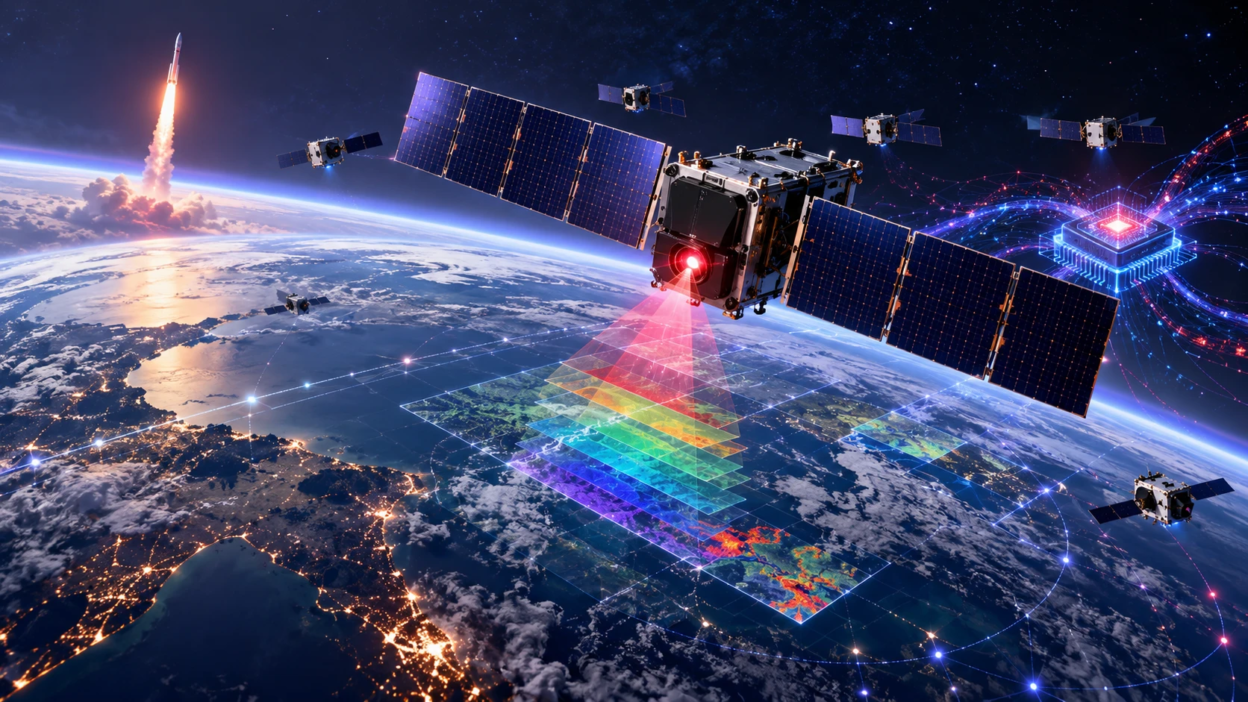
Planet Labs has launched 20 spacecraft aboard SpaceX’s Transporter-18 rideshare mission, expanding its Earth-observation network while also supporting Google’s first in-orbit test of Tensor Processing Units for Project Suncatcher.
The mission launched on October 1, 2026, from Vandenberg Space Force Base in California. The Planet payloads included Tanager-2, 18 SuperDove Earth-observation satellites and a prototype built with Google for Project Suncatcher.
Planet said it established initial contact with Tanager-2, the Project Suncatcher prototype and two SuperDoves and began commissioning them. The remaining 16 SuperDoves were scheduled to deploy from a D-Orbit ION orbital transfer vehicle.
Tanager-2 is Planet’s latest hyperspectral Earth-observation satellite, developed in partnership with Carbon Mapper. Unlike a conventional camera that records a limited range of colors, its imaging system measures hundreds of narrow wavelength bands, allowing researchers to identify materials and gases that may be difficult to distinguish in normal imagery.
Tanager-2 can collect imagery across 426 contiguous spectral bands at about 30-meter spatial resolution. The system is designed to help detect methane emissions while also supporting applications such as water-quality analysis, agricultural monitoring and identification of certain minerals.
The new satellite expands the work already being carried out by the Tanager program. Better detection of methane sources can help researchers and organizations locate large emissions and study how they change over time.
The mission also carried 18 SuperDove satellites from Planet’s Flock 4J group. These spacecraft will supplement PlanetScope, the company’s near-daily global Earth-monitoring system, which provides imagery for commercial businesses, governments, defense organizations and other customers.
By repeatedly imaging large areas of Earth, PlanetScope allows users to compare locations over time. The data can support applications including agriculture, mapping, environmental monitoring, disaster response and analysis of changes on the ground.
Another major part of the mission is Google’s Project Suncatcher prototype, built in partnership with Planet. The spacecraft will conduct the first in-orbit test of Google’s Tensor Processing Units, specialized chips used for artificial intelligence and machine-learning workloads.
Google plans to study how the hardware handles the physical stresses of spaceflight as well as radiation and extreme thermal conditions in orbit. The experiment is part of a longer-term research effort exploring whether scalable machine-learning infrastructure could eventually operate in space.
Project Suncatcher remains an experimental research program rather than a working orbital data center. However, the mission will provide real-world information about how advanced AI hardware performs outside the controlled environment of terrestrial computing facilities.
The Transporter-18 mission marked Planet’s 40th successful launch and brought its total to 718 satellites built and delivered to orbit.
The launch also comes during a period of expanding SpaceX satellite launch activity, including recent progress in deploying larger next-generation spacecraft.
The mission is part of a wider shift toward next-generation satellite networks designed for Earth observation, communications and increasingly advanced computing workloads.
The mission brings together three fast-growing areas of space technology: high-frequency Earth imaging, hyperspectral environmental monitoring and experimental AI computing in orbit. Tanager-2 and the SuperDoves expand Planet’s observation capabilities, while Project Suncatcher tests a very different possibility — whether powerful AI hardware could eventually operate beyond traditional data centers on Earth.