

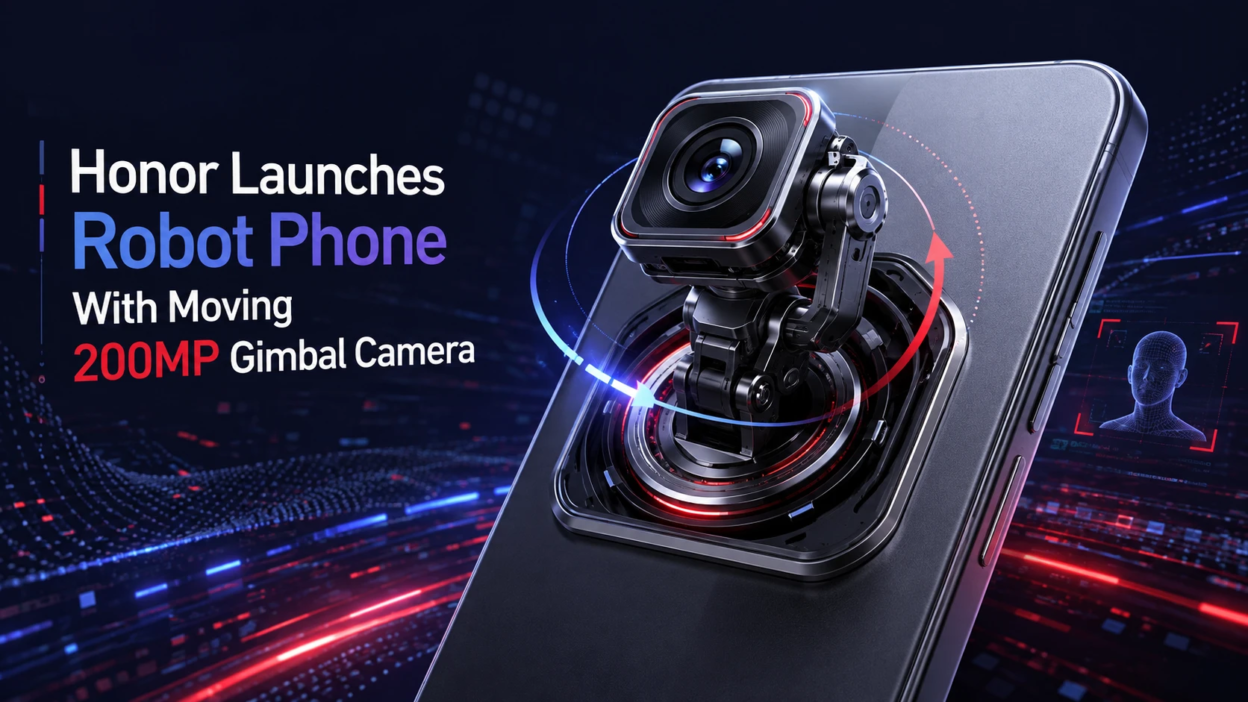
Honor has officially launched its unusual Robot Phone, a flagship smartphone built around a motorized 200MP camera that can physically move, rotate and follow subjects. The device combines a regular premium smartphone with a small robotic gimbal, giving users new ways to shoot videos, take selfies and track moving people.
The biggest feature is the 200MP main camera mounted on a robotic gimbal at the top of the phone. Instead of depending only on software or traditional optical image stabilization, the camera itself can move in different directions. Honor says the system offers four degrees of freedom along with three-axis mechanical stabilization.
The moving camera can automatically follow a person while recording. Users can select a subject, and AI-powered tracking works with the gimbal to keep that subject inside the frame even when they move around. This could be especially useful for vloggers, travelers, livestreamers and people who often record themselves without another person holding the phone.
Honor has also added special camera movements, including 90-degree and 180-degree rotation effects. These are designed to create smoother and more cinematic video shots without requiring a separate handheld gimbal.
The company has worked with professional cinema camera company ARRI on the imaging experience. The Robot Phone supports ARRI-inspired color processing and professional video tools, including LogC3 recording and LUT-based color workflows. This gives more advanced users additional control when shooting and editing video.
The Robot Phone does not depend on a single camera either. Alongside the moving 200MP main camera, Honor has included a 200MP periscope telephoto camera and a 50MP ultra-wide camera. A 50MP front-facing camera is also included for regular selfies and video calls.
Honor is also using artificial intelligence to make the moving camera more interactive. Its YOYO AI system can control several camera functions and automatically adjust the gimbal in supported situations. The camera can even perform small movements and gestures, giving the phone some of the personality suggested by its “Robot Phone” name.
For video calls, the moving camera can keep users in view as they move around. The system can also react to music with physical movements and use the camera mechanism as a form of visual expression.
Under the hood, the Robot Phone is powered by Qualcomm’s Snapdragon 8 Elite Gen 5 processor. It is available with high-end memory and storage configurations, including up to 16GB of RAM and 1TB of internal storage.
The phone features a 6.31-inch OLED display with a 120Hz adaptive refresh rate. Honor has also packed a large 7,060mAh battery inside despite the additional space needed for the mechanical camera system. It supports up to 120W wired fast charging and 50W wireless charging.
The unusual hardware does make the phone heavier and thicker than some conventional flagships. It weighs about 248 grams and is roughly 9.6mm thick. The moving camera mechanism also creates different durability challenges compared with phones that have completely fixed camera modules.
Honor is initially offering the Robot Phone in China, with prices starting at 9,999 yuan for the 512GB version. A higher-end model with 16GB of RAM and 1TB of storage is priced at 12,999 yuan. Sales are scheduled to begin on August 18.
Availability in more international markets has not yet been clearly confirmed.
The Robot Phone shows how smartphone makers are looking beyond normal camera upgrades. Instead of simply adding more megapixels or stronger software processing, Honor has placed an actual robotic camera system inside the device.
Whether moving cameras become common in future smartphones remains to be seen, but Honor’s Robot Phone stands out as one of the more unusual attempts to combine AI, robotics and mobile photography in a single device.