
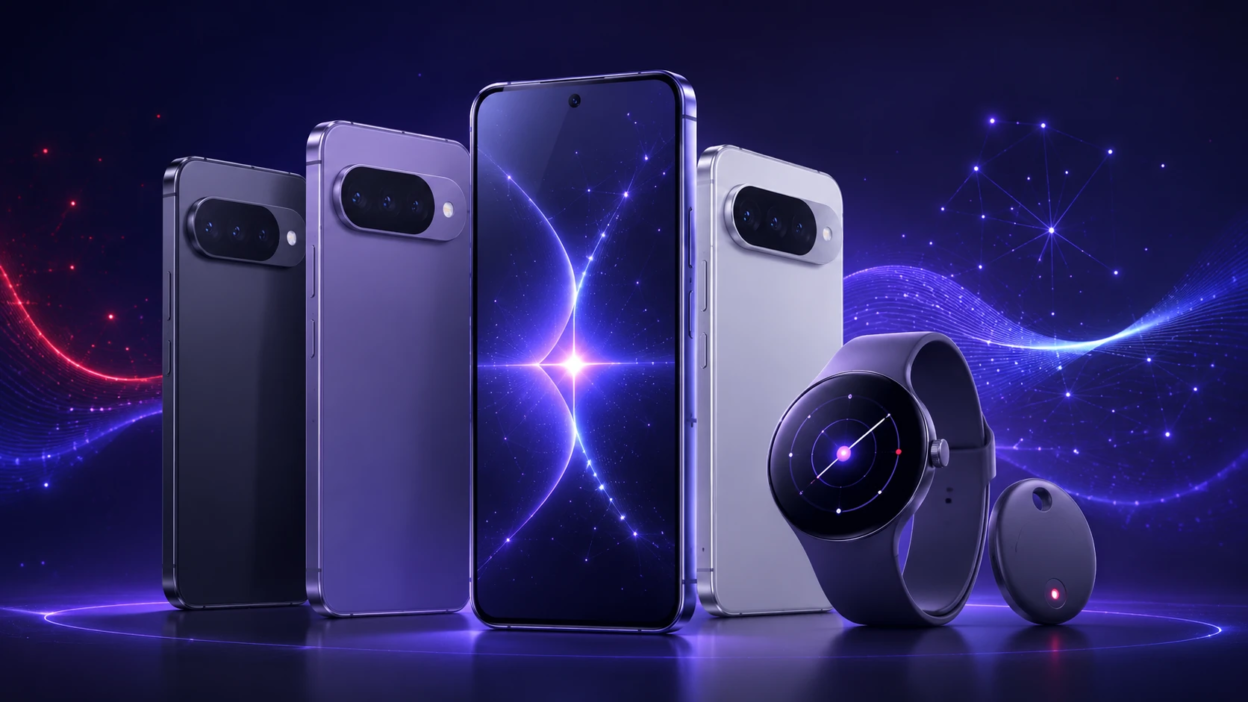
Google has introduced its latest Pixel hardware lineup, including the Pixel 11 series, Pixel Watch 5 and the company’s first Pixel Tag. The new devices put Gemini AI at the center of the experience, with Google aiming to make its phones and wearables more helpful without requiring users to manually open apps for every task.
The Pixel 11 family includes the Pixel 11, Pixel 11 Pro, Pixel 11 Pro XL and Pixel 11 Pro Fold. All four devices are designed around Google’s Gemini Intelligence system, while the new Tensor G6 chip powers the latest Gemini Nano model directly on the phones.
One of the biggest changes is how Gemini can provide help based on what a user is already doing. The AI can work across more apps, suggest useful actions and assist with multi-step tasks. For example, a Pixel phone may show travel information when a user is discussing an upcoming trip, suggest saving an event to Calendar or help with a restaurant reservation during a conversation.
Google is also adding Rambler, a Gemini-powered voice typing feature that turns natural speech into cleaner text. Users can speak normally, including pauses and filler words, while the phone organizes the important parts into a clearer message.
Camera upgrades are another major part of the Pixel 11 launch. The standard Pixel 11 gets a larger 48-megapixel main camera sensor and supports up to 30x Super Zoom. The Pixel 11 Pro and Pro XL receive upgraded camera hardware as well, including a redesigned telephoto camera and Pro Zoom reaching up to 120x.
Google has also introduced AI-supported photography tools such as Magic Capture and Camera Looks. Magic Capture is designed to make it easier to get the right moment when people or objects are moving, while Camera Looks lets users give photos a more personalized visual style.
The Pixel 11 Pro Fold also receives a major update. The new foldable is thinner and lighter than the previous generation and uses a redesigned hinge for better durability. It comes with the Tensor G6 chip, 16GB of RAM, improved multitasking tools and a new 48-megapixel main camera.
Alongside the phones, Google announced the Pixel Watch 5 with deeper Gemini integration. The smartwatch can provide proactive information and assistance while also expanding its health and fitness features. Google says the watch offers its most accurate GPS route tracking yet and includes personalized strength coaching.
The Pixel Watch 5 also introduces new Health Guardian features. These include wellness trends related to blood pressure, insulin resistance and sleep breathing quality. A breathing emergency detection feature is designed to recognize possible breathing emergencies and help contact emergency services when needed. Availability of some health features will depend on the country and region.
Google’s new Pixel Tag marks the company’s first entry into its own finder-tag hardware. The small tracker connects to Google’s Find Hub network and can be attached to items such as keys, wallets or luggage.
Pixel Tag includes a built-in speaker, IP67 water and dust resistance and a replaceable battery rated for up to one year. Users can also share a Pixel Tag with up to 10 people, which could be useful for tracking shared items. It will cost $29 for one tag or $99 for a four-pack.
The Pixel 11 starts at $899, while the Pixel 11 Pro starts at $1,099 and the Pixel 11 Pro XL at $1,299. Pre-orders opened on August 12, with the phones reaching stores on August 20.
Pixel Watch 5 is also available for pre-order, starting at $399 for the 41mm model and $429 for the 45mm version, with general availability beginning August 20. Pixel Tag will arrive later, on November 11.
With this launch, Google is making it clear that Pixel hardware is becoming more closely connected to Gemini AI. Instead of limiting AI to a chatbot or separate app, the company is increasingly building it into everyday tasks across phones, watches and other devices.