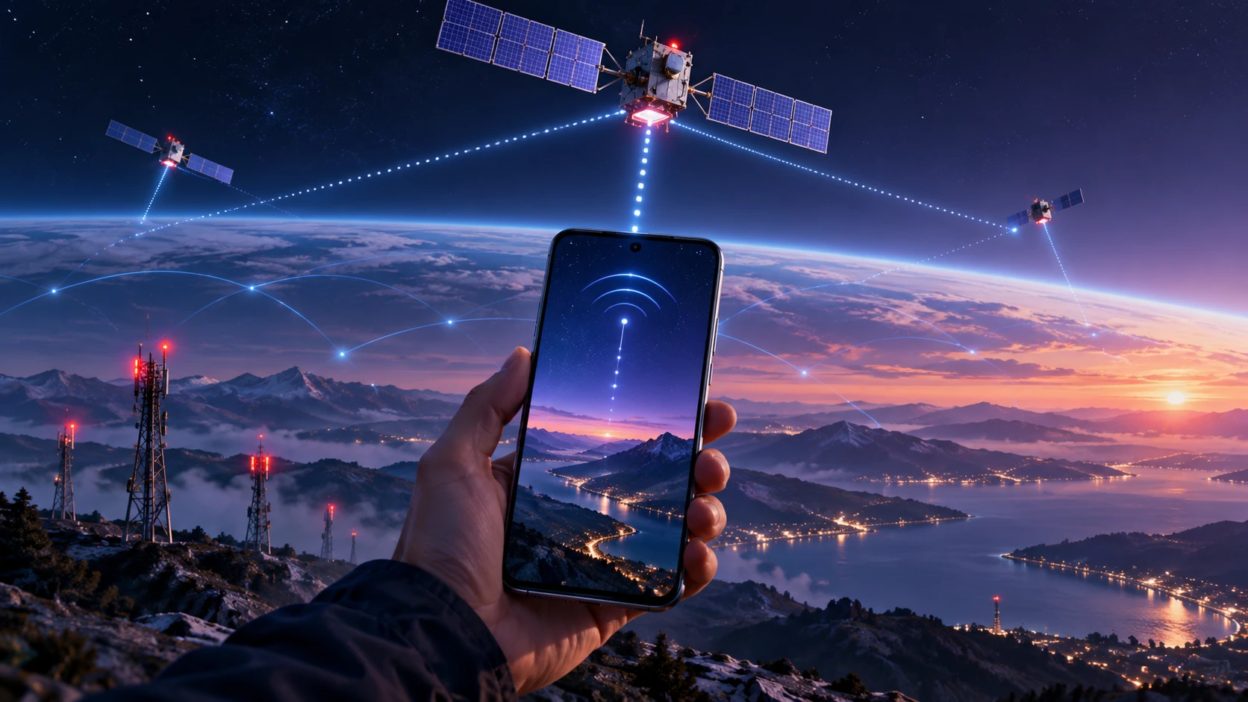
Satellite direct-to-phone technology allows compatible smartphones to communicate through satellites when conventional cellular coverage is unavailable. In some systems, satellites work with mobile carriers to extend existing cellular networks into remote areas, while other services use dedicated satellite capabilities built into supported phones. These connections can enable emergency messaging, location sharing, and other limited communications without relying on a nearby cell tower.
Unlike conventional satellite broadband, direct-to-phone connectivity is designed for handheld devices with limited antenna size and transmission power. Available features depend on the smartphone, satellite network, mobile operator, and country, so satellite access does not automatically mean unrestricted calls or internet connectivity.
What Satellite Direct to Phone Means?
Satellite direct-to-phone, also called direct-to-device (D2D) connectivity, enables supported mobile phones to communicate with satellites without an external dish or dedicated satellite handset. Some carrier-integrated services are designed to work with ordinary smartphones using compatible cellular frequency bands, while other satellite messaging systems require specific hardware and software capabilities.
The primary purpose is to extend communication into areas where terrestrial mobile networks cannot provide reliable coverage. Depending on the service, users may be able to send text messages, share their location, contact emergency responders, or access limited mobile data.
Most early deployments focus on messaging and emergency services because those require relatively little bandwidth and tolerate higher latency. Over time, the same approach can expand into low-rate data and limited voice in specific conditions.
How Regular Smartphones Talk to Satellites?
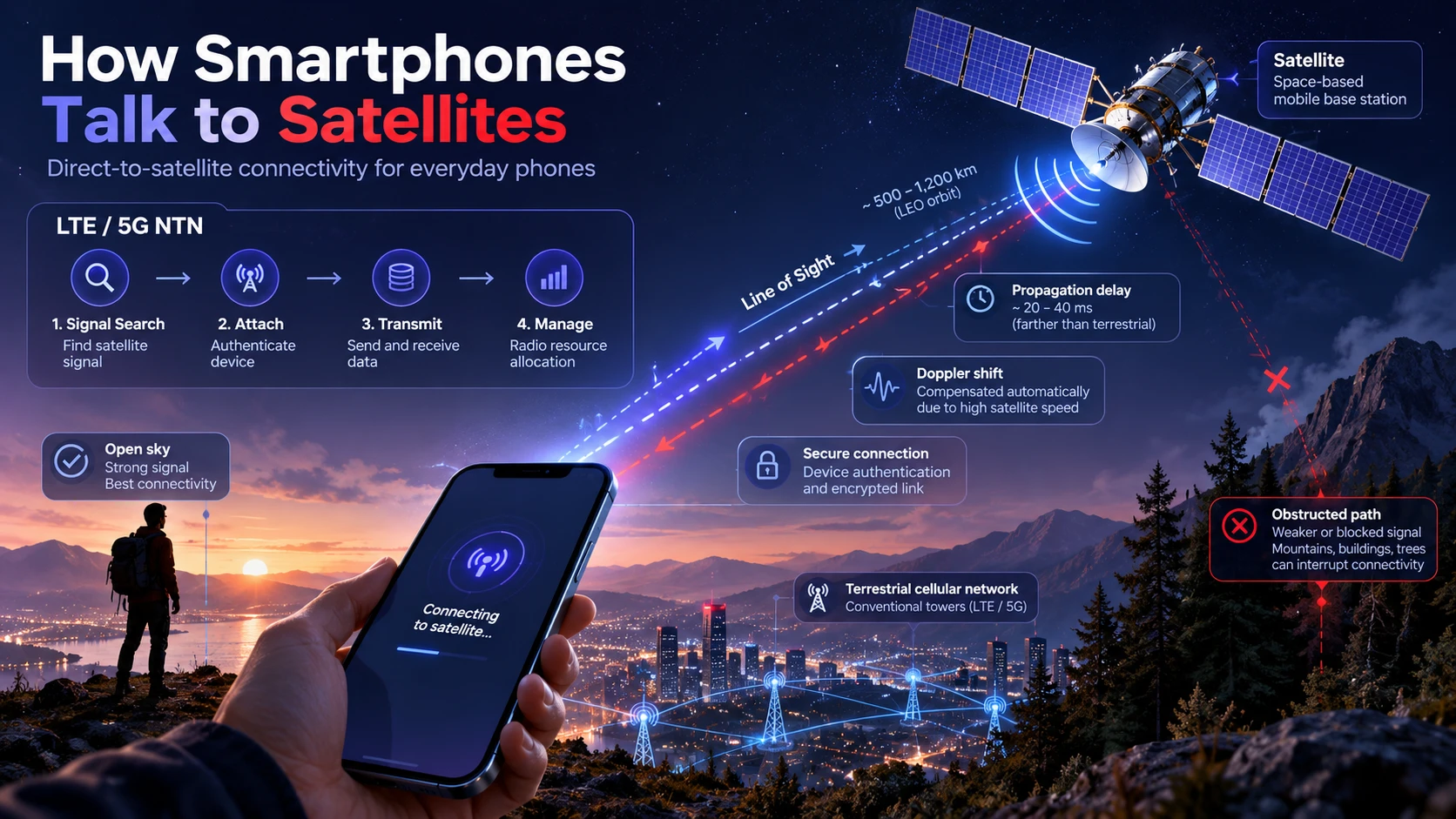
Modern phones already include powerful radios, sensitive receivers, and adaptive antennas designed for licensed cellular bands. Direct-to-phone systems build on these capabilities by using carefully planned spectrum and satellite payload designs so the phone can detect and respond to a satellite signal.
The satellite functions as a base station in space, while the phone behaves like it would on a terrestrial network. The difference is distance, motion, and link budget, which require tighter engineering and more conservative service expectations.
Using Cellular Bands and Network Signaling
Satellite direct-to-phone systems can use different radio and network architectures. Some services adapt existing LTE-based cellular technology and mobile operator spectrum so compatible smartphones can communicate with satellites. Other approaches use non-terrestrial network (NTN) capabilities developed through 3GPP standards, including support for satellite communications in the 5G ecosystem.
These approaches address challenges such as satellite movement, propagation delay, frequency shifts, device authentication, and radio resource management. The exact connection process depends on the satellite operator, supported frequencies, handset capabilities, and network configuration.
In practical terms, the phone searches for a compatible signal, attaches, and then transmits with power and timing settings that fit the satellite link. The network limits what the device can do based on coverage, interference, and available capacity.
For a deeper technical explanation, 3GPP’s overview of non-terrestrial networks describes how satellite communications are incorporated into cellular standards, including the adaptations needed for long propagation distances, satellite movement, and network operation.
Why Line of Sight Matters?
Satellite links need a clearer view of the sky than tower-based links because the signal travels much farther and has fewer opportunities to reflect around obstacles. Dense tree canopy, steep valleys, and heavy building materials can block the path.
This is why many implementations guide users to step into an open area and hold the phone steady. Even small improvements in sky visibility can decide whether a message sends quickly or needs several attempts.
The Role of Low Earth Orbit Satellites
Low Earth orbit satellites are popular for direct-to-phone because they are much closer than geostationary satellites. Shorter distance reduces path loss and improves the chance a standard handset radio can close the link.
Low Earth orbit satellites move rapidly relative to users on the ground, making satellite tracking, signal timing, and handovers important parts of network operation. In smaller constellations, connectivity may be intermittent because a suitable satellite is not always visible. Larger constellations can provide more continuous coverage by transferring connections between satellites as they move across the sky.
Actual service availability depends on constellation size, satellite capacity, geographic location, ground infrastructure, spectrum authorization, and the user’s view of the sky.
Direct to Phone Compared With Traditional Satellite Phones
Classic satellite phones use dedicated hardware, specialized antennas, and satellite-specific protocols tuned for long-range links. They often deliver more predictable connectivity in remote regions but require extra devices, plans, and training.
Direct-to-phone prioritizes convenience and reach by leveraging the device already in your pocket. The tradeoff is that performance is constrained by the phone’s small antenna, limited transmit power, and the need to coexist with terrestrial cellular networks.
Satellite direct-to-phone should also be distinguished from satellite broadband services that rely on dedicated terminals or dishes. Our earlier review of Starlink satellite internet speeds and performance explains the broadband model and its performance considerations. Those broadband speed figures should not be treated as the expected performance of satellite direct-to-phone services.
| Factor | Satellite Direct-to-Phone | Traditional Satellite Phone |
|---|---|---|
| Device Requirements | Compatible consumer smartphone with supported service | Dedicated satellite handset and subscription |
| Network Technology | Cellular-compatible or device-specific satellite connectivity | Satellite networks designed for dedicated handsets |
| Primary Use | Messaging, emergency communication, location sharing, and supported data services | Voice calls, messaging, and remote communication |
| Coverage Requirements | Satellite visibility, compatible network, and regional authorization | Satellite coverage, active subscription, and clear sky access |
| Connection Reliability | Varies by constellation, device, environment, and network capacity | Varies by satellite system, antenna, and surrounding obstacles |
| Data Capabilities | Messaging and service-dependent mobile data | Voice and data capabilities vary by handset and network |
| Main Limitation | Device compatibility, coverage, capacity, and service availability | Additional equipment, subscription costs, and network coverage |
What You Can and Cannot Do Beyond Cell Towers?
Satellite direct-to-phone services may support different communication methods depending on the provider and network architecture. Some systems deliver messages during available satellite contact periods, while others support more continuous messaging when sufficient coverage and network capacity are available. Emergency communication, location sharing, and limited data services may also be supported.
However, these features should not be confused with unrestricted mobile broadband. Message delivery times, available applications, data speeds, and emergency capabilities vary between providers, devices, and regions.
It is helpful to think of it as a resilience layer that appears when normal coverage disappears. That framing keeps expectations aligned with physics, spectrum rules, and real-world capacity.
- Text Messaging: Short messages can be transmitted with minimal bandwidth and strong error correction.
- Location Sharing: GPS coordinates can be attached to help responders or contacts understand where you are.
- Emergency Services: Some deployments support SOS flows that prioritize delivery and guide the user through key prompts.
- Limited Data Bursts: Small packets for status updates may be possible depending on network policy and load.
Even when these features exist, performance depends on sky view, satellite pass timing, and congestion in the footprint. Patience and positioning can make a noticeable difference.
Why Coverage and Speed are Limited?
The main constraint is link budget, which is the balance of transmit power, antenna gain, distance, and noise. A smartphone is power-limited and has a compact antenna, so the network must use robust coding and conservative modulation.
Capacity is another limit because each satellite beam can serve only a certain number of devices at once. If many users attempt to connect in the same area, the service may throttle traffic or focus on emergency use.
End-to-end performance also depends on how traffic moves between access networks, gateways, and core infrastructure. To understand this wider networking process, see our explanation of how backhaul communication networks work. Satellite access and satellite backhaul serve different purposes, but both illustrate why network transport capacity and routing can affect connectivity.
Latency and Timing Effects
Satellite links add delay due to distance and routing through gateways, even in LEO. Some tasks tolerate this well, while real-time apps feel sluggish or may not work at all.
Movement also matters because LEO satellites have high relative speed. Doppler shift must be corrected so the phone and satellite stay aligned, which adds complexity and narrows the range of workable modes.
Interference and Spectrum Coordination
Direct-to-phone must coexist with terrestrial networks that use the same or adjacent spectrum. That requires careful power control, beam shaping, and geographic coordination to avoid harming tower-based service.
The GSMA’s satellite direct-to-device spectrum guidance explains the importance of spectrum planning, licensing arrangements, and coordination between satellite operators and terrestrial mobile networks. These factors influence how direct-to-phone services can be introduced without causing harmful interference.
Purpose
Regulatory approvals and operator agreements shape what is available in each country and on each carrier. Availability can change by region even when the same smartphone model is used.
For example, the United States introduced a regulatory framework for satellite-to-phone coverage through the Federal Communications Commission’s Supplemental Coverage from Space regulations. The framework establishes conditions for satellite and terrestrial mobile network cooperation while addressing spectrum authorization and interference protection.
What Your Phone Needs to Support it?
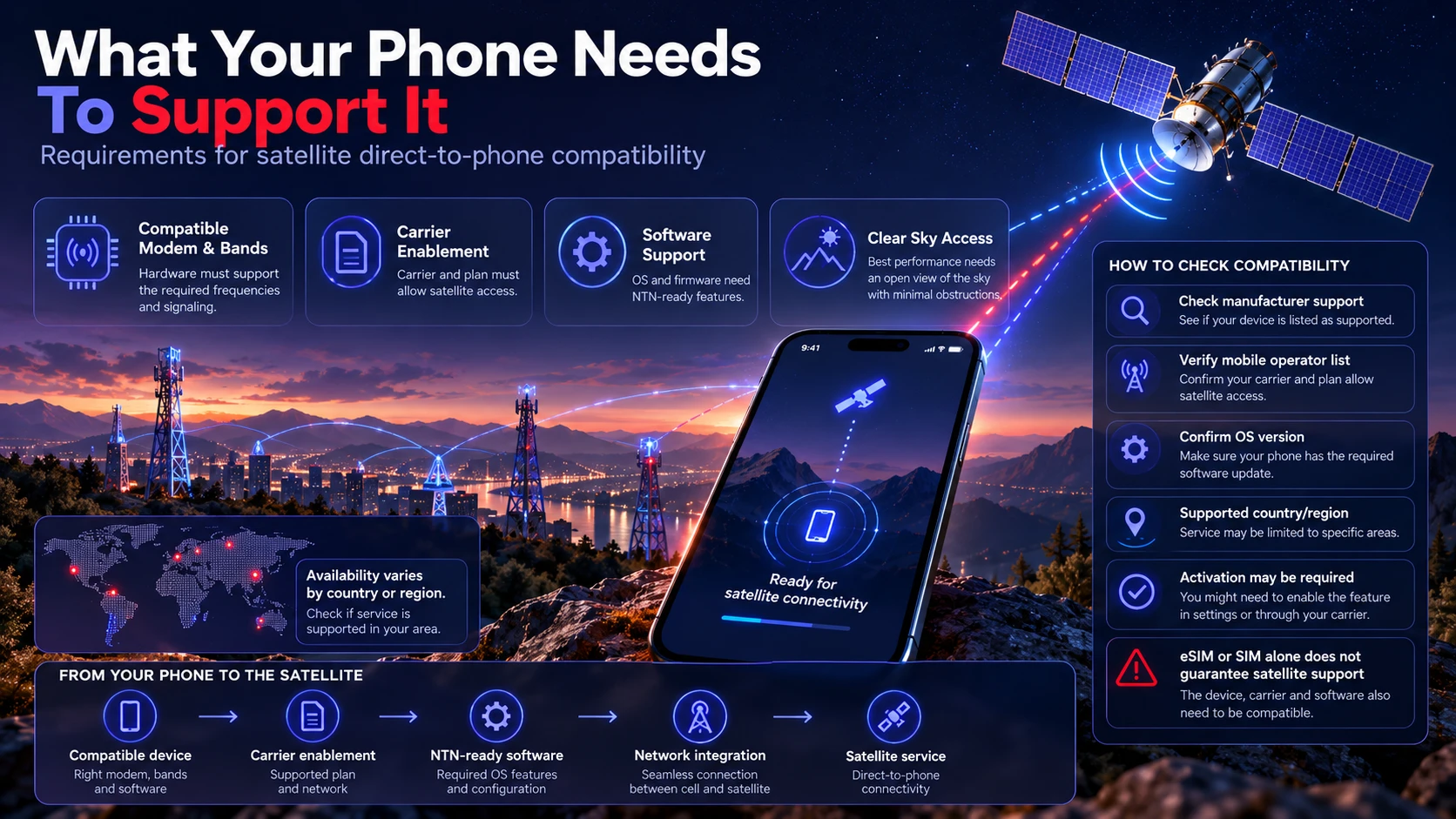
Satellite direct-to-phone compatibility depends on the specific service, smartphone hardware, supported frequency bands, software configuration, and mobile operator. Some carrier-integrated systems are designed to work with compatible existing smartphones, while other satellite services require dedicated modem capabilities or specially supported devices.
A software update may enable a feature when the necessary hardware and network support already exist, but software alone cannot add missing radio capabilities. Users should verify support through their smartphone manufacturer and mobile provider before relying on satellite connectivity in areas without cellular coverage.
Even when the hardware supports it, the carrier must enable the feature and authenticate the device. The user may also need to keep the operating system and carrier settings current to receive network profiles and emergency workflows.
Mobile subscription management is another part of device connectivity. Readers unfamiliar with SIM technology can explore our guide to eSIM and physical SIM differences to understand how mobile devices store subscriber identities and connect to carrier networks. However, using an eSIM instead of a physical SIM does not automatically provide satellite support.
- Compatible Modem and Bands: The phone must support the frequencies and signaling used by the satellite-enabled network.
- Carrier Enablement: The subscription and SIM or eSIM profile must be allowed to attach to the service.
- Software Support: Firmware and OS components must include the necessary non-terrestrial network features.
- Clear Sky Access: Practical usability improves when the device can maintain a stable view of the sky.
To check satellite connectivity support, start with the smartphone manufacturer’s official compatibility information and your mobile operator’s supported-device list. Confirm whether the feature requires a particular operating system version, active mobile plan, supported frequency bands, or additional activation.
Next, verify whether the service is available in your country and intended travel area. A phone may support satellite communication technically while the service remains unavailable because of network coverage, subscription restrictions, or regulatory requirements.
Security and Privacy Considerations
Direct-to-phone systems typically inherit many of the security properties of cellular networks, including identity management and encryption at different layers. The exact protections vary by implementation and service type.
Users should still treat satellite connectivity as a network path rather than a privacy guarantee. Metadata such as approximate location, attachment timing, and routing points can exist, and emergency systems may share details with responders.
How to Improve Reliability When You Need it?
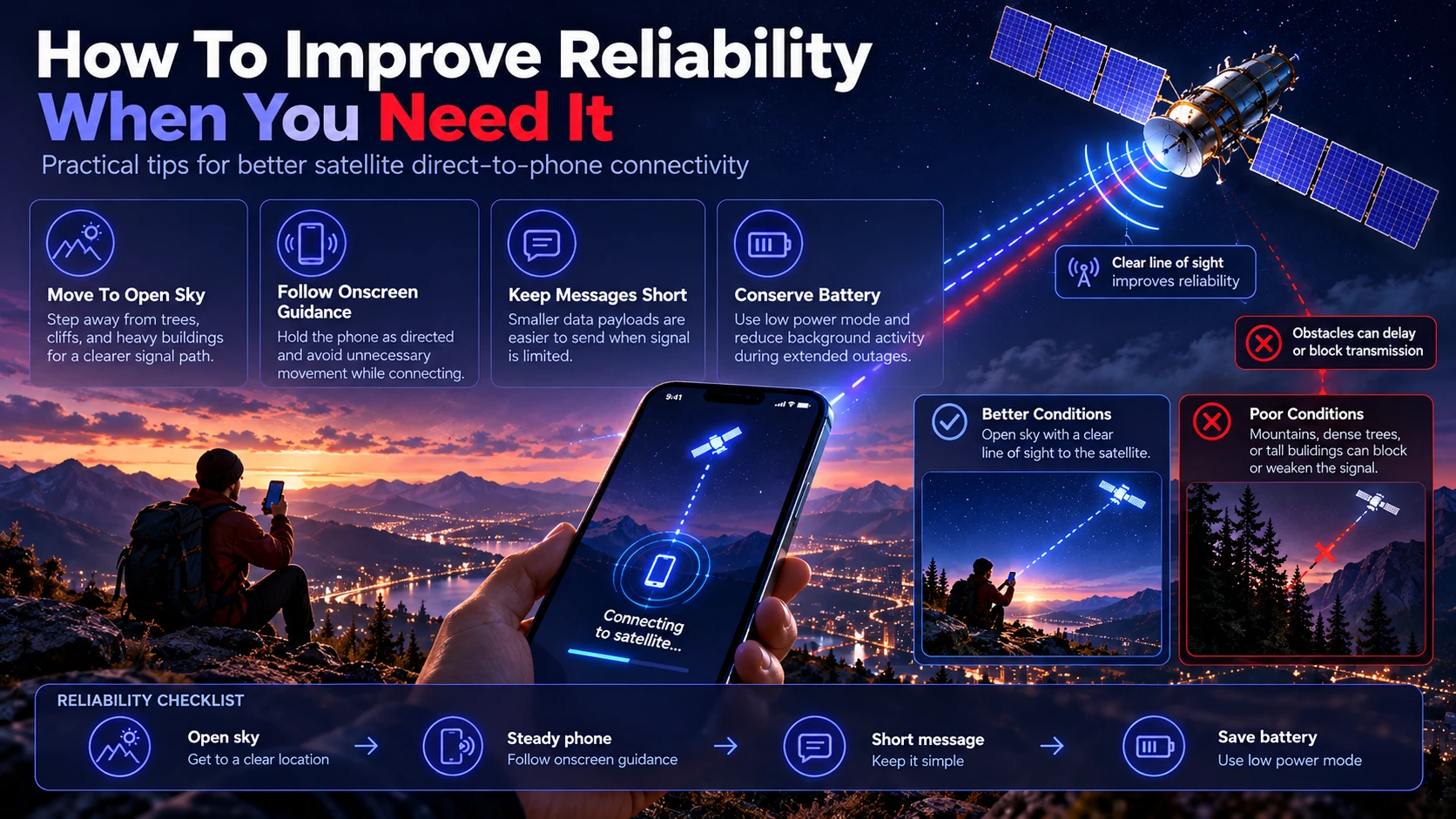
Small behavior changes can increase successful sends when towers are unavailable. Because the system depends on sky visibility and short contact windows, reducing obstacles and keeping the phone steady are practical steps.
- Move to Open Sky: Step away from tall walls, heavy canopy, and narrow ravines when possible.
- Follow the Phone’s Satellite Connection Instructions: Keep the device positioned as directed by its satellite connection interface. Some services provide onscreen guidance for alignment or positioning, while others manage the connection automatically. Avoid unnecessary movement when the device is establishing a weak connection.
- Keep Messages Short: Smaller payloads finish sooner and are easier to deliver under weak signal conditions.
- Conserve Battery: Low power mode and reduced background activity preserve energy during extended outages.
These adjustments do not change the underlying physics, but they improve the odds that the network can close the connection and deliver the data.
For an example of device-specific instructions, Apple’s official satellite connection guide explains how supported iPhones establish satellite connections, why a clear view of the sky matters, and how users can practice with the satellite connection demo. Other smartphone manufacturers and mobile operators may provide different instructions, so users should follow the guidance for their particular device and service.
What Comes Next for Direct to Phone?
Satellite direct-to-phone services are evolving beyond emergency messaging toward broader communication capabilities. Some providers are introducing or developing expanded text messaging, supported applications, mobile data, and voice services, although these capabilities differ significantly across networks and regions.
Future improvements in satellite constellations, antenna technology, spectrum efficiency, and ground infrastructure could increase coverage and capacity. However, widespread adoption will also depend on regulatory approvals, mobile operator partnerships, compatible devices, and the economics of providing service.
Standards work in non-terrestrial networking also helps by aligning device and network behavior across vendors. Over time, the experience should feel less like a special mode and more like an automatic fallback.
Satellite integration is also part of the broader development of mobile networks. Our guide to 5G-Advanced and its evolving network capabilities explains how newer cellular standards improve network efficiency, mobility, and support for emerging services, including non-terrestrial networking.
Purpose
Conclusion
Satellite direct-to-phone extends basic connectivity beyond cell towers by turning satellites into space-based cellular nodes that regular smartphones can reach under the right conditions. It is best understood as a safety and continuity feature for messaging, location sharing, and emergency contact when terrestrial coverage fails.
Expect limitations in speed, latency, and consistency, especially in obstructed environments. With compatible devices, enabled carrier support, and a clear view of the sky, it can be a practical layer of resilience rather than a replacement for traditional mobile networks.
Frequently Asked Questions
Does Satellite Direct to Phone Work Without Any Signal Bars?
It can, because it does not rely on nearby cell towers when the feature is available and enabled on your device and carrier plan. The phone still needs to detect a compatible satellite signal, which often requires an open view of the sky.
Will Direct to Phone Drain Battery Faster Than Normal?
It can increase battery use during acquisition and transmission because the phone may transmit at higher power and retry more often. Battery impact varies by device, software, and how long the phone searches for service.
Can You Make Regular Voice Calls Over Satellite Direct to Phone?
Some networks are working toward voice, but early services commonly focus on messaging and emergency flows. Voice needs more consistent link quality and capacity, so availability depends on the specific carrier and satellite partner.
Does Satellite Direct-to-Phone Work in Every Country?
No. Satellite direct-to-phone availability depends on the service provider, satellite coverage, national regulations, supported devices, and mobile operator agreements. A smartphone that supports satellite communication in one country may not have access to the same features in another.
Before traveling to a remote location, check the official coverage information provided by your phone manufacturer and mobile operator. Confirm which functions are available, including emergency messaging, regular texting, location sharing, and mobile data.