
TechTrendery.com and TechTrendery.org share almost the same name, but their publicly available About pages describe different editorial focuses. TechTrendery.com emphasizes biographies and stories about influential people, while TechTrendery.org describes itself as a technology-first publication launched in 2026. A shared owner or official relationship could not be verified from the public information reviewed. This guide compares what the websites disclose, explains which ownership clues matter, and shows readers how to check a domain’s identity before sharing personal information.
Why Similar Domains Cause Confusion?
People often assume that websites with the same name and different endings, such as .com and .org, are official versions of one brand. However, domain names under these endings can be registered independently, so similar names do not establish shared ownership.
Some organizations intentionally run multiple domains for branding, regional access, or security. Others may have a second domain due to past ownership, a rebrand, or an older project that was never retired.
What A Connection Really Means?
A real connection usually means shared ownership, shared operational control, or a verified partnership. A loose similarity in name does not prove anything.
Look for consistency across legal identity, site policies, and technical setup. A single matching element can be coincidence, but several independent matches can point to a relationship. Stronger evidence includes consistent legal disclosures, independently verifiable ownership information, or an official statement confirming the relationship.
What We Could Verify About TechTrendery.com and TechTrendery.org?

TechTrendery.com’s About Us page emphasizes biographies and stories about influential people. Its Contact Us and Privacy Policy pages describe ways to contact the site and its data practices, but the pages reviewed do not clearly name a legal publishing company.
TechTrendery.org’s About Us page presents it as a technology-first publication launched in 2026, with coverage including AI, social media, news, biographies, and digital trends. The page describes an editorial team, but it does not establish shared ownership with TechTrendery.com.
An article on TechTrendery.org titled “TechTrendery.Com USA” identifies TechTrendery.org as the publication being discussed. That wording may cause confusion, but a reference to the other domain’s name does not, by itself, prove that the sites have the same owner.
The evidence reviewed shows different public descriptions, not verified different owners. No official statement confirming shared ownership or a partnership was found in the pages checked. For now, readers should treat the relationship as unconfirmed.
Ownership and Legal Signals to Check
Start by looking for information about the publisher responsible for each website. An About page, legal policy, or contact page can provide useful evidence, but some legitimate websites publish limited details. Missing information should therefore be treated as a transparency gap, not automatic proof of fraud.
- About Page and Publisher Name: Check whether both sites list the same company, team, or editor names, including spelling and location. Matching details can be useful, but a shared brand name alone does not confirm common ownership.
- Contact Information: Compare email domains, phone numbers, and mailing addresses. Consistent contact information may suggest a relationship, while different details require further investigation rather than an immediate conclusion.
- Privacy Policy and Terms: Review whether the legal entity name and jurisdiction match. Policy text can be templated, so focus on identifiable organizations and specific legal details rather than generic wording.
- Copyright and Trademark Notices: Look for consistent ownership claims in footers and site credits. Remember that a copyright notice or brand name is not independent proof of domain ownership.
Readers can also compare publicly available domain registration details using ICANN’s Registration Data Lookup Tool. Enter TechTrendery.com and TechTrendery.org separately to review available information such as registration dates, registrars, and nameservers. However, registrant information may be hidden or redacted for privacy, so registration records do not always reveal the person or company controlling a website.
If one domain provides only a generic contact form or limited ownership disclosures, you may be unable to verify who runs it. Treat that as an information gap and avoid sharing sensitive data until the publisher’s identity is sufficiently clear. Transparent contact and legal information can make a website easier to evaluate, but the absence of such information does not automatically establish fraudulent activity.
Technical Clues That Often Reveal Relationships
Technical details can help, but they should not be treated as definitive on their own. Hosting providers and tools overlap widely across unrelated sites. To understand what an encrypted connection does and does not prove, read our guide explaining why your browser says “Not Secure”.
- HTTPS and Certificate Details: A website’s TLS certificate can help identify the domain covered by an encrypted connection. Some organization-validated certificates also contain verified organizational details, but ordinary domain-validated certificates do not establish who legally owns the website. HTTPS alone cannot prove that two sites share an operator.
- DNS and Nameservers: Matching nameservers may suggest the same hosting or DNS setup, but many unrelated websites use common managed DNS services. Shared infrastructure should be treated as supporting information rather than ownership proof.
- Redirect Behavior: If one domain redirects to another, the redirect may reflect a website move, partnership, or configuration decision. However, the operator of one domain can redirect visitors to a website it does not own. A redirect is therefore useful evidence of a technical relationship, but it does not independently establish common ownership.
- Site Technology Fingerprints: Similar content management systems, themes, and plugins can be copied or used independently. Treat matching website technology as weak evidence unless it is supported by stronger ownership information.
When results are unclear, prioritize what the sites claim legally and whether those claims are consistent across pages. Then use technical indicators as supporting context.
For TechTrendery.com and TechTrendery.org specifically, technical similarities would need to be assessed alongside their published ownership information. Without reliable supporting evidence, matching hosting technology or certificate details would not be enough to confirm a shared publisher.
Content and Branding Signals That Matter
Visual similarity can be misleading, since logos and layouts can be copied. Focus on stable editorial signals that are harder to fake consistently.
- Author Pages and Bios: Check whether writers, bios, and profile links match across both domains. Named contributors can help identify editorial relationships, but authors may also work with multiple independent publishers.
- Editorial Standards: Look for sourcing habits, update notes, correction policies, and consistent editorial practices. Similar standards can suggest a related publishing approach, but they do not establish ownership.
- Brand Assets: Compare logo files, style guides, and brand language. Exact matches can indicate shared assets, but they can also result from copying or commonly available templates.
- Publishing Cadence: Similar posting patterns and synchronized updates can suggest shared planning. However, publication schedules alone are weak evidence because unrelated websites can follow similar content strategies.
Identical or very similar articles across websites can result from licensed syndication, shared editorial operations, or unauthorized copying. Check for original publication dates, source attribution, and syndication disclosures before treating duplicated content as evidence of shared ownership or wrongdoing.
The different editorial descriptions published by TechTrendery.com and TechTrendery.org provide a useful starting point for comparison. However, readers should evaluate actual articles, author information, and supporting sources before assuming that the two websites share an editorial team or operate independently.
Security and Trust Checks Before You Engage
If you plan to sign up, comment, or provide an email address, review each domain as a separate destination until its identity is verified. Similar website names can be especially confusing when links appear in emails, messages, or QR codes. Our guide to QR code phishing explains how a seemingly familiar link can lead to a deceptive website.
- Account and Signup Pages: Confirm the complete website address before entering credentials. Small differences in domain names can lead to websites operated by different organizations.
- Cookie and Tracking Notices: Review what data is collected and whether consent controls are functional and clear. A privacy policy should explain relevant data practices rather than relying only on broad assurances.
- Ads and Popups: Excessive popups, forced notifications, and aggressive redirects can be quality and safety warning signs. Be especially cautious when unfamiliar websites request browser permissions or unexpected downloads.
- Payment Requests: If either site requests payments, verify the merchant identity, payment process, and refund terms before proceeding. Do not assume that similarly named websites share the same payment operator.
If any part of the experience feels inconsistent with the site’s stated identity, pause and verify before continuing. Trust should be earned through clarity and consistency.
Before visiting an unfamiliar login or payment page, you can check the domain using Google’s Safe Browsing Site Status tool. Check TechTrendery.com and TechTrendery.org separately to see whether Google currently reports known unsafe content. Remember that the absence of a warning does not prove a website is trustworthy or establish who owns it.
Quick Checklist for Verifying A Website Relationship
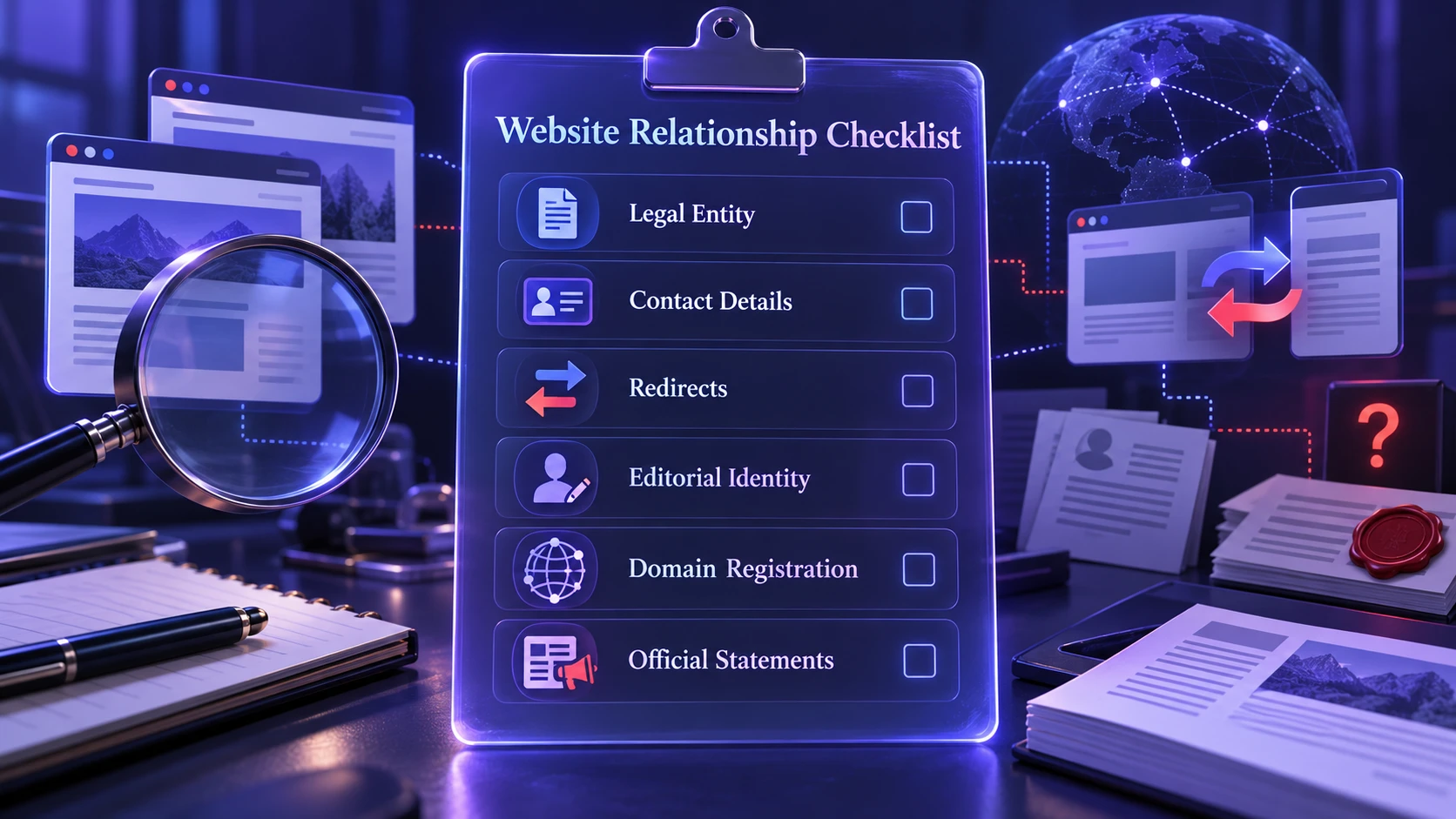
This table summarizes practical checks you can run to judge whether TechTrendery.com and TechTrendery.org are connected, and what different outcomes may imply.
| Check | What To Look For | What It May Mean |
|---|---|---|
| Legal Entity | Same identifiable company, address, and jurisdiction in published policies | May support shared ownership when independently verified |
| Contact Details | Consistent contact information and identifiable staff or publishing organizations | May indicate shared operations or a partnership, but requires confirmation |
| Redirects | One domain consistently forwards visitors to the other | Shows a configured forwarding relationship, not proof of common ownership |
| Editorial Identity | Matching authors, biographies, publishing standards, and editorial disclosures | May suggest editorial overlap without establishing legal ownership |
| Domain Registration | Available registrar details, registration dates, and registrant disclosures | Can provide supporting evidence, although ownership information may be redacted |
| Official Statements | A clear acknowledgment of the relationship from an identifiable publisher | Provides stronger evidence when the statement can be independently verified |
Use the table as a starting point, not a final verdict. The most reliable conclusion comes from multiple independent matches, especially verified legal identity and consistent editorial disclosure.
For these two TechTrendery domains, the published About pages show differences in editorial positioning, while the available evidence reviewed does not establish a confirmed ownership relationship. Readers should distinguish between observations that can be checked directly and conclusions that still require verification.
How to Decide If You Should Trust One or Both?
If you find clear, consistent identity signals on both domains, it can be reasonable to investigate whether they are connected. Even then, verify that both sites maintain appropriate security practices, transparent policies, and reliable content standards. A relationship between publishers would not automatically establish that every article or service is trustworthy.
If ownership signals conflict or important disclosures are missing, manage the domains as separate destinations until their relationship is verified. This is a safety precaution, not a finding that they have different legal owners. When choosing which website to use, prioritize clear contact information, transparent editorial practices, relevant sourcing, and responsible handling of personal data.
It is also important to separate website legitimacy from content quality. A website may be operated by a genuine publisher while still containing outdated or inaccurate information. For important decisions involving cybersecurity, money, health, or personal data, confirm relevant claims using authoritative and current sources.
What to Do If You Suspect Confusing or Misleading Similarity?

If one domain appears to imitate another, focus on protecting your accounts without assuming malicious intent until evidence supports it. Do not reuse passwords or sign in through unexpected links. A password manager that checks the website address before filling credentials can help reduce phishing risk. For more guidance, see our comparison of password managers and browser password saving.
It also helps to bookmark the domain you trust and access it through the bookmark. That simple habit reduces the risk of landing on a lookalike site.
If you encounter a webpage that appears designed to impersonate another service and steal login details or personal information, avoid entering any data and consider reporting the suspicious page. Google’s guidance for reporting phishing websites explains how to submit a report. Similar domain names alone are not sufficient grounds to accuse a website of phishing.
If you have already entered a password on a website that you later discover was fraudulent, change that password through the legitimate service and review your account’s security settings. Use a unique password and enable appropriate multi-factor authentication where available. Also review recent account activity for unfamiliar sign-ins or changes.
Conclusion
The available public information does not confirm whether TechTrendery.com and TechTrendery.org share the same owner. Their About pages describe different editorial priorities, with TechTrendery.com emphasizing biographies and TechTrendery.org presenting itself as a technology-first publication. Those differences are useful context, but they do not establish separate legal ownership.
Until a verified ownership record or official statement clarifies the relationship, readers should treat the connection as unconfirmed. Check the exact domain before entering personal information, review the publisher’s disclosures, and rely on independently verifiable evidence when deciding which website to trust.
Frequently Asked Questions
Do TechTrendery.com and TechTrendery.org Have the Same Owner?
A common owner could not be verified from the public pages reviewed. TechTrendery.com and TechTrendery.org describe different editorial priorities, but those differences do not prove that the websites are separately owned. An official ownership disclosure or independently verifiable registration information would be needed for a stronger conclusion.
Can A .com and .org With the Same Name Be Owned By Different People?
Yes. Domain names under .com and .org can be registered independently, so similar names can belong to different people or organizations. Always verify available ownership information, publisher disclosures, and contact details before assuming a relationship.
Is A Redirect Proof That TechTrendery.com and TechTrendery.org Are Connected?
No. A redirect shows that one domain currently sends visitors to another destination, but it does not prove that the two websites share the same legal owner. Redirects can result from a website migration, partnership, or a decision made by the redirecting domain’s operator. Check official statements and ownership disclosures before drawing a conclusion.
What is the Safest Way to Use Sites With Similar Domain Names?
Open a known website address directly or use a saved bookmark, check the domain before entering login or payment details, and review the site’s published policies. For accounts that support them, passkeys can reduce credential-phishing risks because authentication is tied to the legitimate website. Our guide to passkeys versus passwords explains how this protection works. If a website’s identity remains unclear, avoid sharing sensitive information.
Does Having HTTPS Mean Both Websites Are Safe and Trustworthy?
No. HTTPS encrypts information exchanged between your browser and a website, but it does not verify the publisher’s honesty, content accuracy, or legal ownership. Both legitimate and malicious websites can use valid HTTPS certificates. Check the domain, publisher information, and available security warnings before trusting a website with sensitive information.