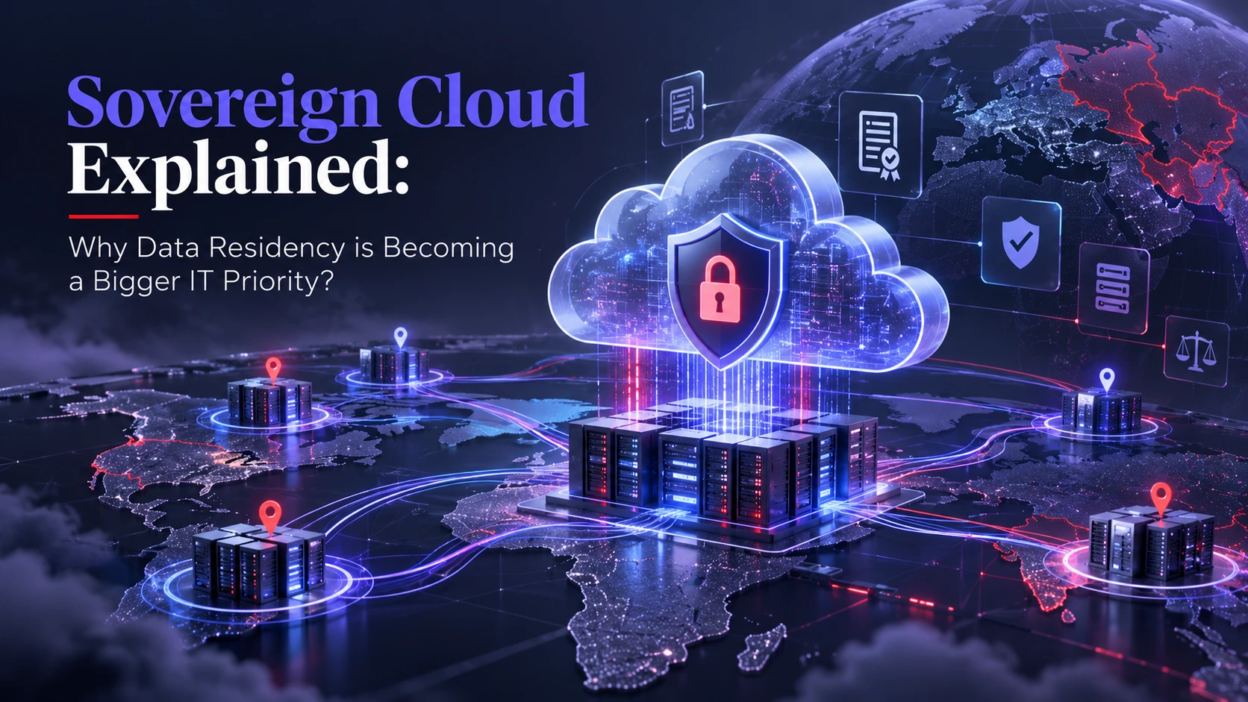
Sovereign cloud is becoming an important consideration for organizations that need greater control over sensitive data, cloud infrastructure, and regulatory compliance. As businesses expand their cloud operations across different countries, IT leaders must understand where information is stored and processed, who can access it, and which laws apply to their cloud providers.
Data residency is central to these decisions, but keeping information in a specific country does not automatically guarantee data sovereignty or legal compliance. Organizations must also examine encryption key management, administrative access, third-party dependencies, and the legal obligations of cloud service providers.
What Sovereign Cloud Means?
A sovereign cloud is a cloud environment designed to meet defined requirements for data location, operational control, security, and legal jurisdiction. Depending on the organization’s needs, these controls may involve keeping regulated workloads within approved geographic boundaries, limiting foreign administrative access, or maintaining stronger control over encryption keys and infrastructure operations.
Sovereign cloud is not simply another name for local cloud hosting. Although geographic data placement is important, organizations must also evaluate the provider’s legal obligations, subcontractors, support arrangements, access privileges, and data processing activities. The level of sovereignty achieved depends on how these controls are implemented and independently verified.
Data Residency and Data Sovereignty are Not the Same
Data residency focuses on the physical or geographic location where data is stored and processed. Data sovereignty is broader and covers which national laws govern the data, even if the infrastructure is local.
This difference matters because a workload can be resident in a country while still subject to foreign legal reach through corporate ownership or remote administrative access. Sovereign cloud aims to align both residency and sovereignty so compliance is defensible during audits and investigations.
For a broader explanation of how organizations handle sensitive information, our guide to data privacy covers the relationship between privacy, security, legal responsibilities, and data sovereignty.
International data protection requirements also depend on how information is disclosed and accessed. Under the EU GDPR, providing personal data to a separate organization in a third country can constitute an international transfer when the relevant legal conditions are met. The European Data Protection Board’s guidelines on international data transfers help organizations understand when the GDPR’s transfer rules apply, including situations involving remote access to personal information.
Why Data Residency is Becoming a Bigger IT Priority?
Data is now directly tied to national security, critical infrastructure, and consumer trust. As a result, IT leaders are being asked to reduce geopolitical exposure and tighten control over cross-border data flows.
Several forces are pushing data residency up the priority list, even for teams that already run mature security programs.
- Regulatory enforcement: Privacy and sector rules are being applied more actively, with stronger documentation and audit expectations.
- Cross-Border Data Transfer Requirements: Organizations processing personal data must assess whether international transfers require an approved legal mechanism or additional safeguards. For example, the European Commission’s rules on international data transfers describe mechanisms available under the GDPR, including adequacy decisions, standard contractual clauses, and binding corporate rules.
- Supply chain risk: Cloud dependencies extend into support, identity platforms, monitoring, and managed services where remote access can create sovereignty gaps.
- Customer and partner demands: Procurement and due diligence increasingly include questions on residency, key ownership, and operator nationality.
- Incident response realities: During a breach, proving data location and access history quickly is easier when governance and logs remain in one jurisdiction.
These drivers lead many organizations to treat residency as a design constraint, not a legal footnote.
Common Sovereign Cloud Models
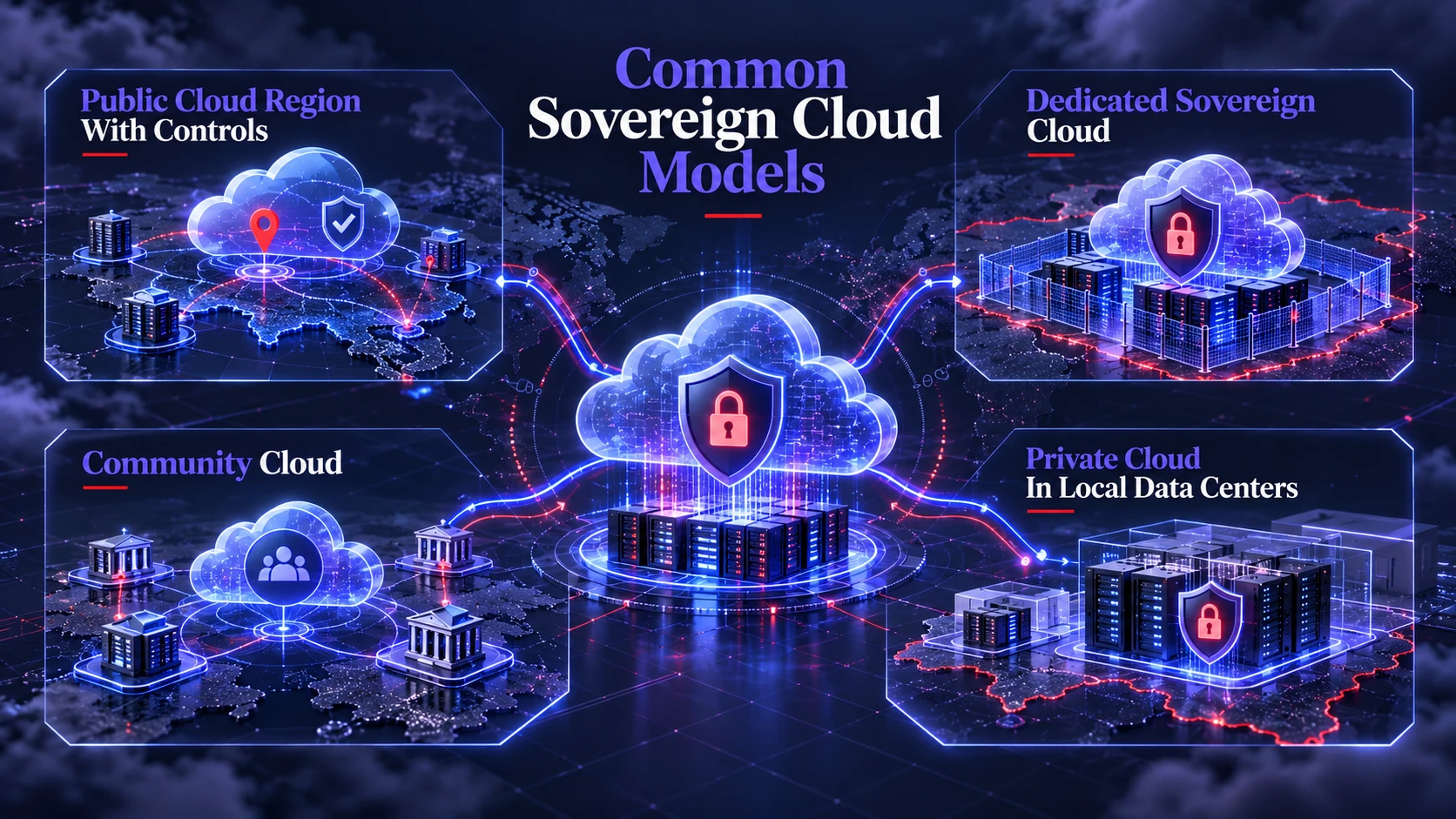
Sovereign cloud requirements can be addressed through several cloud deployment and operating models. The right option depends on legal obligations, the sensitivity of the workload, acceptable administrative access, technical capabilities, and the organization’s available resources.
- Public Cloud Region With Sovereignty Controls: Uses an approved geographic region with additional controls for data location, administrative access, encryption, and compliance reporting. Customers must verify which individual services and data flows remain within the required boundaries.
- Dedicated Sovereign Cloud Environment: Provides an environment designed around specific legal, operational, or jurisdictional requirements. The level of independence depends on its ownership structure, personnel, infrastructure, and provider access arrangements.
- Government or Industry Community Cloud: Supports organizations with similar regulatory or operational needs through shared infrastructure and defined security controls. Compliance still depends on the responsibilities of each participating organization.
- Private Cloud in Local Data Centers: Gives organizations more direct control over infrastructure and operational policies, but requires investment in security, staffing, maintenance, and disaster recovery. Local ownership or hosting alone does not eliminate legal and third-party risks.
Each model can meet residency goals, but sovereignty requirements often determine which is acceptable.
Sovereign cloud requirements may also influence whether an organization adopts private, hybrid, or multi-cloud infrastructure. Our comparison of hybrid cloud vs multi-cloud explains how these architectures differ and what organizations should consider when selecting an appropriate deployment approach.
Key Capabilities to Validate Before You Commit
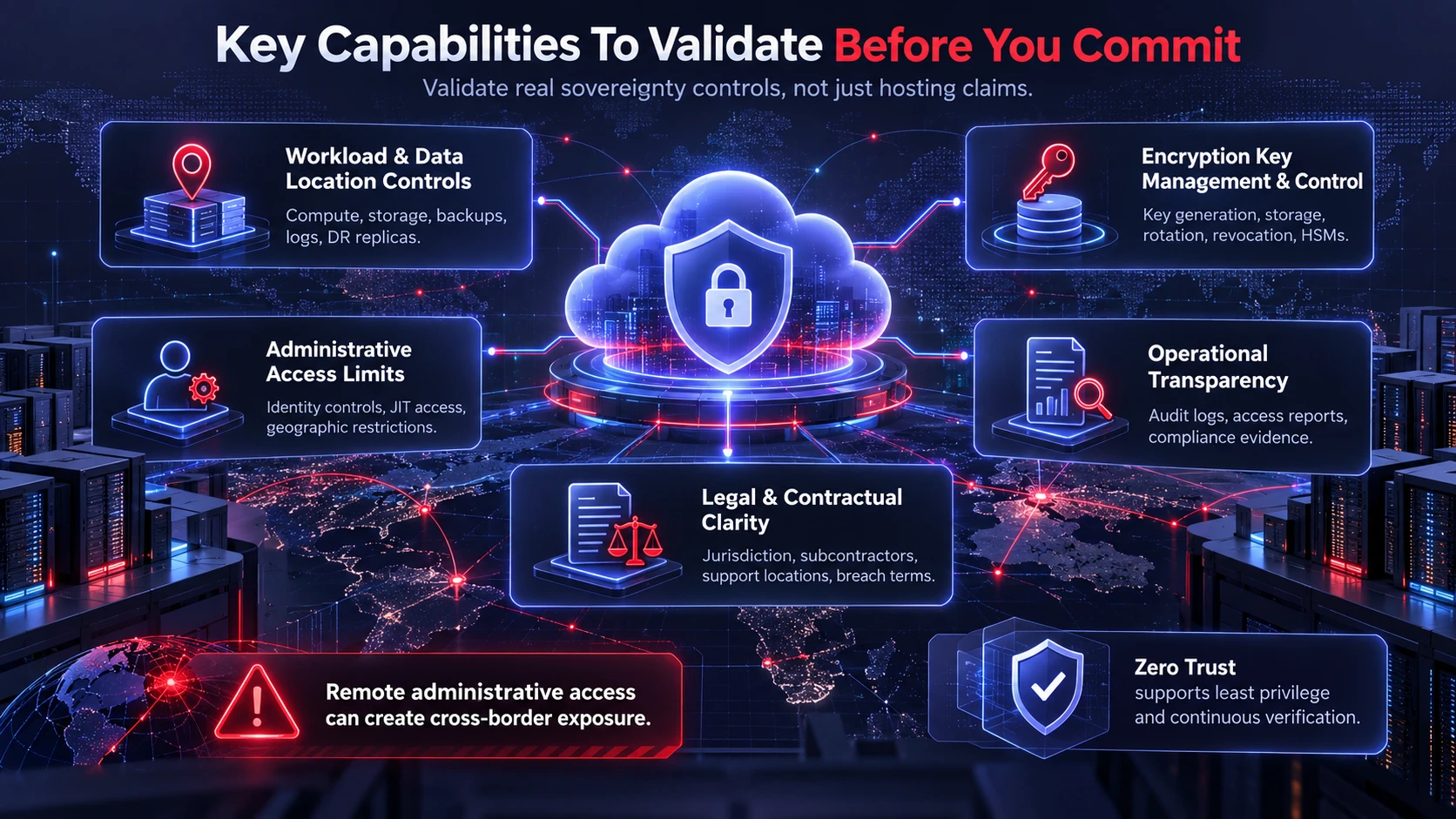
Marketing claims can blur the line between basic regional hosting and true sovereignty. Validation should focus on controls that stand up under legal scrutiny and operational stress.
- Workload and data location controls: Clear boundaries for compute, storage, backups, logs, and disaster recovery replicas.
- Encryption Key Management and Control: Verify who generates, stores, rotates, revokes, and can use encryption keys. Evaluate customer-managed keys, locally hosted hardware security modules, and external key management where required. Confirm whether the provider can access plaintext during processing and whether key operations create dependencies outside the approved jurisdiction.
- Administrative access limits: Strong identity controls, just-in-time access, and geographic restrictions on privileged operations.
- Operational transparency: Audit logs, access reports, and evidence packs that support compliance reviews.
- Legal and contractual clarity: Contract language that defines jurisdiction, subcontractors, support locations, and breach notification expectations.
Remote administrative access deserves particular attention because data can become accessible across borders without being physically relocated. For example, the UK Information Commissioner’s Office explains in its guidance on restricted international transfers that allowing a separate overseas organization to access personal information held on UK systems can qualify as a restricted transfer under UK GDPR rules. The precise requirements depend on the organizations involved and the applicable law.
No single model guarantees complete data sovereignty. Organizations should compare the actual controls, contractual commitments, recovery arrangements, and audit evidence available under each option.
Restricting privileged access is also a core cloud security requirement. Our guide to Zero Trust security explains how identity verification, least privilege, and continuous access controls can reduce the risk of unauthorized access across cloud environments.
Residency Considerations Across the Data Lifecycle
Residency decisions often fail when teams focus only on primary storage. Modern architectures create data copies through caching, observability, analytics, and backups.
The table below highlights where residency commonly breaks and what to confirm during design reviews.
| Lifecycle Area | Potential Sovereignty Risk | What Organizations Should Verify |
|---|---|---|
| Primary Data Storage | Sensitive data stored outside approved jurisdictions | Storage regions, replication settings, service-specific location controls |
| Backups and Snapshots | Backup copies replicated to unauthorized regions | Backup locations, retention policies, replication settings, restore procedures |
| Disaster Recovery | Failover moves regulated workloads across borders | Recovery regions, failover boundaries, recovery runbooks, testing results |
| Logging and Monitoring | Application logs or telemetry sent to external platforms | Log storage location, support access, retention settings, data minimization |
| Identity and Access | Privileged accounts or identity services operated internationally | Identity provider location, administrative access restrictions, access logs |
| Application Processing | Sensitive information processed by services outside approved regions | Compute location, API routing, temporary files, managed-service processing |
| Third-Party Integrations | Data shared with external SaaS, analytics, or AI services | Vendor locations, subprocessors, data-sharing terms, transfer mechanisms |
This lifecycle view helps prevent late-stage surprises during audits and go-live readiness checks.
Disaster recovery deserves separate planning because backup restoration and failover can introduce new data location risks. Our disaster recovery planning guide explains how organizations can prepare recovery procedures, test backups, and document responsibilities before outages occur.
Architecture Patterns That Support Sovereignty
Meeting residency goals is easier when sovereignty is designed into the platform layer. Patterns that reduce data sprawl and external access simplify compliance and cut operational risk.
- Data classification tied to placement: Tag data by sensitivity and enforce placement rules through policy and infrastructure templates.
- Regionalized microservices: Keep processing close to the data and avoid cross-border service calls for regulated domains.
- Local key management with separation of duties: Control key lifecycle locally and restrict who can approve key export or rotation.
- Minimized Cross-Border Dependencies: Review CI/CD pipelines, deployment credentials, observability platforms, support tools, and monitoring services for sensitive data exposure. Keep regulated data and related operational records within approved boundaries where required, and apply data minimization and access restrictions to services operating internationally.
These patterns also make it easier to demonstrate compliance evidence without manual workarounds.
For sensitive workloads that require additional protection during processing, confidential computing may provide another security layer. Our comparison of confidential computing vs cloud security explains how hardware-backed isolation can reduce exposure of data in use, while also clarifying why traditional cloud security controls remain necessary.
Operational Governance and Audit Readiness
Sovereign cloud success depends on ongoing governance, not only initial deployment. Changes in teams, vendors, and tooling can quietly erode sovereignty over time.
A practical governance baseline includes policy as code, periodic access reviews, and clear runbooks for incident response within the same legal boundary. Evidence collection should be automated so audit packages can be produced quickly and consistently.
Organizations can use recognized cybersecurity frameworks to structure these governance activities. The NIST Cybersecurity Framework 2.0 provides guidance for identifying, governing, protecting, detecting, responding to, and recovering from cybersecurity risks. Its risk-management approach can support cloud governance assessments, although using the framework alone does not establish compliance with specific data residency laws.
Migration Planning Without Breaking Compliance
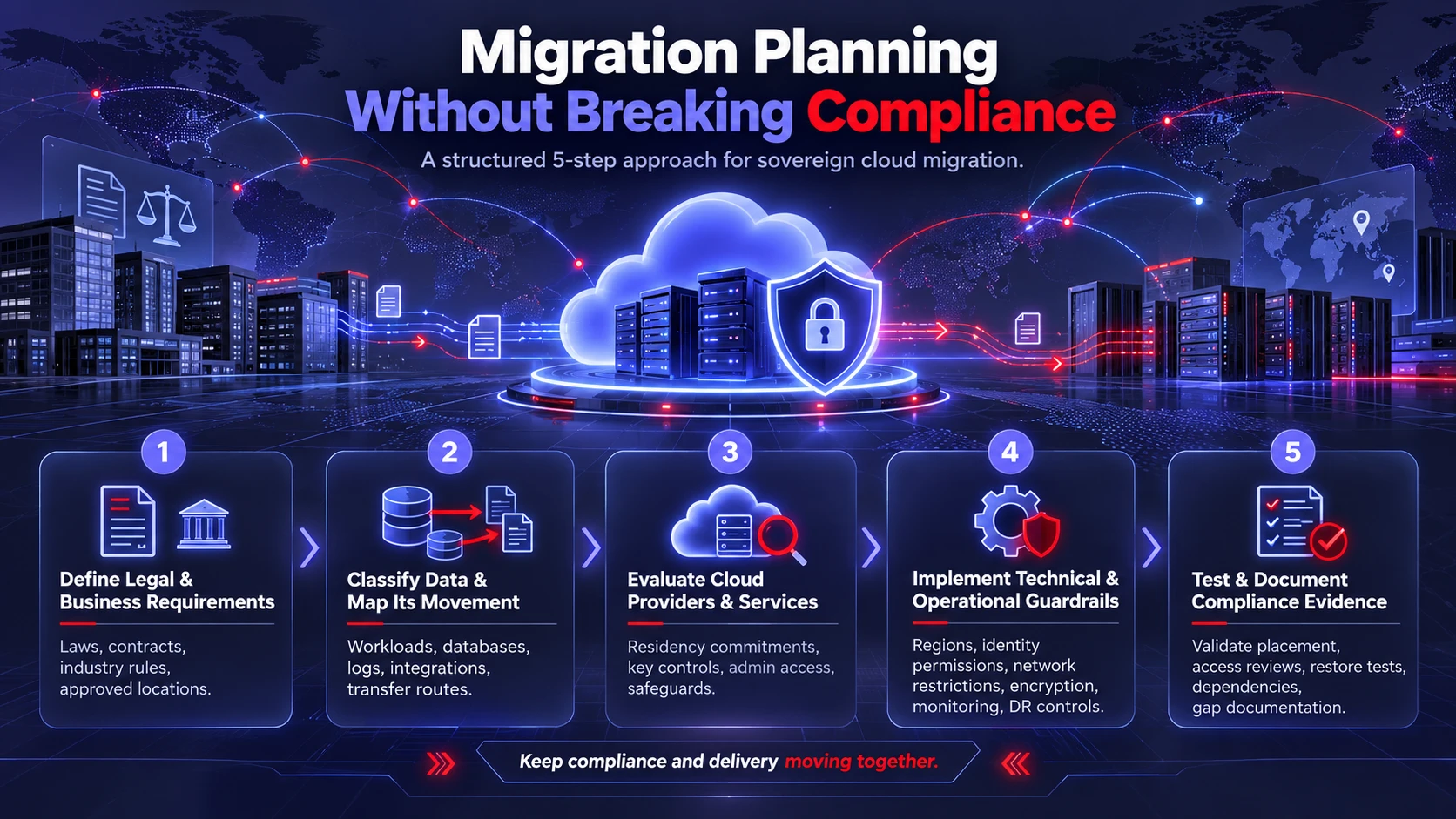
Moving to a sovereign cloud model often involves re-platforming decisions, new security controls, and updated operating procedures. A structured approach reduces the chance of rework later.
- Define Legal and Business Requirements: Identify applicable data protection laws, contractual obligations, industry rules, and approved geographic locations. Document whether each requirement concerns storage, processing, remote access, or operational control.
- Classify Data and Map its Movement: Inventory sensitive workloads, databases, backup copies, application logs, identity services, third-party integrations, and data transfer routes.
- Evaluate Cloud Providers and Services: Compare cloud deployment models, service-specific residency commitments, encryption key controls, administrative access arrangements, support locations, and contractual safeguards.
- Implement Technical and Operational Guardrails: Configure approved regions, identity permissions, network restrictions, encryption policies, monitoring, backup locations, and disaster recovery controls before migration.
- Test and Document Compliance Evidence: Validate data placement, conduct access reviews, test restore and failover procedures, assess third-party dependencies, and document any remaining compliance gaps.
This sequence keeps compliance and delivery moving together rather than competing for attention.
Questions to Ask Before Choosing a Sovereign Cloud Provider
Choosing a sovereign cloud provider requires more than reviewing regional hosting options or compliance certifications. Organizations should ask for clear evidence of where their data is stored, how it is processed, who can access it, and what happens during outages or security incidents.
Before committing to a provider, ask the following questions:
- Which services, backups, logs, and replicas are guaranteed to remain within approved regions?
- Can overseas support personnel or subcontractors access regulated data?
- Who controls encryption keys, and can the provider access decrypted information?
- What legal jurisdictions and contractual terms apply to the provider and its subcontractors?
- Can disaster recovery occur entirely within the required geographic boundaries?
- What audit reports, certifications, access logs, and compliance evidence can the provider supply?
Providers should be evaluated against documented requirements rather than marketing claims alone. Organizations may also need legal and compliance specialists to assess cross-border transfers, sector rules, and contractual responsibilities.
Conclusion
Sovereign cloud is gaining momentum because data residency is no longer a narrow compliance issue. It is an operational, legal, and risk management priority that affects architecture, vendor selection, and incident response.
The strongest outcomes come from treating sovereignty as an end-to-end discipline across data lifecycle, access control, and governance. When requirements are clearly defined and validated early, organizations can keep cloud agility while maintaining defensible control over sensitive data.
Frequently Asked Questions
What is the Main Benefit of a Sovereign Cloud?
The main benefit is stronger control over where data is stored and who can access it under local laws. It also improves audit readiness by keeping operational evidence and governance in a consistent jurisdiction.
Does Data Residency Automatically Mean Compliance?
No, residency only confirms location, not legal control or access pathways. Compliance often depends on sovereignty factors such as key ownership, administrative access restrictions, and contracts with providers and subcontractors.
What Should Be Reviewed First When Planning a Sovereign Cloud Move?
Start with a clear requirements document covering data categories, acceptable locations, and access constraints. Then map end-to-end data flows including backups, logs, and third-party services so hidden cross-border transfers are identified early.
Is Hosting Data in a Local Cloud Region Enough for Data Sovereignty?
No. Hosting data in a local cloud region can help satisfy geographic residency requirements, but sovereignty may also depend on legal jurisdiction, provider ownership, remote administrative access, encryption key control, and third-party processing. Organizations must evaluate these factors against applicable laws and contracts rather than relying on server location alone.