
API rate limiting helps protect endpoints from automated abuse, sudden traffic spikes, and excessive requests that can overload backend services. By controlling how frequently clients access an API, developers can improve reliability, distribute resources more fairly, and reduce the impact of malicious or poorly configured applications. The goal is to limit harmful traffic while allowing legitimate users to access the service with minimal disruption.
What is API Rate Limiting?
Rate limiting is a control that caps how many requests a client can make within a defined time window. It reduces the chance that bots, scrapers, or buggy clients can overwhelm an API.
Effective rate limiting controls how frequently clients can send requests based on predefined thresholds. Unlike a circuit breaker, which temporarily stops calls to an unhealthy service, a rate limiter controls request volume before traffic overwhelms available resources. When configured correctly, it can reduce automated abuse and help legitimate users maintain reliable access during traffic spikes.
Rate limits should also be distinguished from quotas and concurrency limits. A rate limit controls how many requests are accepted over time, while a quota restricts total usage across a longer period, such as a day or month. A concurrency limit controls how many requests can run simultaneously. Combining these controls helps protect APIs against both sustained traffic and sudden resource-intensive operations.
Why Bots Slip Through Basic Limits?
Simple per-IP limits often fail because modern bot traffic is distributed. Attackers rotate IP addresses, use residential proxies, and mimic normal browsing patterns to avoid basic request thresholds.
Automated clients may send requests at unusual speeds, but sophisticated bots can also imitate human timing and behavior. For that reason, request frequency alone is not a reliable test of whether traffic is legitimate. Effective protection combines rate limits with verified identity, endpoint sensitivity, behavioral signals, and risk-based decisions.
Common Rate Limiting Strategies

No single strategy fits every API. Most teams use a small set of policies and apply them differently according to the endpoint, user tier, and security risk.
- Fixed Window: Counts requests within a fixed period, such as 60 seconds. It is relatively easy to implement, but clients can create large bursts near window boundaries.
- Sliding Window: Measures activity over a moving interval rather than resetting all counts at one boundary. It can reduce edge spikes, although its implementation may require additional state or calculations.
- Token Bucket: Allows short bursts of requests while enforcing a sustained request rate through gradually replenished tokens. It is useful for applications where legitimate users occasionally generate sudden traffic. The AWS API Gateway throttling documentation explains how token bucket controls manage steady request rates and burst capacity.
- Leaky Bucket: Smooths incoming traffic by allowing requests to leave a bucket at a controlled rate. Depending on the implementation, excess requests may be queued temporarily or rejected when capacity is exhausted. This approach helps protect backend services from sudden traffic bursts, although queueing can increase response times.
Once the policy type is chosen, the real work is selecting identifiers, thresholds, and safe responses.
OWASP identifies unrestricted API resource consumption as an important API security risk. Its recommendations include limiting request frequency, controlling expensive operations, validating payload sizes, and applying different restrictions to endpoints based on their resource requirements.
Picking the Right Identifier Without Blocking Real Users
Identification determines who shares a limit. If you choose the wrong key, many real users can get throttled together, or bots can evade the limits by changing identifiers.
Prefer stable identity signals when available, and use fallback signals carefully when authentication is not yet possible.
- API Key or OAuth Client: Useful for partner and public developer APIs because the limit can be associated with a known application or client.
- User Account: Works well after authentication and supports tiered plans. It reduces the chance that one shared network will cause unrelated users to be throttled together.
- IP Address With Care: Useful for early filtering at the edge, but risky for schools, offices, and mobile carriers that use network address translation (NAT).
- Device Fingerprint Signals: Browser and device characteristics can help identify unusual automated activity when combined with account information and behavioral signals. However, fingerprints can change or be spoofed, and their collection may create privacy and data-protection concerns. Use them only when justified, minimize collected information, and avoid treating fingerprints as proof of identity.
A practical pattern is layered limiting, with cautious IP-based controls before login and more specific per-account limits after authentication. When an API sits behind a reverse proxy or content delivery network, obtain the client IP address only from properly configured and trusted proxy information. Do not blindly trust an incoming client-supplied forwarding header.
Endpoint-Based Rate Limits That Match Risk
Not all endpoints have the same abuse profile. Login, password reset, search, and scraping-prone catalog endpoints tend to attract automated traffic. Authentication endpoints also require protection against repeated attempts to guess passwords or verification codes.
Start by classifying routes by both abuse risk and resource cost. Apply stricter controls to sensitive operations while allowing reasonable bursts for legitimate application activity.
| Endpoint Type | Typical Abuse Risk | Rate Limit Direction |
|---|---|---|
| Login and MFA | High | Conservative limits with progressive delays and account-aware detection |
| Password Reset | High | Conservative limits, identity checks, and protection against account enumeration |
| Search and Autocomplete | Medium to High | Request and cost limits with controlled bursts |
| Public Read Endpoints | Varies by operation | Higher limits only when resource cost permits, supported by caching and monitoring |
This kind of mapping keeps protection tight where it matters while reducing the chance of accidental throttling during normal product use. However, public read endpoints are not automatically low-risk. Expensive searches, large data exports, complex database queries, and bulk requests can consume significant resources even when they do not modify information. Rate limits should therefore consider both security risk and the processing cost of each request.
Soft Blocking With Throttling and Backoff
Hard blocks can create support tickets and lost conversions. A more flexible approach is progressive enforcement that gives real users a path forward while still slowing bots.
- Return HTTP 429 With Clear Guidance: When a client exceeds an enforced request limit, return HTTP 429 Too Many Requests where appropriate. Include a Retry-After header when a reliable retry time is available. Additional rate-limit information can help legitimate clients manage their requests, but these headers are not mandatory for every 429 response.
- Apply Progressive Enforcement: Introduce stricter limits, temporary cooldowns, or additional verification when suspicious traffic continues. Avoid holding large numbers of application requests open simply to delay responses, because this can consume server resources and create additional performance problems.
- Recommend Exponential Backoff With Jitter: Explain how clients should gradually increase retry delays, add random variation, and stop after a reasonable number of attempts. Clients should respect Retry-After when provided and avoid automatically retrying operations that cannot be safely repeated.
Progressive throttling also helps you learn where thresholds are too strict before you start blocking legitimate traffic.
Developers should also understand what happens when clients exceed an API’s configured limits. Our guide to API 429 errors and retries explains common causes of HTTP 429 responses and practical solutions, including exponential backoff, caching, request batching, and improved request management.
Bot Resistance Beyond Rate Limits
Rate limiting is necessary, but it is rarely sufficient against determined automation. Combine it with checks that raise the cost of abuse while minimizing disruption for legitimate users.
Rate limiting is only one part of a broader API security strategy. Developers should also address authentication weaknesses, authorization problems, data exposure, and insecure integrations. Our guide to API security risks and best practices explains these common vulnerabilities and the protections used to reduce them.
- Request Validation: Enforce request schemas, payload sizes, and accepted content types. Reject malformed traffic early to reduce unnecessary processing.
- Behavior Signals: Monitor unusual request timing, repeated errors, unexpected access patterns, and abnormal navigation sequences. Interpret these signals together instead of treating any one signal as proof of automation.
- Proof of Work or Security Challenges: Apply challenges selectively when multiple signals indicate elevated risk. Consider accessibility, device performance, user experience, and the possibility that sophisticated bots may bypass challenges. Avoid introducing unnecessary verification steps for every legitimate API request.
- WAF and Edge Rules: Filter known malicious patterns before they reach the application. Combine edge protection with server-side authentication and authorization rather than assuming a web application firewall can stop every attack.
A practical API protection strategy combines endpoint-specific rate limits, request validation, identity-based controls, gateway policies, and continuous monitoring. These measures should be tested together to ensure that automated abuse is restricted without disrupting legitimate application workflows.
Designing Limits for Humans and Mobile Networks

Real users can look like bots when they share networks in offices, schools, or mobile carrier systems. Sudden app launches after a push notification can also generate legitimate bursts of requests.
To reduce false positives, allow short bursts with token bucket settings and apply limits per account when possible. Consider separate limits for background synchronization and interactive actions so routine background work does not prevent users from completing important tasks.
Review the effects of each rule on shared networks and mobile connections before enforcing stricter limits widely. A threshold that works for a small test audience may block legitimate users when traffic increases.
Handling Distributed and Credential Stuffing Attacks
Credential stuffing is a common case where per-IP limits fail. Attackers spread attempts across many IP addresses while targeting the same accounts.
OWASP’s Credential Stuffing Prevention Cheat Sheet recommends combining multiple defenses rather than relying only on IP-based restrictions. Account-level controls, authentication monitoring, multi-factor authentication, and risk-based verification can help reduce the effectiveness of distributed login attacks.
Apply account-based and network-aware rate limits to login attempts, monitor unusual authentication failures, and detect patterns associated with credential stuffing and password spraying. Introduce progressive delays or risk-based challenges when suspicious activity continues. However, avoid relying on permanent account lockouts alone, because attackers may deliberately trigger them to prevent legitimate users from signing in. Multi-factor authentication and phishing-resistant sign-in methods provide additional protection against stolen credentials.
Modern authentication methods can also reduce reliance on reusable passwords. Our comparison of passkeys and passwords explains how passkeys work and why phishing-resistant authentication can improve account security.
Implementing Rate Limits With API Gateways and Microservices
Centralizing rate limiting at an API gateway can reduce complexity and support consistent enforcement. It also prevents each microservice from having to recreate common request-control logic with potentially different thresholds.
API gateways can enforce authentication, request routing, and rate-limiting policies before traffic reaches backend services. However, they serve a different primary purpose from load balancers, which distribute incoming requests across available servers. Our comparison of API gateways and load balancers explains how these components work together in modern cloud applications.
When rate limiting operates across multiple application instances, use a shared counter store or coordinated gateway policies to maintain consistent enforcement. Atomic counter updates can reduce race conditions when requests arrive simultaneously. Teams should also define how limits behave during network failures, counter-store outages, and failover. Depending on the system’s requirements, enforcement may prioritize strict protection or temporary availability when shared rate-limit infrastructure becomes unavailable.
Observability and Tuning Without Guesswork
Rate limiting is an iterative control. Without good telemetry, teams risk blocking legitimate users or leaving gaps that bots can exploit.
Effective API protection depends on understanding request patterns, backend performance, and the impact of security controls on legitimate clients. Developers can explore the differences between observability and monitoring to understand how metrics, logs, and system analysis support troubleshooting and continuous improvement.
- Track Throttle Rates by Route: Monitor how often HTTP 429 responses occur and which endpoints trigger them.
- Measure Impact on Latency: Check whether throttling reduces backend load without introducing unnecessary response delays or queue buildup.
- Segment by Client Type: Separate browser, mobile, partner, and internal traffic where appropriate so limits can be tuned for different usage patterns.
- Review Allowed and Throttled Requests: Examine sampled logs to determine whether suspicious traffic is being restricted and legitimate users can complete important actions. Track false positives, repeated authentication failures, customer complaints, and changes in request success rates. Avoid storing passwords, authentication tokens, or unnecessary personal information in monitoring logs.
As limits mature, teams can align them with product tiers and partner service-level agreements while maintaining a strong baseline for abuse prevention. Revisit thresholds after major feature launches, changes in traffic patterns, or security incidents.
Recommended Response Patterns and Error Messages
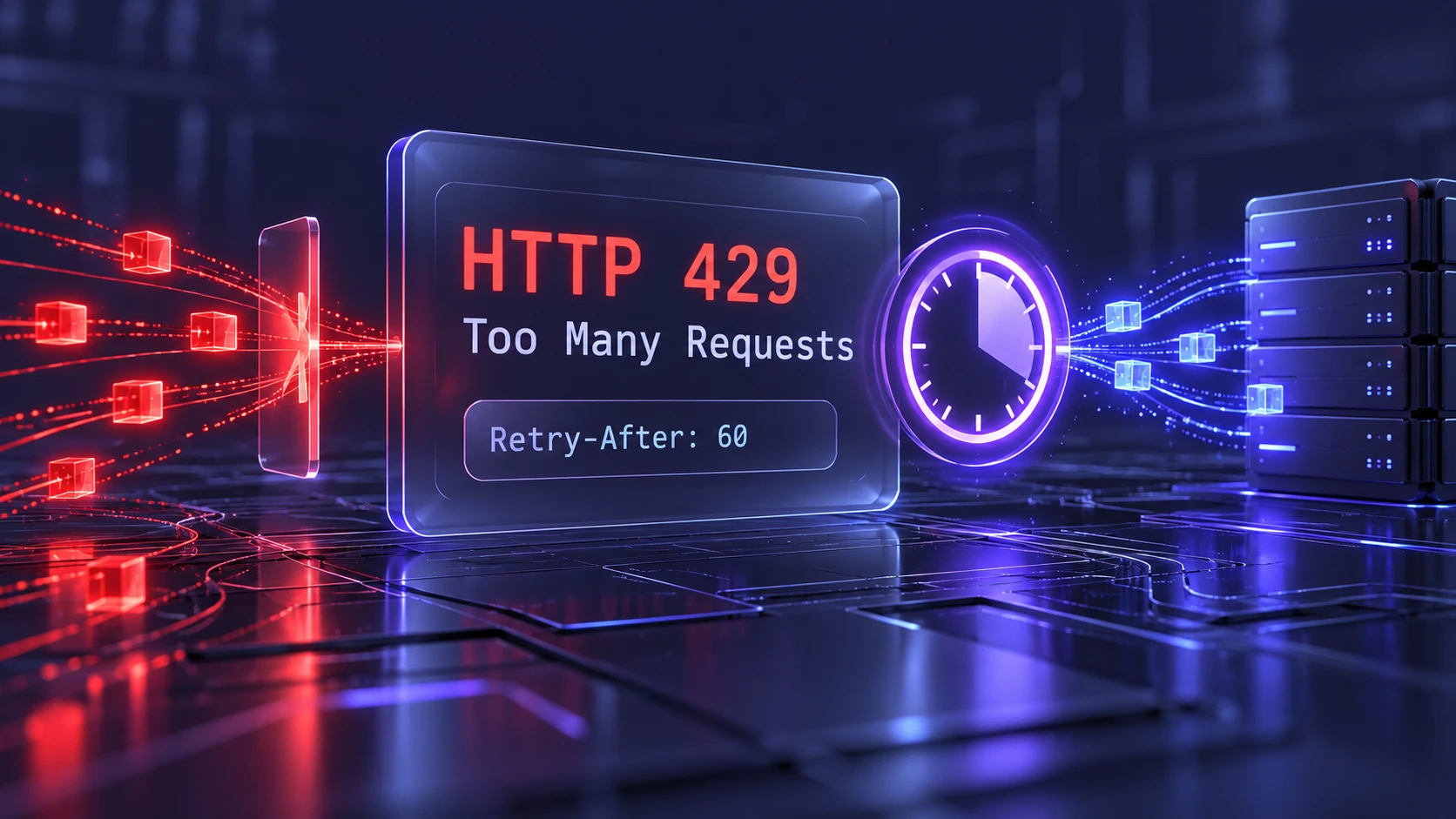
When you throttle, the response should be predictable and easy for developers to handle. Returning clear status codes and useful retry guidance reduces repeated traffic and improves the developer experience.
The HTTP 429 specification in RFC 6585 defines the Too Many Requests response for situations where a client exceeds an allowed request rate. The specification also allows servers to include a Retry-After header to communicate when another request may be attempted.
Provide a concise message, a retry window when known, and a stable error code. Avoid responses that leak security details or encourage bots to fine-tune their behavior around the protection policy.
Example of a Rate-Limited API Response
When an authenticated API client exceeds its configured request limit, the server may respond with HTTP 429 and a short error message. For example:
HTTP/1.1 429 Too Many Requests
Content-Type: application/json
Retry-After: 60

{
  "error": "rate_limit_exceeded",
  "message": "Too many requests. Please retry later."
}
In this illustrative example, the Retry-After header tells the client to wait 60 seconds before attempting another permitted request. The exact waiting period depends on the API’s policy. Clients should respect the server’s retry instructions and avoid repeatedly resending requests during the cooldown period.
The official Retry-After header specification explains that retry instructions may be expressed as either a number of seconds or an HTTP date. Developers should support the appropriate format when building clients that automatically handle rate-limited requests.
Conclusion
API rate limiting works best when it is layered, endpoint-aware, and tied to meaningful identity signals. Throttling and progressive backoff can reduce bot efficiency while helping legitimate users continue to access services.
Start with a small set of rate-limiting policies, measure their effects on real traffic, and adjust thresholds as application usage changes. Effective API protection requires continuous monitoring, reliable authentication, careful gateway configuration, and regular testing against automated abuse. By combining these measures, developers can improve security while maintaining a dependable experience for legitimate users.
Frequently Asked Questions
What is the Best HTTP Status Code for Rate Limiting?
HTTP 429 Too Many Requests is the standard HTTP response when a client exceeds an enforced request rate limit. The server may include a Retry-After header to indicate when another request can be attempted. Additional quota or rate-limit headers can help clients manage traffic, but their availability depends on the API provider.
Can Rate Limiting Disrupt Legitimate Mobile App Traffic?
Yes, especially when users are behind carrier NAT or when an app performs bursty background synchronization. Token bucket limits, per-account identifiers, and separate budgets for interactive requests and background calls can help reduce accidental throttling.
Should Rate Limiting Live in the API Gateway or the Application?
Gateway-level limits can provide consistent enforcement and protect microservices from spikes before requests reach backend systems. Application-level limits remain useful for business rules, such as per-user quotas and sensitive workflows like login. Many systems benefit from combining both approaches.