
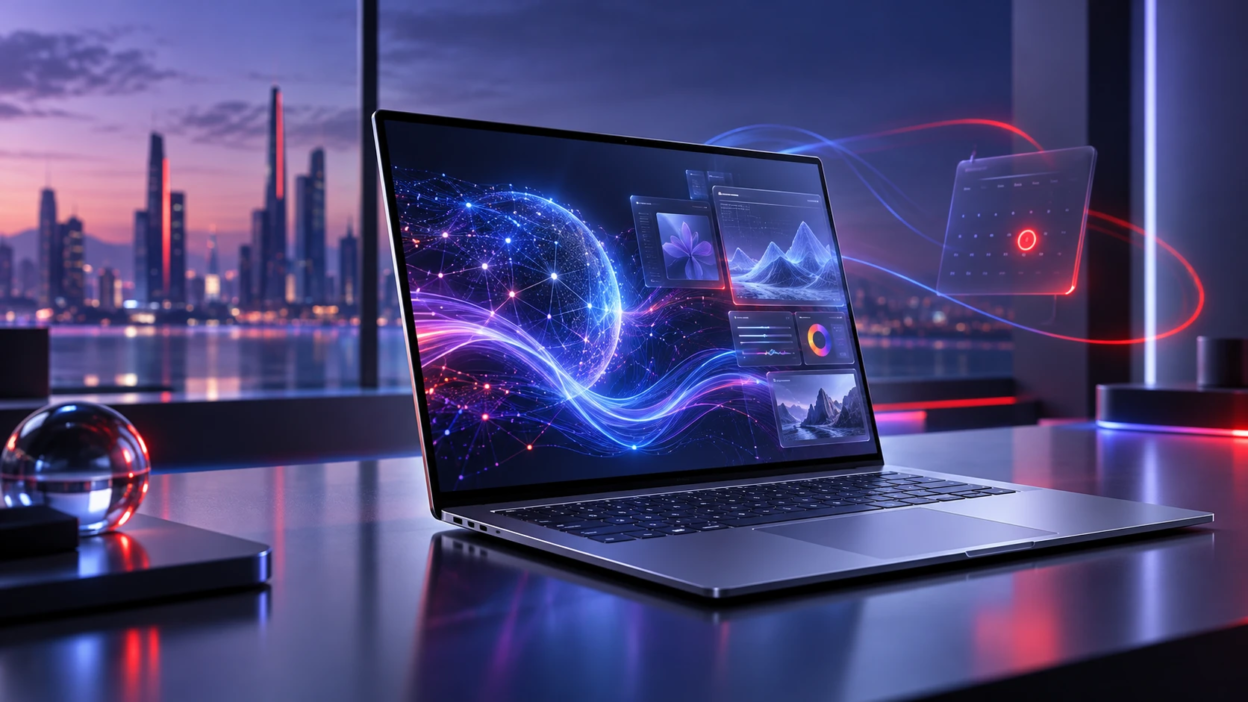
Microsoft has opened preorders for the Surface Laptop Ultra, its new high-performance Windows laptop powered by Nvidia’s RTX Spark chip. According to Microsoft’s October 7 Surface announcement, the device starts at $2,599 and is scheduled to become available on October 16, 2026.
The new laptop targets software developers, AI researchers, designers, and creative professionals. It combines Nvidia’s Grace processor and Blackwell RTX graphics with up to 128GB of unified memory, allowing supported AI models and demanding applications to run directly on the computer.
Microsoft opened preorders for the Surface Laptop Ultra on October 7, with availability beginning October 16, 2026. The starting price is $2,599 in the United States, while higher-end configurations can reach approximately $5,900. Final prices depend on the processor, memory, storage, and selected model.
The Surface Laptop Ultra runs on Nvidia’s RTX Spark Superchip, which combines a Grace CPU with a Blackwell RTX GPU. Depending on the configuration, the processor offers up to 20 CPU cores, while the graphics component includes up to 6,144 GPU cores.
The hardware is designed for demanding tasks such as 3D rendering, video production, software development, gaming, and local AI processing. Actual performance will depend on the software, workload, and selected configuration.
One of the laptop’s main features is its unified memory architecture, which allows the processor and graphics hardware to share a pool of memory. Selected configurations offer up to 128GB, providing additional capacity for large projects and AI workloads.
Microsoft says the RTX Spark platform can run supported AI models exceeding 120 billion parameters locally. The company also advertises up to one petaflop of theoretical AI performance under specific FP4 processing conditions.
These capabilities could help developers test AI models, run compatible coding tools, and process certain workloads without sending every request to a cloud server. However, real-world performance and model compatibility will vary.
Microsoft’s approach reflects a wider move toward computers designed for local AI processing. Another example is Ghost’s Core personal AI computer, which uses dedicated hardware to run supported AI models and agents directly on a personal device.
According to the official Surface Laptop Ultra specifications, the laptop features a 15-inch PixelSense Ultra touchscreen with a 120Hz refresh rate. Microsoft advertises peak HDR brightness of up to 2,000 nits, although sustained brightness and brightness during ordinary use will be lower.
The laptop also includes a haptic touchpad that is 30% larger than the one in the previous-generation Surface Laptop. It has an aluminum design, measures less than 18mm thick, and weighs under 4.5 pounds.
The Surface Laptop Ultra includes three USB-C ports, HDMI, USB-A, an SD card reader, and a 3.5mm headphone jack. It also introduces Magnetic Connect, a built-in magnetic USB-C charging connection designed to detach more easily if the cable is pulled.
The magnetic charging port can also function as a regular USB-C connection for compatible accessories. Microsoft says the laptop supports up to three external 4K displays when used with appropriate equipment.
The starting configuration includes an 18-core processor, 24GB of unified memory, and 512GB of storage. Higher-end versions offer more processing power, memory, and storage.
Because RTX Spark uses an Arm-based processor, the laptop runs Windows on Arm. Many traditional Windows applications can run through Microsoft’s Prism emulation technology, but users should check compatibility for specialized programs, drivers, and games before purchasing.
Alongside the new hardware, Microsoft introduced its Windows Hybrid Intelligence approach, which combines AI processing on a local computer with cloud-based services.
The goal is to use local models when they are suitable for a task and cloud resources when additional processing is needed. Microsoft is developing intelligent routing and related features to support this approach, but their availability and behavior will depend on the application and service. The strategy also complements Microsoft’s expanded Copilot AI tools, which bring coding, productivity, and AI-agent capabilities into a more connected experience.
Microsoft also announced the general availability of Microsoft Execution Containers (MXC), a security technology that lets developers and organizations limit what supported AI agents can access. Policies can restrict access to files, networks, and other system resources, helping contain potentially unsafe actions.
MXC is part of Microsoft’s wider approach to managing AI agents on Windows 11. These protections depend on how applications and administrators configure them and do not remove every security risk.
Microsoft also opened preorders for the Surface RTX Spark Dev Box, a compact desktop system designed for AI developers and engineers. The device uses the RTX Spark platform, supports up to 128GB of unified memory, and offers theoretical AI performance of up to one petaflop.
The Dev Box starts at $5,999 in the United States and is expected to begin shipping in November 2026. Unlike the laptop, it is designed for developers who want a dedicated AI workstation at their desks.
The Surface Laptop Ultra enters the premium professional laptop market, where Apple’s MacBook Pro is one of its main competitors. Microsoft is focusing on local AI processing, graphics performance, and developer tools to attract buyers who regularly handle demanding workloads.
However, the starting price of $2,599 makes the device less practical for users who mainly browse the internet, stream videos, or complete basic office tasks. Professionals considering the laptop should compare application compatibility, battery life, memory requirements, and real-world performance before making a purchasing decision.
The Surface Laptop Ultra reflects Microsoft’s growing focus on computers that can handle demanding AI tasks locally rather than depending entirely on cloud services. Its RTX Spark processor, unified memory, and new Windows capabilities are aimed at professionals who need advanced computing power.
With preorders open and availability scheduled for October 16, 2026, the Surface Laptop Ultra marks another step in Microsoft’s premium hardware strategy. Its long-term appeal will depend on real-world performance, software compatibility, and whether its AI capabilities justify the high price.