Private AI gives organizations greater control over where artificial intelligence systems operate, how business data is handled, and who can access sensitive information. TechFides Private AI focuses on customer-controlled AI infrastructure, with on-premises deployments as its standard approach and dedicated hosted or hybrid options also available. However, the level of privacy, ownership, and operational control depends on the selected deployment, contractual terms, and security configuration.
What Private AI Means in Practice?
Private AI refers to AI systems deployed with defined infrastructure, access controls, and data-handling boundaries. These systems may operate on company-owned hardware, dedicated hosted infrastructure, or a combination of private and external services. Private deployment can reduce dependence on shared AI services and provide more direct control over sensitive information. However, it does not automatically eliminate cybersecurity risks or guarantee regulatory compliance. Organizations must still evaluate external integrations, administrative access, backups, model updates, and data-processing arrangements.
With TechFides Private AI, the emphasis is on end-to-end ownership of the AI lifecycle, from data handling and model access to policy enforcement and monitoring. That ownership is not only a technical decision, it is also a governance and risk decision.
According to TechFides’ private AI deployment overview, the company’s standard offering runs on customer-owned hardware installed on-site, while dedicated hosted and hybrid configurations are also available. Organizations should verify which deployment is included in their agreement and whether any business information is transferred to external services.
What It Means to Own Your AI?
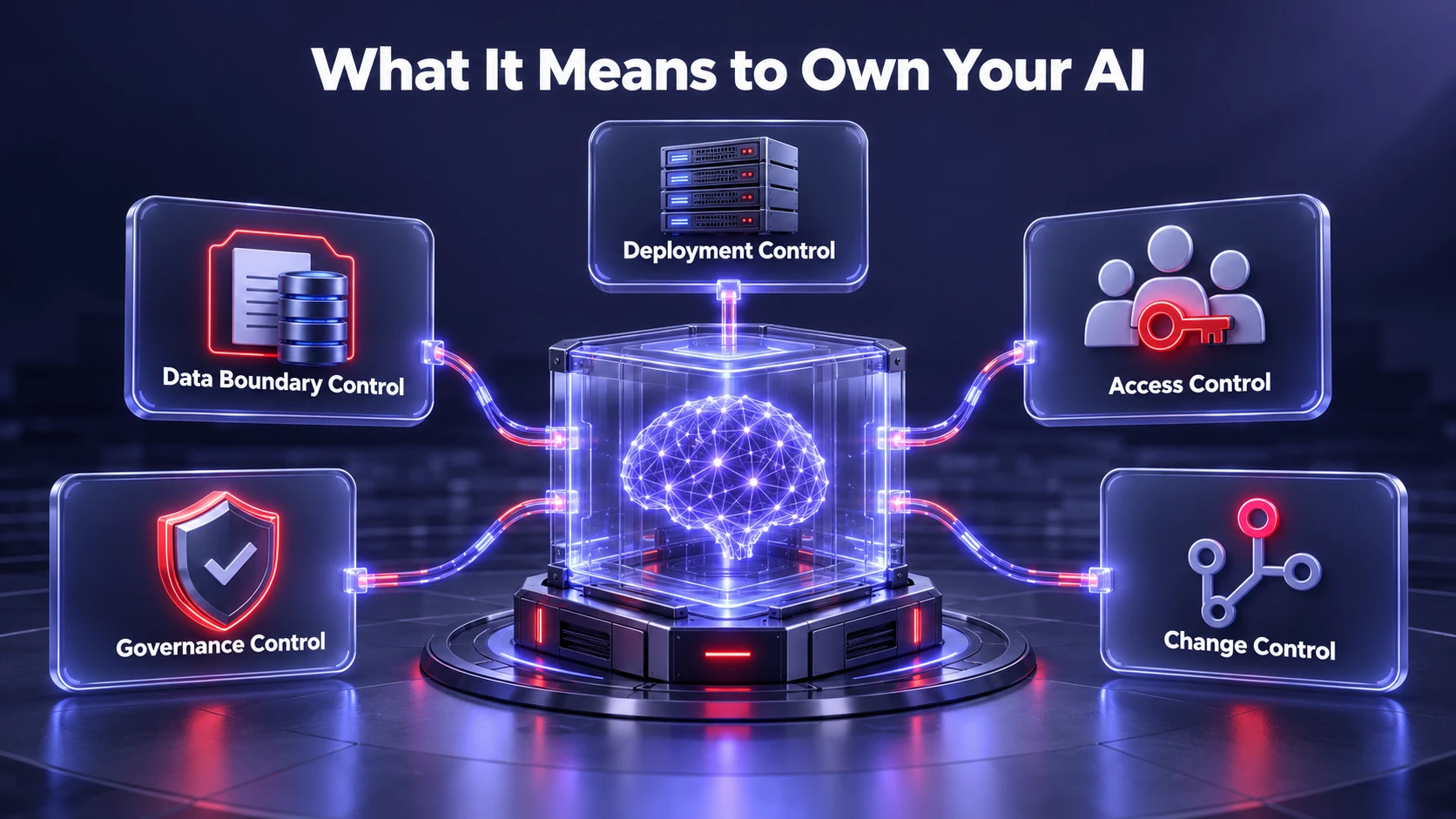
Ownership is not a legal slogan, it is a set of capabilities your team can verify. When you own your AI, you can set and enforce rules across infrastructure, data, identity, and operational workflows.
- Deployment control: Models run in a private cloud, dedicated environment, or on-prem setup that matches your risk posture and performance needs.
- Data boundary control: Prompts, documents, embeddings, and logs stay within defined systems and retention rules.
- Access control: Authentication, authorization, and role-based permissions determine who can use which AI tools and data sources.
- Governance control: Policies for acceptable use, auditing, and approvals are enforced consistently across teams.
- Change control: Model updates, prompt templates, and retrieval sources are versioned so outputs are explainable and repeatable.
These elements work together to create dependable AI operations that can scale beyond a single team or pilot.
Why Organizations Choose Private AI?
Public and private AI services offer different levels of infrastructure control, operational responsibility, and flexibility. Many public AI providers offer enterprise privacy protections, contractual data-handling commitments, and administrative security features. Private AI may provide stronger control over deployment and internal data flows, particularly when workloads involve confidential documents or strict infrastructure requirements. The appropriate choice depends on the organization’s security needs, regulatory obligations, technical resources, and total operating costs.
TechFides Private AI aligns with the needs of teams that must protect sensitive information, meet regulatory requirements, and maintain strong internal controls. This is common across healthcare, finance, legal services, manufacturing, and internal enterprise functions such as HR and procurement.
Healthcare organizations should distinguish private infrastructure from regulatory compliance. The HHS Summary of the HIPAA Security Rule describes the administrative, physical, and technical safeguards required for covered electronic health information. An on-premises AI system may help address certain data-handling requirements, but organizations must still conduct risk assessments, manage access, document safeguards, and evaluate the security of the complete environment.
- Risk reduction: Lower exposure to data leakage, shadow AI usage, and uncontrolled sharing of sensitive context.
- Compliance planning: Private deployments can help organizations define data residency, retention, and audit controls, but regulatory compliance still depends on documented risk assessments, appropriate safeguards, contractual obligations, and ongoing review.
- Operational predictability: Clearer performance baselines and fewer surprises tied to shared infrastructure and shifting provider constraints.
Once AI supports real workflows, these advantages tend to outweigh the convenience of purely public, unmanaged usage.
Core Components of TechFides Private AI
A private AI program succeeds when it is designed as a system, not a single model. TechFides Private AI centers on practical building blocks that help teams deploy, secure, and manage AI across the organization.
Private Deployment Architecture
TechFides describes its standard Private AI deployment as a system installed on hardware owned by the customer and operated within the customer’s premises. According to the company, dedicated hosted and hybrid configurations are also available. Organizations should compare these options based on data sensitivity, internal IT capabilities, network connectivity, hardware maintenance, and the need to access external AI services.
Before selecting a TechFides deployment, organizations should request documentation explaining server locations, network isolation, administrative access, software updates, backup storage, and recovery responsibilities. Security and deployment arrangements should be verified through architecture diagrams, written agreements, and appropriate technical testing rather than assumed from general product descriptions.
Organizations considering hosted or hybrid private AI should also examine data residency and sovereign cloud requirements. Server location alone does not determine which laws apply or who can access stored information. Administrative access, encryption key management, service-provider arrangements, and backup locations are equally important.
Enterprise Data Integration
Most enterprise value comes from using AI with internal knowledge, not generic data. Private AI should integrate with documents, knowledge bases, databases, and ticketing or workflow systems while keeping access rules intact.
Organizations should also understand the difference between retrieval-based knowledge access and model customization. Our comparison of RAG vs fine-tuning explains how retrieval-augmented generation can give AI systems access to approved business documents, while fine-tuning changes model behavior through additional training. The appropriate method depends on data sensitivity, accuracy requirements, maintenance needs, and the intended workflow.
When TechFides designs private AI solutions, data integration focuses on precision and control. That includes retrieval design, document permissions alignment, and limiting what the model can see based on role and purpose.
Security and Identity
Identity is a critical control point for private AI. Single sign-on, role-based access control, and least-privilege permissions reduce misuse and support auditing.
These controls are closely related to the principles of Zero Trust security, where users, devices, and applications are verified rather than automatically trusted. Private AI systems should restrict access to authorized users, enforce appropriate permissions, and review sensitive operations even when the infrastructure is located within the organization’s network.
TechFides emphasizes security controls that align with existing enterprise identity systems. This reduces friction for users while strengthening access governance.
Guardrails and Policy Enforcement
Guardrails define what the AI is allowed to do and what it must refuse. Policies can include data handling rules, restricted topics, output formatting constraints, and safe completion behavior.
Guardrails should also account for prompt injection attacks, in which malicious instructions influence how an AI system responds or acts. This risk can arise when private AI processes emails, documents, retrieved knowledge, or external information. Testing should therefore cover unauthorized information access, unsafe tool actions, and attempts to bypass application rules.
Private AI guardrails work best when they are measurable and testable. TechFides approaches governance with clear requirements, validation, and continuous monitoring.
Private deployment does not remove the risk of prompt injection or other attacks against AI applications. As explained in OWASP’s prompt injection guidance, malicious instructions can be hidden in documents, webpages, or other material processed by an AI system. Effective defenses require restricted permissions, trusted data sources, application-level safeguards, approval requirements for sensitive actions, and repeatable security testing.
Private AI Versus Public AI
Choosing private AI is not about rejecting public tools. It is about matching the deployment model to the sensitivity and criticality of the work.
| Decision Area | Public AI Services | TechFides Private AI |
|---|---|---|
| Deployment | Typically uses provider-managed infrastructure | On-premises by default; dedicated hosted and hybrid options are available |
| Data Handling | Depends on provider policies, service configuration, and enterprise agreements | On-premises deployments can keep processing within the customer’s environment; hybrid data flows require verification |
| Access Governance | May include enterprise identity integration, administrative policies, and access controls | Access controls depend on the configured system and should be verified |
| Compliance | Enterprise services may provide supporting documentation and compliance controls | Private deployment may support specific compliance requirements but does not guarantee compliance |
| Reliability | Depends on provider availability, service limits, and network connectivity | Depends on hardware capacity, maintenance, backup arrangements, and support |
| Cost Structure | Often subscription-based or usage-based | May include setup fees, hardware, ongoing support, and other operating costs |
| Infrastructure Control | Provider generally manages the underlying infrastructure | Greater customer control, depending on the deployment and service agreement |
This comparison highlights the trade-offs between managed public AI services and private deployments. Organizations should evaluate security controls, infrastructure responsibilities, contractual commitments, performance requirements, and total costs before deciding which approach is suitable.
What to Verify Before Choosing TechFides Private AI?
Before investing in a private AI deployment, organizations should confirm how the proposed system will operate within their existing infrastructure. Product descriptions can explain intended capabilities, but written specifications and practical demonstrations are needed to establish what a particular installation will provide.
Ask the provider these questions before signing an agreement:
- Infrastructure Ownership: Who legally owns the servers, storage devices, and other hardware after installation and contract termination?
- Model Licensing: Which AI models are included, and what restrictions apply to their commercial use, modification, and updates?
- Data Location: Where are prompts, retrieved documents, generated outputs, backups, and diagnostic logs processed and stored?
- External Connectivity: Does the deployment contact outside AI APIs, monitoring services, or software-update servers?
- Security Controls: Which authentication methods, permissions, encryption features, and audit logs are included?
- Maintenance Responsibilities: Who installs updates, fixes vulnerabilities, monitors failures, and restores the system after an outage?
- Pricing and Exit Terms: Which costs are recurring, what services are excluded, and what happens when the customer ends the agreement?
Request written answers, technical architecture diagrams, and demonstrations for important security or operational requirements. A private AI solution should be evaluated according to verifiable controls and business needs, rather than marketing claims alone.
Data Ownership and Model Training Boundaries
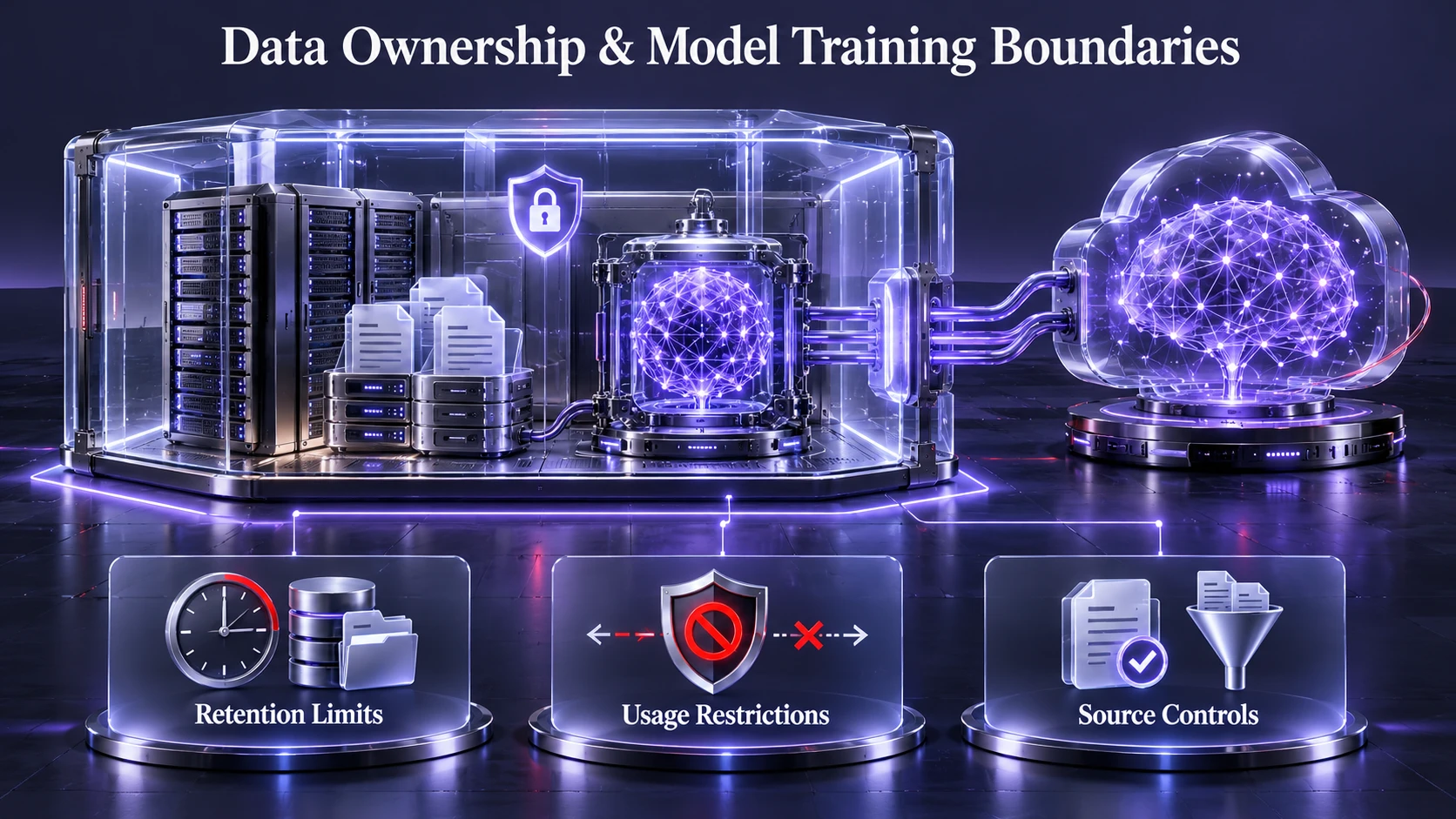
Owning AI infrastructure does not necessarily mean owning the underlying model weights, training data rights, or every software component in the system. Organizations should distinguish ownership of hardware and business data from licenses to use AI models and supporting applications. Before adopting TechFides Private AI, review the written agreement to identify who owns the hardware, what model licenses apply, how prompts and documents are processed, and whether logs, backups, or support diagnostics may be accessed or transferred outside the organization.
TechFides Private AI helps establish clear training boundaries, logging rules, and retention policies so the system behaves consistently across teams. That also supports stronger internal trust since users know what happens to their inputs.
Data control must also account for accidental information disclosure through AI-generated responses. The OWASP guidance on sensitive information disclosure explains how language-model applications can expose personal information, confidential business records, and other sensitive data. Organizations should test access restrictions, retrieval permissions, output filtering, and logging practices before allowing private AI systems to process confidential information.
- Retention limits: Define how long prompts, outputs, and retrieval traces are stored.
- Usage restrictions: Prevent data from being used to train shared models outside your control.
- Source controls: Restrict retrieval to approved repositories and approved document types.
These controls reduce exposure while keeping the AI helpful for daily work.
Governance and Auditability You Can Prove
AI governance becomes real when it produces evidence. Auditability includes being able to show who accessed the system, what data sources were used, and how outputs were generated.
Organizations can use the NIST AI Risk Management Framework to structure AI risk assessment, governance, performance evaluation, and ongoing monitoring. The framework encourages organizations to identify relevant risks, measure system behavior, and manage potential impacts throughout the AI lifecycle.
TechFides Private AI supports governance workflows that fit real operations. That can include approval paths for new data sources, validation for new prompt templates, and reporting for leadership and compliance teams.
Key Governance Artifacts
Clear documentation and repeatable controls make AI adoption safer and faster. Ownership improves when teams can standardize how AI is introduced and modified.
- Acceptable use policy: Defines permitted use cases and prohibited data types.
- Model and prompt inventory: Tracks versions, owners, and intended purposes.
- Access review cadence: Confirms users and roles remain appropriate over time.
- Testing and validation records: Shows how safety, accuracy, and bias checks were performed.
With these in place, private AI moves from informal experimentation to controlled capability.
Performance, Reliability, and Cost Predictability
Ownership also means being able to tune performance to the workload. That includes latency, throughput, and availability targets based on the business process the AI supports.
The total cost of a private AI deployment depends on hardware requirements, setup charges, ongoing support, maintenance, electricity, software licensing, backup systems, and future upgrades. TechFides publishes setup and recurring service fees for several deployment tiers, but organizations should confirm the applicable pricing and included services through a written proposal. Cost predictability should be evaluated alongside performance targets, reliability requirements, and long-term operating responsibilities.
- Workload sizing: Align compute resources to actual usage patterns and peak demand.
- Monitoring and alerts: Track latency, error rates, and retrieval quality.
- Budget controls: Set limits by team, application, or environment to prevent surprise spend.
These practices support consistent user experience and reduce the operational burden on engineering teams.
Organizations selecting hosted or hybrid private AI should also consider data-transfer expenses. Depending on the infrastructure provider and configuration, transferring information between cloud services, regions, and on-premises systems may generate additional charges. Understanding cloud egress fees can help businesses estimate the total cost of operating an AI system across different environments.
How to Adopt TechFides Private AI Without Disruption?
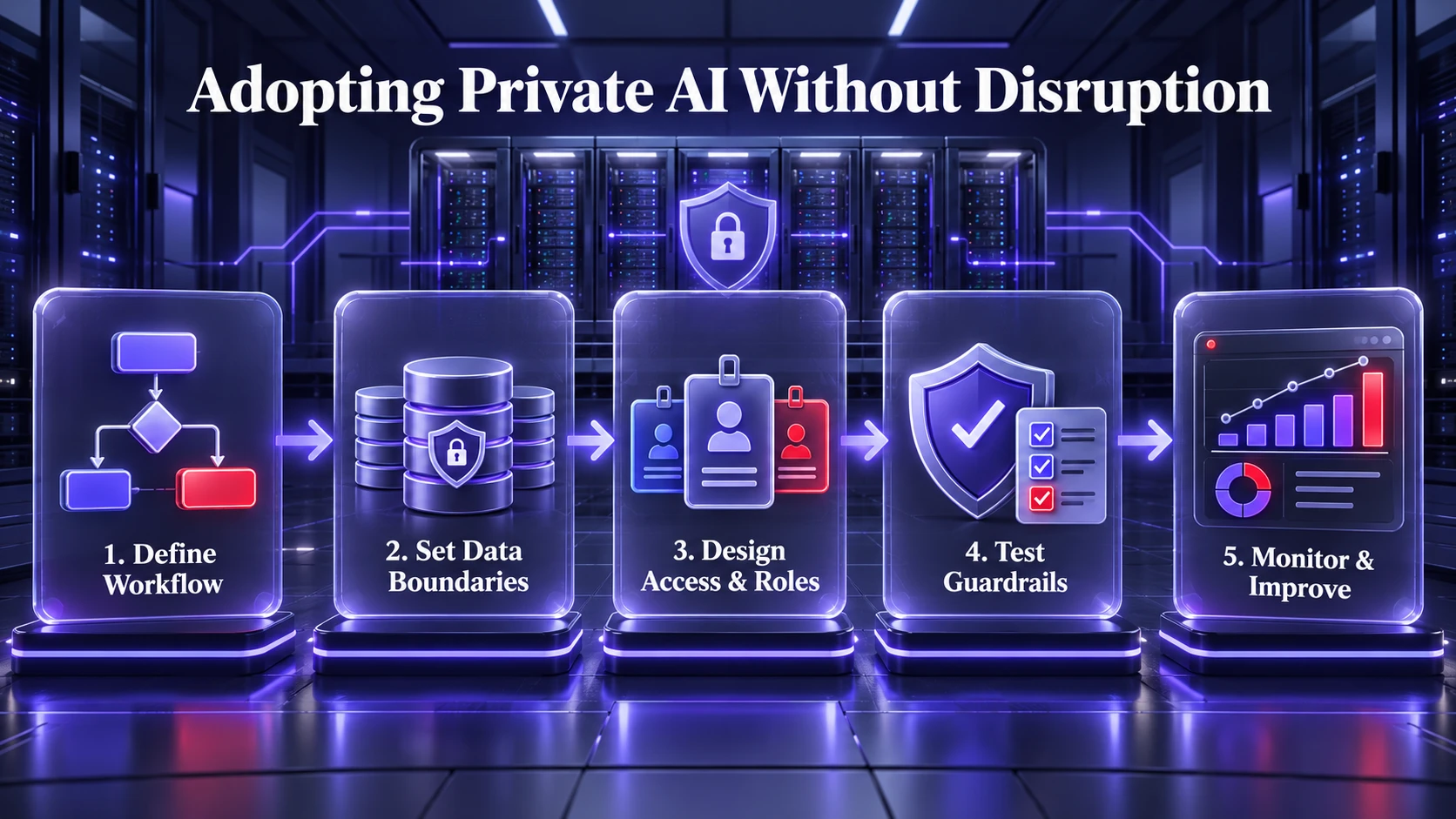
Private AI adoption works best when it starts with a focused scope and a clear operating model. The objective is to build a secure foundation that can expand, rather than launching many disconnected pilots.
- Define the first business workflow: Choose a process where data sensitivity and value are both high, and where success can be measured clearly.
- Set the data boundaries: Identify allowed repositories, excluded data types, and retention requirements before deployment.
- Design access and roles: Map user groups to permissions, and align them with your identity provider.
- Implement guardrails and testing: Validate safety behavior, retrieval accuracy, and output consistency with repeatable tests.
- Operationalize with monitoring: Add telemetry for quality, latency, and usage, then refine policies as adoption grows.
This approach keeps momentum high while avoiding uncontrolled sprawl.
Conclusion
TechFides Private AI is about turning the idea of owning your AI into measurable control over deployment, data, access, and governance. That control supports safer adoption, stronger compliance posture, and more reliable performance for real workflows.
Private AI can be a practical option for organizations that need greater control over sensitive information, infrastructure, and AI operations. However, the benefits depend on deployment architecture, security practices, contractual terms, and continuous oversight. Before selecting TechFides Private AI, organizations should compare available deployment options, verify ownership and data-handling arrangements, and assess whether the proposed system meets their operational and compliance requirements.
Frequently Asked Questions
Is Private AI Only for Highly Regulated Industries?
Private AI is common in regulated sectors, but it also fits any organization that handles sensitive customer data, internal IP, or confidential strategy. The need usually becomes clear when AI is used in core workflows rather than casual experimentation.
Does Owning Your AI Mean Building A Model From Scratch?
No. Organizations can deploy existing AI models on private infrastructure without developing a foundation model from scratch. However, owning the hardware does not automatically grant ownership of the model weights or associated intellectual property. Before choosing a private AI provider, review the model license, software ownership terms, update responsibilities, and contractual rights to business data.
What Should Be in Scope for A First TechFides Private AI Rollout?
A good first scope is a single workflow with clear users, clear data sources, and measurable quality requirements. Starting small makes it easier to validate access controls, guardrails, and monitoring before expanding to additional teams.