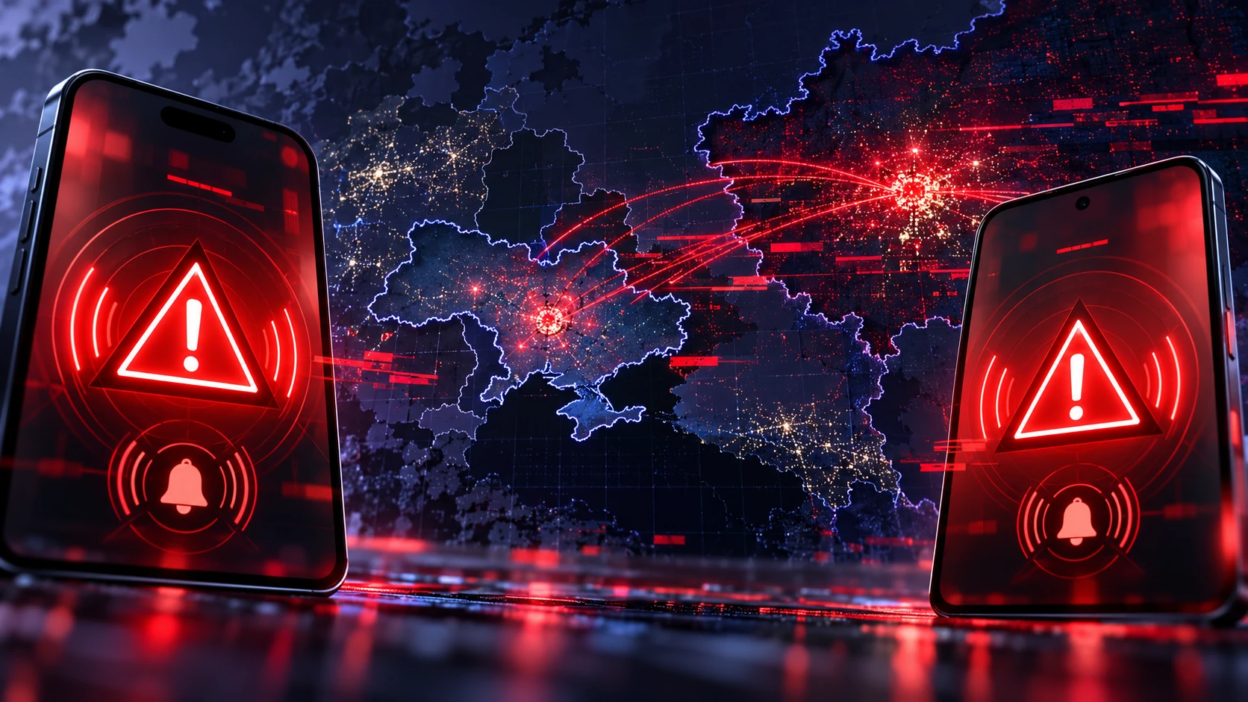
Emergency warning applications in Ukraine and Russia were targeted by separate reported cyberattacks on November 1–2, 2026, causing false safety notifications to reach mobile users. Ukraine’s Air Alert app displayed misleading warnings about radiation, chemical threats, street fighting, and the claimed deployment of Russia’s Oreshnik missile. Russia’s emergency ministry also reported that attackers had used its mobile application to distribute false information.
The first incident became public late on November 1, when Ukrainian users began receiving unusual warnings through the Air Alert application. Early on November 2, Russia’s Ministry of Emergency Situations reported a separate attack on its own mobile app. Both services are designed to help residents receive important safety information, including warnings about airstrikes, drone activity, and other emergencies.
Ukraine first reported unusual activity on its Air Alert application late on November 1. The mobile app, which millions of residents rely on for safety notifications, began displaying incorrect warnings about serious threats in Kyiv and other regions. Some messages suggested that certain areas were facing nuclear or chemical dangers, while others warned about possible fighting in the streets.
One false notification also claimed that Russia had deployed its Oreshnik hypersonic missile. The unexpected messages caused concern because the application normally provides important information about real security threats. Ukrainian authorities quickly responded and explained that the warnings were not genuine.
Ukraine’s Air Force said the Air Alert application appeared to have been compromised by hostile interference. The military confirmed that the radiation warning distributed through the app was false and urged residents to remain calm and follow verified official updates. At that stage, the Air Force had not identified the attackers or explained how the application had been compromised.
Ukraine’s Ministry of Digital Transformation said the Air Alert application was temporarily unavailable following the incident. The development team explained that it had disabled push notifications and suspended the service after detecting unauthorized interference. Officials said other public warning channels, including traditional air raid sirens, continued working during the disruption.
The developers later said that push notifications had resumed and the app’s map was again displaying yellow and red danger levels. However, the display of individual aerial threats on the map remained temporarily disabled while additional security work continued. The team also stated that the application does not store users’ personal data. The full technical details of the unauthorized access had not been publicly disclosed.
Early on November 2, Russia’s Ministry of Emergency Situations announced that its mobile application had experienced what it described as a massive cyberattack. According to the ministry, attackers used the application to distribute false information to users. Officials said technical teams were working to address the problem and restore normal operation.
Russia’s emergency application provides additional safety information about dangerous situations, including drone attacks and other public threats. The ministry said the country’s broader public warning system was not affected by the application incident. Other warning channels, including sirens, loudspeakers, text messages, television, and radio, remained available for communicating emergencies.
Although the two incidents happened only hours apart, there has been no publicly established connection between them. Ukraine’s Center for Strategic Communications accused Russia of being responsible for the attack on the Ukrainian warning application. However, that accusation has not been independently verified, and the technical methods used in either incident have not been fully disclosed.
The situation raises important questions about the reliability of emergency notification technology. Mobile warning applications have become essential tools in areas affected by military conflict because they can quickly deliver location-based alerts to thousands or millions of people.
However, these systems can create serious problems when attackers gain control over the information being distributed. False warnings can cause unnecessary panic, interrupt daily activities, and make people question whether future emergency notifications are trustworthy.
The spread of false emergency warnings also makes independent verification important, particularly when screenshots or claims appear on unfamiliar websites and social media pages. Readers can learn how to check whether a tech website is trustworthy before relying on information that has not been confirmed through official channels.
The exact technical methods used in these attacks have not been publicly confirmed. Investigators have not established whether attackers gained access through a server, an administrative account, a notification service, or another part of the system. More generally, protecting emergency applications requires securing their supporting servers, alert delivery services, staff accounts, and other connected systems against unauthorized access.
Strong account protection, continuous security monitoring, and reliable backup communication channels can help reduce the impact of attacks on public warning infrastructure. Having multiple ways to communicate emergencies is particularly important when a digital service becomes unavailable.
The incidents also demonstrate how cyberattacks can be used to spread confusion and misleading information without directly damaging physical infrastructure. During a conflict, false emergency notifications can affect public confidence and create uncertainty about genuine threats.
Deceptive security messages are also a problem outside emergency applications. Other online threats, such as fake CAPTCHA malware, show how attackers can use familiar-looking warnings or verification screens to persuade people to take unsafe actions.
People receiving unexpected emergency notifications should compare them with updates from official authorities and other authorized warning channels. Users should avoid opening unfamiliar links included in suspicious alerts, following basic guidance on recognizing phishing messages. Residents of Ukraine can also consult the official air-alert map for additional information about current warnings. However, an unusual app notification should never be treated as a reason to ignore genuine sirens or official instructions to take shelter.
The cyberattacks in Ukraine and Russia serve as another reminder that digital security is closely connected to public safety. As governments increasingly depend on mobile technology to communicate emergencies, protecting these systems against cyber threats is becoming more important than ever.