

AI model distillation, often called knowledge distillation, is a training approach that transfers useful behavior from a larger teacher model to a smaller student model. Instead of learning only from ground-truth labels, the student can also learn from the teacher’s probabilities, logits, generated outputs, or intermediate representations, depending on the distillation method.
AI Model Distillation: Meaning and Why It Matters

Large language models and deep neural networks can deliver strong performance, but they may also require substantial memory, compute, and serving cost. Distillation can reduce these deployment requirements by training a smaller student model to reproduce useful behavior from a larger teacher, although some loss of capability or accuracy may occur depending on the task and compression level.
This matters most when latency, device limits, or serving budgets are strict. Distillation also helps teams standardize a production model that is easier to monitor, test, and scale across different environments.
Teacher Student Learning Explained
Distillation starts with a capable teacher model and a smaller student model intended for deployment. During training, the student learns from supervision generated by the teacher. In classification tasks, this may involve matching probabilities or logits. In generative AI, the student may also learn from teacher-generated responses, token-level probability distributions, or other model outputs.
The teacher’s outputs often contain useful signals about uncertainty and class relationships. This richer supervision can improve the student’s generalization compared to training from hard labels alone. For example, imagine a teacher model classifies an image as 70% cat, 20% fox, and 10% dog. A normal hard label only tells the student that the answer is “cat.” Distillation can also expose the student to the teacher’s uncertainty, helping it learn that the image shares more characteristics with a fox than with a dog.
Soft Targets and Temperature Scaling
In classical knowledge distillation for classification, soft targets are probability distributions produced by the teacher instead of simple one-hot labels. A temperature parameter can make these distributions softer, exposing relationships among alternative classes that would otherwise be hidden by a single hard label.
A higher temperature generally produces a smoother probability distribution during distillation. The temperature and loss weighting must be tuned carefully because excessive smoothing can weaken the useful training signal.
Logits Distillation and Feature Distillation
Logits distillation aligns the student with the teacher’s pre-softmax outputs, encouraging similar decision boundaries. Feature-based distillation can compare intermediate representations such as hidden states, embeddings, or attention-related representations between teacher and student models.
Feature-level distillation encourages the student to reproduce useful intermediate representations from the teacher. When teacher and student architectures differ, additional projection or alignment layers may be required so their representations can be compared. The goal is to transfer useful representation patterns rather than reproduce the teacher’s internal processing exactly.
Common Distillation Techniques
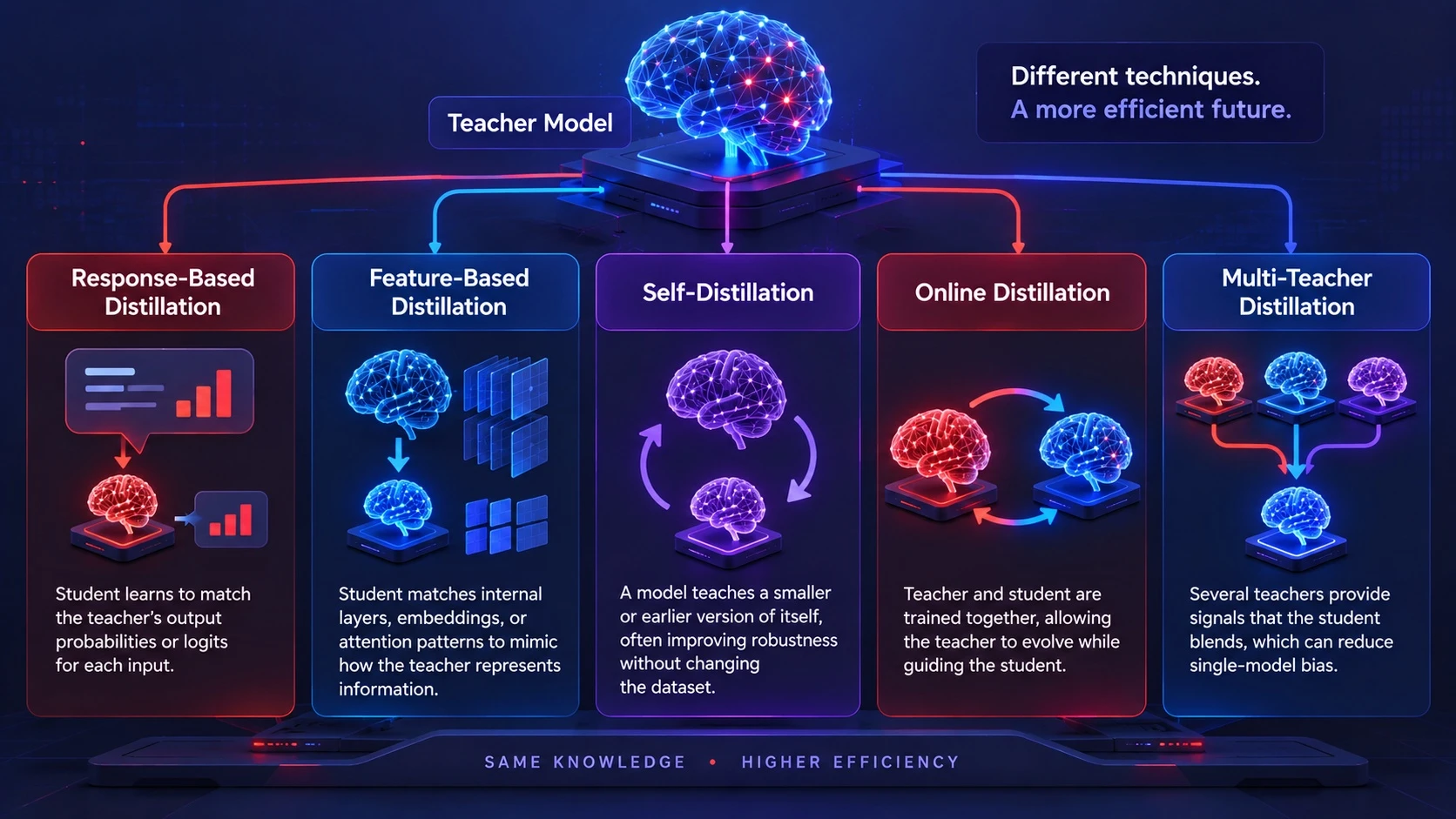
Distillation is not one method, but a family of techniques chosen based on the model type and deployment needs. The best approach depends on whether the priority is accuracy, speed, privacy, or hardware constraints.
- Response-Based Distillation: The student learns to match the teacher’s output probabilities or logits for each input.
- Feature-Based Distillation: The student matches internal layers, embeddings, or attention patterns to mimic how the teacher represents information.
- Self-Distillation: Knowledge is transferred between versions, checkpoints, layers, or components of the same model or model family rather than relying on a completely separate external teacher. It can improve training efficiency or model quality in some setups.
- Online Distillation: Teacher and student are trained together, allowing the teacher to evolve while guiding the student.
- Multi-Teacher Distillation: The student learns from multiple teacher models and combines their supervision signals. This can provide broader knowledge coverage, although conflicting teacher outputs may require careful weighting or filtering.
Once the technique is selected, teams usually tune the loss weighting between hard labels and teacher guidance to balance faithfulness and correctness.
Distillation Versus Other Model Compression Methods
Distillation is commonly discussed alongside techniques such as quantization and pruning because all three can help make AI systems cheaper or easier to deploy. However, they achieve efficiency in different ways and are often combined in production.
| Approach | Primary Goal | Typical Tradeoff |
|---|---|---|
| Model Distillation | Transfer behavior from a large teacher to a smaller student | Requires teacher access and careful training setup |
| Quantization | Use lower precision weights and activations | Potential accuracy drop on sensitive tasks |
| Pruning | Remove weights, neurons, or attention heads | May need retraining to recover quality |
Another common optimization is AI model quantization, which reduces numerical precision rather than training a separate student model. Distillation is most valuable when the goal is a smaller model that behaves like a strong reference model. Quantization and pruning are often chosen when the architecture must remain the same.
Parameter-efficient fine-tuning methods such as LoRA and adapters solve a related but different problem. They reduce the number of parameters that must be updated during customization, but they do not automatically make the underlying model smaller or faster during inference.
Where Distilled Models Work Best
Distilled models are commonly used where serving cost per request must be low or where real-time responses matter. They are also used when models must run on edge devices, private environments, or constrained containers.
For generative AI, distillation can produce small language models that approximate parts of a larger teacher’s response behavior, instruction following, or domain-specific capabilities. Results depend on the student model’s capacity, the quality and coverage of the training examples, the distillation objective, and the evaluation process.
How to Run AI Model Distillation in Practice?
A practical distillation pipeline starts with clear target constraints such as latency, memory, throughput, and acceptable quality. It also starts with a reliable teacher model, ideally one that is stable and well-evaluated on the target domain.
- Define The Target Metrics: Set thresholds for accuracy, latency, cost per request, and model size so tradeoffs are measurable.
- Select Teacher And Student Architectures: Pick a teacher with strong task performance and a student that fits deployment hardware and scaling needs.
- Prepare The Distillation Dataset: Prepare a representative training set using production-like examples with appropriate quality filtering and coverage. When representative real-world examples are limited or sensitive, carefully validated synthetic data can supplement the training set, although it should still be tested against real production distributions.
- Choose The Distillation Objective: Combine hard-label loss with teacher matching loss, and decide whether to align logits, probabilities, or internal features.
- Train And Validate Iteratively: Track both offline benchmarks and stress tests such as long-tail queries, outliers, and distribution shifts.
- Deploy With Monitoring: Monitor drift, failure modes, and latency regression, then refresh training data when behaviors change.
This workflow keeps the student optimized for real constraints rather than only leaderboard metrics. Always benchmark the student on the actual target hardware. A reduction in parameter count does not necessarily produce the same percentage improvement in latency because runtime efficiency also depends on memory bandwidth, kernels, batch size, sequence length, and hardware acceleration. Developers who want a hands-on implementation can also follow the official PyTorch knowledge distillation tutorial, which demonstrates how a smaller student network can learn from a stronger teacher.
Key Tradeoffs and Common Pitfalls
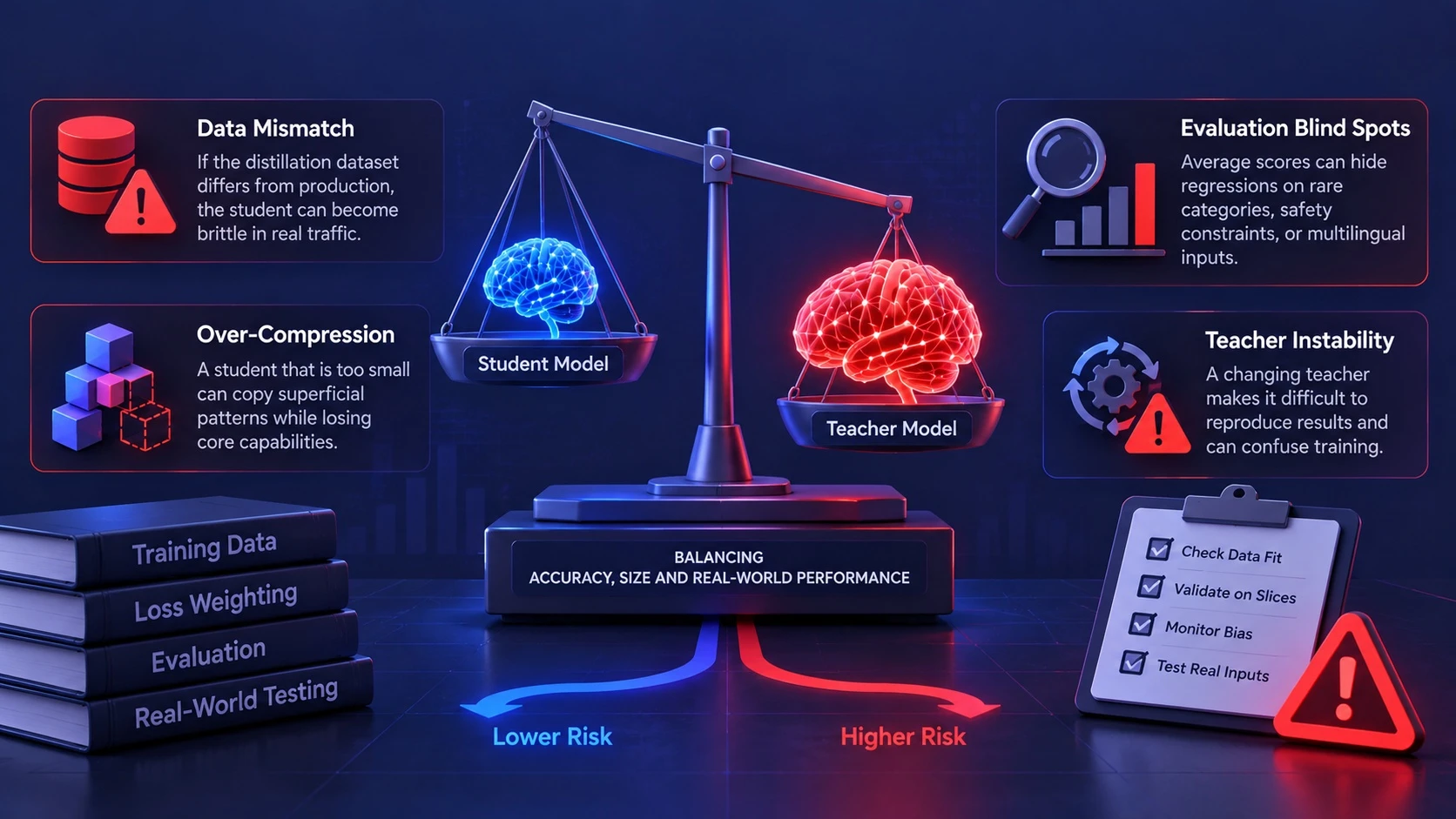
Distillation can fail when the teacher is strong but inconsistent, or when training data does not reflect real inputs. The student may also inherit teacher biases and errors if the teacher outputs are treated as truth.
Another common pitfall is over-optimizing for matching the teacher at the expense of ground truth accuracy. A balanced loss and careful evaluation across slices usually prevents this.
- Data Mismatch: If the distillation dataset differs from production, the student can become brittle in real traffic.
- Over-Compression: A student that is too small can copy superficial patterns while losing core capabilities.
- Evaluation Blind Spots: Average scores can hide regressions on rare categories, safety constraints, or multilingual inputs.
- Teacher Instability: A changing teacher makes it difficult to reproduce results and can confuse training.
Clear baselines and slice-based evaluation keep these risks visible throughout training.
Security, Privacy, and Governance Considerations
If a distilled student model is deployed on infrastructure an organization controls, it can reduce reliance on remote inference and may simplify some data-residency and access-control requirements. However, distillation itself does not provide privacy automatically. Privacy still depends on training-data handling, teacher outputs, deployment architecture, logging, access controls, and governance policies. Deployment architecture also matters, so teams should compare local AI and cloud AI when deciding where a distilled student model should run.
Teacher outputs should be treated as training data and reviewed accordingly. If those outputs contain sensitive, proprietary, or unwanted information, the student may reproduce some of those patterns. Filtering, privacy testing, access controls, evaluation, and clear data-handling policies should therefore remain part of the deployment process. Organizations deploying distilled models can also use frameworks such as the NIST AI Risk Management Framework to structure AI evaluation, governance, monitoring, and risk controls throughout the model lifecycle.
Operational Considerations for Deploying Distilled Models
Deploying a distilled model requires more than training the student. Teams also need representative evaluation datasets, latency benchmarks, serving infrastructure, monitoring, version control, and processes for identifying regressions after deployment.
Distillation can also be combined with optimizations such as quantization, caching, batching, and hardware-aware inference. Each optimization should be measured against both model quality and production performance so that lower serving cost does not create unacceptable accuracy or reliability losses.
Conclusion
AI model distillation is a widely used approach for transferring useful behavior from large teacher models into smaller student models. When implemented carefully, it can reduce memory use, serving cost, and latency while retaining much of the performance needed for a specific task.
Successful distillation depends on representative data, the right objective, and disciplined evaluation. With strong governance and monitoring, distilled models can deliver practical performance without the overhead of always running a large model.
Frequently Asked Questions
Is AI Model Distillation The Same As Quantization Or Pruning?
No. Distillation trains a new student model to imitate a teacher, while quantization and pruning compress an existing model by reducing precision or removing parameters. These methods can be combined to reach tighter latency and memory targets.
Do You Need Labeled Data For Model Distillation?
Not always. Knowledge distillation with unlabeled data is possible because the teacher model can generate supervision for inputs that do not have human-written labels. Mixing in labeled data can still improve correctness.
How Do You Know Whether A Distilled Model Is Good Enough For Production?
Evaluate it against clear acceptance thresholds across accuracy, safety, latency, and cost. Use slice-based testing for long-tail inputs and monitor post-deployment drift. A limited shadow deployment, where the student receives copies of real production requests without generating the response shown to users, can help teams compare its behavior with the existing system before a full rollout.