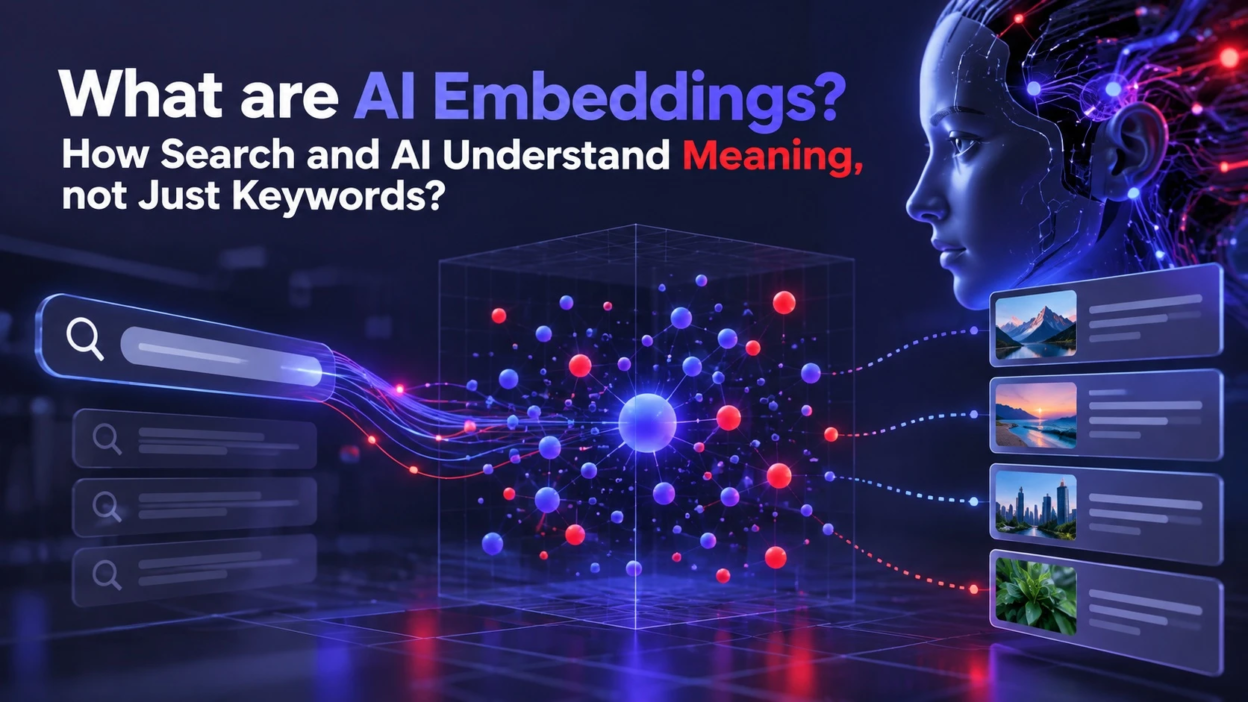
AI systems can match meaning even when words differ because they convert language into a mathematical form that preserves relationships. That representation is called an embedding, and it is one of the core building blocks behind modern search relevance, recommendations, and many AI applications.
What AI Embeddings are?
An AI embedding is a vector, which is a list of numbers that represents a piece of content such as a word, sentence, paragraph, image, or product. The goal is not to store the text itself, but to store its meaning in a way machines can compare.
Embeddings place related items near each other in a high dimensional space. Items that are unrelated end up farther apart, which makes similarity measurable rather than subjective.
How Embeddings Turn Text into Meaning?
Modern embedding models convert text into fixed-length numerical representations that capture patterns and relationships in meaning. During training, the model adjusts internal weights until it can predict or relate language in a consistent way.
Embeddings are also important in multimodal AI, where text, images, audio and other forms of information can be converted into numerical representations that models can compare and relate.
The output is a fixed length vector. Because the length stays consistent, different texts can be compared quickly using a distance or similarity score.
Key Properties of A Useful Embedding

Not all embeddings are equally helpful. Strong embeddings tend to share a few practical traits that make them reliable for search and AI workflows.
- Semantic proximity: Related phrases map close together even when they share few or no exact terms.
- Context sensitivity: Meaning shifts based on surrounding words, especially for ambiguous terms.
- Robustness: Minor changes in wording do not create large jumps in the vector space.
- Compact comparison: Similarity can be computed fast across large corpora using efficient vector math.
These properties explain why embeddings often outperform keyword matching when the query is vague, conversational, or uses different terminology than the content.
Why Search Uses Embeddings Instead of Only Keywords?
Keyword search depends heavily on exact token overlap. That works well for short, precise queries, but it breaks down when a user expresses intent in a different way than the page or document.
Embedding based retrieval uses semantic similarity to find content that answers the intent. It can also bridge synonyms, abbreviations, and domain language without manually curated rules.
What Gets Better With Semantic Search?
Embedding driven search improves several failure points of classic search systems. It also helps reduce over reliance on exact match terms.
- Query understanding: The system can rank results that align to intent rather than repeating the query text.
- Long tail coverage: Rare queries still map into the same semantic space, enabling better matches.
- Natural language queries: Conversational questions can be handled without complex parsing rules.
- Concept matching: Topics and entities can be matched even if the wording varies across sources.
After retrieval, many systems still use additional ranking signals such as freshness, authority, and user behavior. Embeddings often power the candidate set and improve relevance upstream.
Embeddings in AI Applications Beyond Search
Embeddings are not limited to search engines. Any system that benefits from similarity, clustering, or retrieval can use them.
Common uses include recommendations, grouping customer feedback, deduplicating content, detecting near duplicates, and powering retrieval augmented generation pipelines. In these setups, embeddings help an AI assistant fetch the most relevant context before writing an answer.
Vector Databases and Similarity Search
When you store embeddings at scale, you need infrastructure to query them quickly. A vector database or a vector search layer indexes embeddings so the system can find nearest neighbors efficiently.
Similarity search often relies on aproximate nearest-neighbor algorithms reduce the amount of search work required, trading some retrieval exactness for substantially faster queries at large scale improvement, which matters when you have millions of vectors.
Core Pieces in A Vector Search Stack

A practical semantic search stack includes several parts that must work together. Each one affects quality, cost, and latency.
- Embedding model: Produces vectors with the right balance of quality, speed, and domain fit.
- Chunking strategy: Splits long content into segments that can be retrieved accurately.
- Indexing method: Enables fast nearest neighbor lookup under memory constraints.
- Metadata filters: Limits results by language, access level, category, or other structured fields.
- Reranking layer: Refines top results with a stronger model or additional signals.
When these components are aligned, embeddings can power a search experience that feels closer to understanding than matching.
How Similarity is Measured?
Embeddings become useful when you can compare them. Most systems use cosine similarity or dot product to measure how aligned two vectors are.
Distance metrics are not just math details. The choice influences recall and ranking behavior, especially when vectors are normalized or when you mix multiple embedding sources.
| Concept | What It Means | Why It Matters |
|---|---|---|
| Cosine Similarity | Measures angle between vectors | Stable for comparing meaning regardless of vector length |
| Dot Product | Measures alignment and magnitude | Fast and common in large scale retrieval systems |
| Euclidean Distance | Measures straight line distance | Useful in some clustering setups, less common for text retrieval |
| Normalization | Scales vectors to length one | Makes cosine and dot product behave more consistently |
Limitations and Common Failure Modes
Embeddings can feel magical, but they are not perfect. They can miss nuance, mix senses of ambiguous terms, or return content that is topically similar but not actually answering the question.
Domain mismatch is another issue. A general model may not capture specialized terminology, so results can drift toward popular meanings rather than the user intent.
Quality Risks to Watch
Teams get better outcomes when they know what can go wrong early. This helps shape evaluation and monitoring.
- Semantic near miss: Results share topic overlap but fail the specific need.
- Overgeneralization: Vectors compress meaning and can blur important distinctions.
- Bias in training data: Learned associations can reflect skewed data distributions.
- Stale indexing: New content is not embedded and indexed quickly enough.
These risks are manageable with strong evaluation sets, human review loops, and careful model choice.
How to Use Embeddings Well in Real Systems?
Successful implementations start with the user journey and the information architecture. Retrieval quality depends as much on content structure and metadata as it does on the embedding model.
It also helps to design for observability. When search results look wrong, you need to know whether the problem came from chunking, indexing, filtering, or the model itself. In AI assistants and RAG systems, coordinating retrieval, metadata, source selection and model inputs is also an important part of context engineering.
Practical Implementation Guidelines
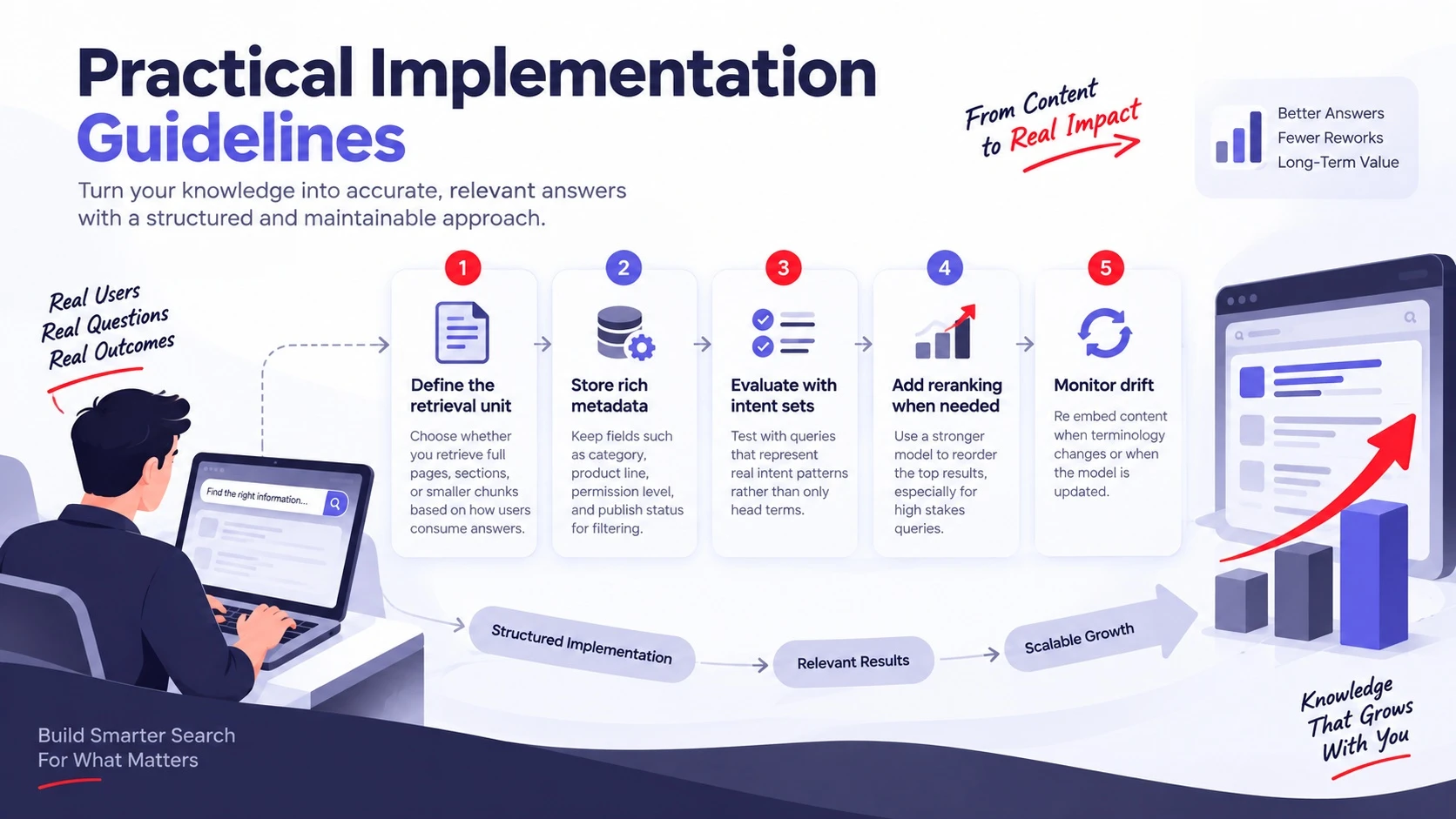
These guidelines reduce rework and improve relevance over time. They also keep the system maintainable as content grows.
- Define the retrieval unit: Choose whether you retrieve full pages, sections, or smaller chunks based on how users consume answers.
- Store rich metadata: Keep fields such as category, product line, permission level, and publish status for filtering.
- Evaluate with intent sets: Test with queries that represent real intent patterns rather than only head terms.
- Add reranking when needed: Use a stronger model to reorder the top results, especially for high stakes queries.
- Monitor drift: Re embed content when terminology changes or when the model is updated.
When teams need help choosing an embedding model, designing chunking rules, or building a vector search layer, TechBonafide typically approaches it as a full pipeline problem rather than a single model swap.
Embeddings and SEO What Content Teams Should Know
Google Search uses AI-based systems such as BERT, neural matching and RankBrain to better understand how words, concepts and user intent relate to one another, rather than relying only on exact keyword matches, which means content should be written for clarity and intent coverage rather than mechanical keyword repetition. That still includes using important terms, but in a natural way that reflects how people ask questions.
Strong internal linking, clean topic organization, and clear definitions help machines and humans. Structured pages that answer related sub questions also make it easier for semantic systems to map the content accurately.
Content Signals That Support Semantic Understanding
These signals help systems align a page with the right intents. They also improve reader experience at the same time.
- Clear topical focus: One page should satisfy one primary intent with supporting sub topics.
- Consistent terminology: Use the terms your audience uses and define specialized language when needed.
- Helpful structure: Use descriptive subheadings and short sections that make scanning easy.
- Entity coverage: Include related concepts, constraints, and comparisons that complete the topic.
For organizations that want to align SEO with semantic search and AI discovery, TechBonafide can map content to intent clusters and support retrieval friendly content structuring for knowledge bases and product documentation.
Conclusion
AI embeddings translate content into vectors that capture meaning and make similarity measurable. That shift enables semantic search, better recommendations, and retrieval pipelines that support AI assistants.
The strongest results come from treating embeddings as part of a system that includes good content structure, metadata, evaluation, and monitoring. When those pieces work together, search becomes less about matching words and more about matching intent.
Frequently Asked Questions
Do AI Embeddings Replace Keywords Completely?
No, keywords still matter for precision, filters, and certain ranking signals. Embeddings improve matching when wording varies and when the query expresses intent indirectly. Many systems use both approaches together.
What Is the Difference Between Embeddings And A Vector Database?
Embeddings are the vectors produced by a model. A vector database stores and indexes those vectors so they can be searched quickly using similarity metrics. The database is infrastructure, while the embedding is the representation.
How Do You Know If An Embedding Model Is Good For Your Domain?
You validate it with an evaluation set that reflects your real queries and content. Measure relevance, not just speed, and review failure cases to see where meaning is being missed. If domain language is specialized, consider domain tuned embeddings and add reranking for critical queries.