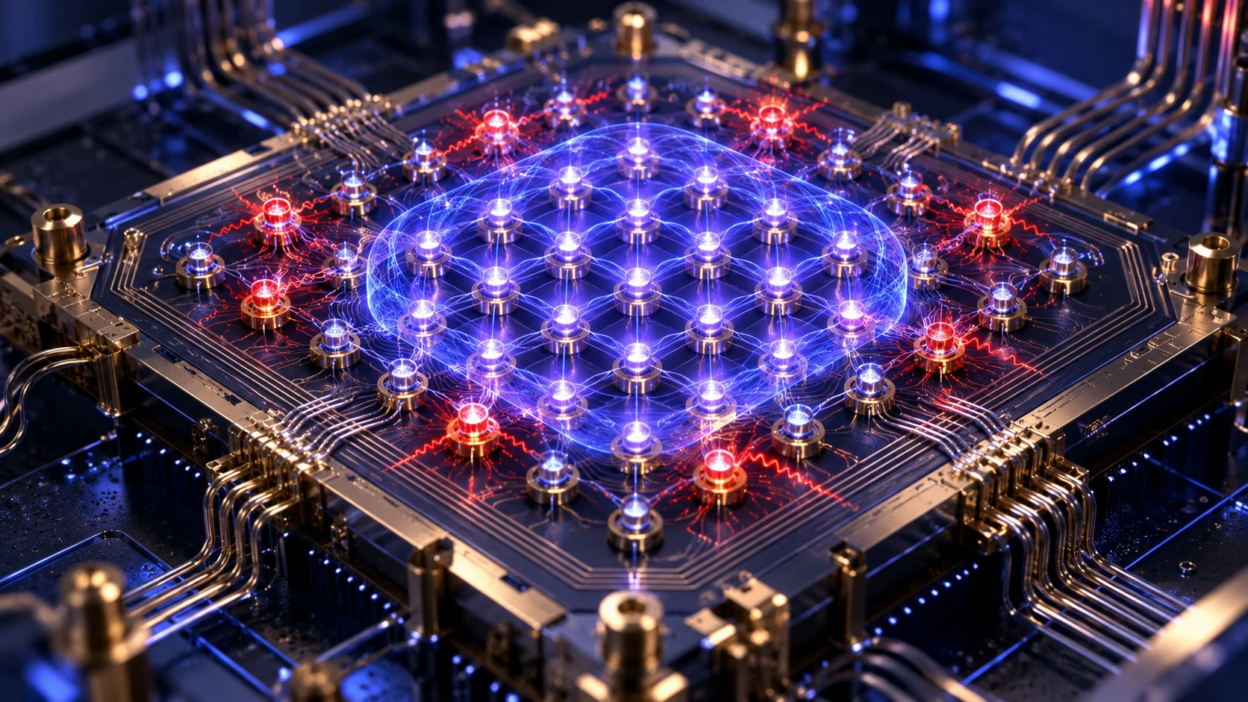
Quantum computing progress is often framed as a race to build bigger chips with more qubits. That headline number matters, but it does not capture whether a device can run useful circuits for long enough to return a correct answer. Quantum error correction is one of the essential technologies needed to turn fragile quantum hardware into a reliable and scalable computing platform.
Why Qubit Count Alone Can Mislead?
Physical qubits are the raw building blocks on a quantum chip. They are also noisy, which means their states can be affected by heat, stray fields, control imperfections, and measurement errors. When noise overwhelms a quantum circuit, adding more physical qubits without improving error rates or implementing effective error correction may not increase the amount of reliable computation.
Chip size can even create new failure paths. Larger layouts increase wiring complexity, crosstalk, calibration burden, and correlated errors across neighboring qubits. The result can be a bigger device with a similar or worse effective computing capability.
What Quantum Error Correction Actually Does?
Quantum error correction works by encoding information across multiple physical qubits so that errors can be detected and corrected without directly learning the encoded quantum state. Instead of trying to make a single qubit perfect, the goal is to make a group behave like one far more reliable unit. That reliable unit is called a logical qubit.
Quantum error correction should not be confused with quantum error mitigation. Error mitigation uses techniques to reduce the impact of noise on measured results, often through additional experiments or classical processing. Error correction goes further by protecting encoded quantum information while a computation runs. Both approaches are valuable, but error correction is essential to the standard path toward large-scale fault-tolerant quantum computing.
Quantum error correction relies on repeated stabilizer measurements that reveal patterns of errors without exposing the encoded logical information. A classical decoder interprets these measurements and determines how to track or correct likely errors. The goal is to reduce the logical error rate, allowing deeper and more reliable quantum circuits.
Logical Qubits Versus Physical Qubits
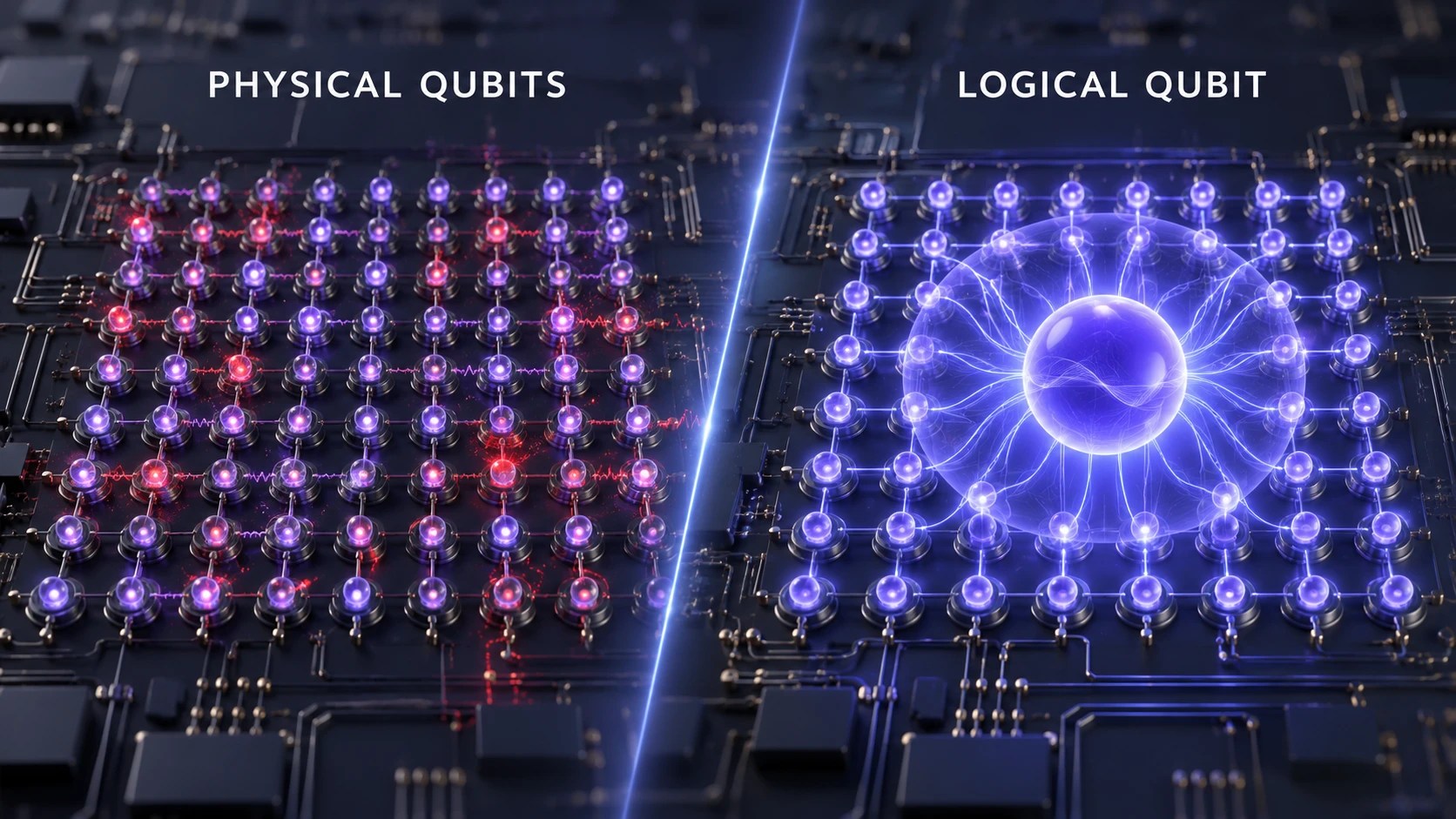
Two quantum computers with the same number of physical qubits can deliver very different results depending on their error rates, connectivity, and ability to support logical qubits. A smaller system with reliable logical qubits may perform certain computations more accurately than a larger system using noisy physical qubits. However, the number of logical qubits, supported operations, and circuit depth must still be sufficient for the intended algorithm. This is why meaningful quantum computing roadmaps increasingly consider logical-qubit performance alongside physical-qubit counts.
Logical qubits are expensive in hardware terms. Depending on the code, connectivity, and noise levels, one logical qubit may require dozens to thousands of physical qubits. That overhead is not waste; it is the cost of reliability.
Noise and Decoherence Set the Real Limit
Quantum information decays through decoherence, which includes energy relaxation and loss of phase coherence. Gate operations and measurements add their own error probabilities. When a computation requires many gates, the total failure probability compounds quickly.
Quantum error correction changes how errors accumulate as a computer scales. When physical error rates remain below the threshold for a particular error-correcting code and noise model, increasing code distance can significantly reduce logical error rates. Under suitable conditions, this reduction can be exponential. However, when physical error rates exceed the threshold, adding more qubits and correction operations may fail to improve reliability because the extra operations introduce too many additional errors.
Quantum Error Correction Thresholds and Code Distance Explained
The quantum fault-tolerance threshold represents a critical physical error level below which a particular error-correcting code and correction procedure can benefit from greater protection. When hardware error rates remain below this threshold and the relevant assumptions hold, increasing code distance can reduce logical error rates. Above the threshold, additional qubits and correction operations may introduce more errors than the system can reliably handle.
Code distance describes the minimum number of physical-qubit errors needed to produce an undetected logical error under the code’s mathematical model. For example, a distance-three code can generally correct an arbitrary error affecting one physical qubit under standard assumptions. Increasing code distance allows protection against more errors, but the benefits depend on sufficiently low physical error rates and reliable correction procedures. Greater distance also requires additional hardware and error-checking operations, making it an important factor in quantum processor design.
Why Bigger Chips Can Be Less Useful Without Correction?
As chips scale, maintaining uniform qubit quality becomes harder. Variability in qubit frequencies, coherence times, and coupling strengths can create weak spots that dominate system behavior. Without an error correction strategy, the weakest components can limit the reliability of the whole machine.
Scaling also increases the chance of correlated errors such as shared noise sources, control line interference, and collective heating. Correlated errors are especially dangerous because many error-correction methods are designed around assumptions about how frequently errors occur together. Designing for fault tolerance requires treating correlated noise as a first-class engineering constraint.
The Role of Fault Tolerance
Fault tolerance is the discipline of running error correction while still performing computation, without letting the correction process introduce more errors than it removes. It requires careful scheduling, compatible gate sets, and hardware that supports frequent measurement and fast classical feedback. It also requires software that can decode syndromes quickly enough to keep pace.
Fault-tolerant quantum computing provides a theoretical path toward running much longer and more reliable quantum algorithms, provided physical error rates remain sufficiently low and enough resources are available. However, demonstrating fault-tolerant operations does not automatically establish practical quantum advantage. Useful performance also depends on the algorithms, the number of available logical qubits, execution time, and whether the quantum system can outperform suitable classical computing methods.
Why Surface Codes Matter in Quantum Error Correction?
The surface code is popular because it tolerates relatively high physical error rates compared to many alternatives and maps well to two-dimensional grids with nearest-neighbor interactions. It uses repeated local measurements, which align with many hardware platforms. Its main drawback is overhead, since large code distances demand many qubits.
A practical example comes from Google’s Willow surface-code experiment, published in Nature. Researchers demonstrated that increasing the surface-code distance from five to seven reduced the logical error rate of an encoded quantum memory. The experiment showed that stronger error correction could improve reliability as the encoded system grew. However, the result involved protecting quantum memory and did not establish that a complete, general-purpose fault-tolerant quantum computer had been achieved.
Other codes and approaches exist, including bosonic codes, color codes, and low-density parity-check codes. Each option trades hardware demands against decoding complexity, connectivity, and tolerance to bias in noise. The best choice depends on the error model and the engineering constraints.
Researchers are also investigating different quantum hardware architectures that may offer improved protection against certain types of errors. One example is Microsoft’s Majorana-based quantum computing approach, which explores the possibility of building more stable qubits using topological properties. This is a different hardware strategy rather than simply another surface-code design, and its practical benefits still require careful experimental validation.
Key Metrics That Matter More Than Chip Size
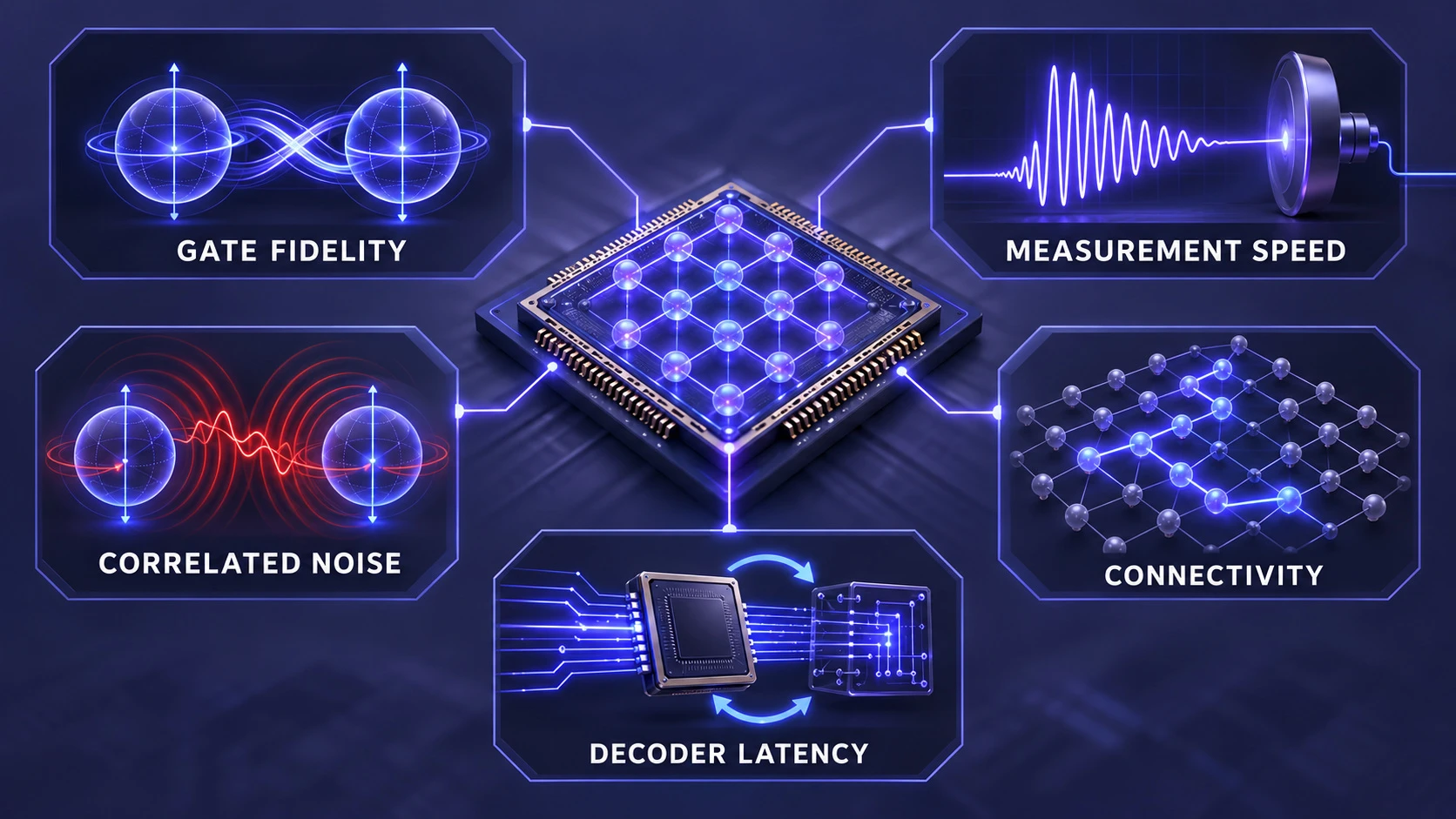
Teams evaluating quantum systems benefit from focusing on metrics that predict whether logical qubits are reachable. These indicators connect device physics to algorithm feasibility. They also reduce the temptation to optimize for a single number.
- Two-Qubit Gate Fidelity: More accurate two-qubit operations reduce errors during quantum computation and stabilizer measurements, improving the conditions needed for effective error correction.
- Measurement Fidelity and Speed: Fast, accurate measurements help identify error patterns before accumulated noise causes logical failures.
- Crosstalk and Correlated Noise: Unwanted interactions and shared noise sources can affect multiple qubits simultaneously, making errors more difficult to identify and correct.
- Connectivity and Routing Cost: Hardware connectivity determines which qubits can interact directly. Efficient layouts and routing strategies reduce unnecessary operations and help limit additional errors.
- Decoder Latency: Error-correction software must process measurement results quickly enough to keep pace with the quantum processor and provide correction information when needed.
When these metrics improve together, logical qubits become a more realistic engineering goal rather than a speculative claim. That is an important signal of technological maturity.
How Error Correction Changes the Roadmap for Practical Quantum Computing?
With error correction, progress shifts from adding qubits to lowering logical error per operation and increasing logical circuit depth. This aligns engineering work across hardware, firmware, and control software. It also changes how organizations plan experiments, since error-corrected systems demand careful resource estimates.
Improvements in logical-qubit reliability also influence how researchers, companies, and investors evaluate progress. Instead of focusing only on larger chips, organizations increasingly look for measurable improvements in stability, operational performance, and scalability. These considerations are closely connected to the trends discussed in TechBonafide’s analysis of quantum computing investment in 2026.
Resource estimation starts with an algorithm’s logical-qubit requirements, gate operations, expected runtime, and acceptable failure probability. Engineers then translate those requirements into physical qubit counts, code distances, and hardware-specific operations. Tools such as the Microsoft Quantum resource estimator demonstrate how different quantum architectures and error-correction methods affect the resources needed to execute an algorithm reliably. This is why error correction plays a central role in credible quantum computing roadmaps.
Quantum Chip Size Still Matters But in A Different Way
None of this means chip size is irrelevant. Larger chips are needed to host the overhead of encoding, syndrome extraction, and routing while still leaving room for useful computation. The point is that scaling must be guided by error correction needs, not by raw qubit totals.
Quantum computing is also part of a broader effort to develop new computing architectures. However, not every emerging processor uses quantum principles. For example, photonic computing and light-based chips can use optical signals for communication or selected calculations without necessarily processing quantum information. Understanding this distinction helps readers evaluate different claims about future computing performance.
In practice, the most meaningful scaling is the ability to run more rounds of error correction with stable performance across the lattice. That kind of scaling tends to be less visible in headlines, but it is what turns prototypes into platforms.
Quantum Computing Scaling: Physical Qubits vs Logical Performance
| Scaling Focus | What Improves | What Can Still Break |
|---|---|---|
| More Physical Qubits | Potential for a larger computational state space and more parallel operations | Noise accumulation, calibration complexity, and correlated errors |
| Higher Gate Fidelity | Lower physical gate error rates and more reliable error-correction operations | Correlated errors, measurement failures, and decoder bottlenecks |
| Faster Measurement and Feedback | More effective syndrome extraction and timely correction | Classical decoding bottlenecks at scale |
| Logical Qubit Scaling | Potential for deeper circuits and more reliable computation | Hardware overhead, logical gate errors, and architectural constraints |
This framing helps separate demonstration scale from useful scale. It also clarifies why error correction has become a central measure of meaningful quantum computing progress.
What to Look for in Claims About Quantum Progress
Credible progress reports describe error models, benchmarking methods, and how performance changes with system size. They also clarify whether results are based on physical circuits or encoded logical operations. Without those details, it is difficult to assess whether scale is translating into reliability.
Strong signals include repeated rounds of syndrome extraction with stable performance, evidence of logical error suppression as code distance increases, and transparent accounting of decoding and control latency. These are harder to produce than a qubit count, but they track real capability.
Conclusion
Quantum chip size sets the stage, but quantum error correction determines whether the play can run to completion. Without reliable logical qubits, larger devices remain limited to short, noisy circuits with narrow utility. With error correction and fault tolerance, scaling becomes meaningful because it increases the length and complexity of computations that can be trusted.
The most important question is not how many qubits fit on a chip. It is how effectively the system can turn noisy physical qubits into stable logical qubits that support deep circuits.