
Building a searchable AI knowledge base does not usually require retraining a language model. Instead, organizations can use retrieval-augmented generation (RAG) to connect an existing AI model with their trusted documents, policies, and internal resources. When someone asks a question, the system retrieves relevant information and provides it to the model before generating an answer. This approach makes knowledge updates easier and can improve accuracy, reduce unsupported answers, and provide verifiable citations when retrieval and source validation are properly implemented.
What a Searchable AI Knowledge Base Really is?
A searchable AI knowledge base is a system that stores curated organizational knowledge and makes it easy for an AI assistant to find and use it during a conversation. Instead of relying only on the model’s learned knowledge, the assistant retrieves relevant passages from documents and uses them as context for a response. This approach is known as retrieval-augmented generation (RAG), which connects a generative AI model with relevant information retrieved from an external knowledge source when a user asks a question.
Search is the core capability. If retrieval is weak, the assistant will miss key policies, specifications, and procedures even when they exist in the repository. Strong retrieval depends on clean source content, good chunking, robust indexing, and meaningful relevance ranking.
Why Avoid Retraining for Knowledge Updates?
Fine-tuning can improve how an AI model follows instructions, uses specialized terminology, or produces consistent response formats. However, it is generally unsuitable for maintaining frequently changing organizational information. Updating facts through fine-tuning requires additional training, evaluation, and deployment, and does not automatically provide reliable source citations. A retrieval-based system can instead refresh its searchable documents without modifying the model’s underlying parameters. This makes RAG a practical choice for knowledge bases containing regularly updated policies, product information, and procedures.
A retrieval-first design keeps the model stable while the knowledge base changes as the business changes. That creates a clearer audit trail, faster publishing, and more predictable behavior. It also supports governance practices such as access controls and document approval workflows.
For organizations deciding between retrieval and model customization, understanding RAG vs fine-tuning can help identify which approach best supports their knowledge management requirements.
Core Components of a No-Retraining Architecture
The architecture has a few essential building blocks that work together as a pipeline. With well-defined interfaces, teams can update individual components as requirements and tools evolve.
- Source Content Layer: Policies, product documents, runbooks, FAQs, tickets, and internal wikis prepared in stable formats.
- Ingestion and Parsing: Connectors that collect content, extract text, and preserve metadata such as owner, system, and effective date.
- Chunking and Enrichment: Splitting content into retrieval-friendly segments and adding tags, titles, and section context.
- Vector Index and Keyword Index: Embedding-based similarity search alongside lexical search for exact terms and identifiers.
- Retriever and Reranker: Query handling, retrieval, and relevance ranking to promote the most useful passages.
- Prompt and Response Layer: Carefully designed instructions and retrieved context that encourage supported answers, traceable citations, and appropriate uncertainty. This is an important part of context engineering, which organizes the information and constraints required for reliable responses.
- Observability and Feedback: Logs, evaluation datasets, and user feedback loops that reveal where retrieval or answer generation fails.
Once these parts are in place, the main work becomes operational excellence. That includes content hygiene, testing, and careful access governance.
Step-by-Step Process to Build a Searchable AI Knowledge Base
A basic RAG knowledge base can be developed without training a new language model. Start with a small collection of reliable documents, validate the retrieval process, and expand the system after confirming that it answers real questions accurately.
Step 1: Define the Knowledge Base’s Purpose
Identify the questions your AI assistant should answer. For example, an internal support assistant might need to explain company policies, IT procedures, and product documentation. Define the intended users, permitted information sources, and situations where the assistant should acknowledge missing information.
Step 2: Collect and Prepare Trusted Documents
Gather approved PDFs, help articles, Markdown files, manuals, and internal documentation. Remove duplicates, identify outdated versions, preserve document headings, and assign an owner to each source. Keep restricted documents separate unless the system can enforce their permissions correctly.
Step 3: Convert Documents Into Searchable Chunks
Extract readable text while preserving titles, sections, lists, and useful table information. Divide longer documents into meaningful passages and retain their original source identifiers. Test different chunk sizes to determine which approach retrieves complete, relevant answers for your content.
Step 4: Generate Embeddings and Create a Search Index
Convert document passages into numerical embeddings using an embedding model. Store the vectors in a compatible search system and retain the original text, source URL, document title, update date, and permission metadata. Add keyword search when exact terms, product identifiers, or policy codes are important.
Step 5: Connect Retrieval to an Existing AI Model
When a user submits a question, authenticate the user, apply document permissions, search the approved knowledge base, and rank the relevant passages. Send the selected passages to an existing language model with instructions to answer from the supplied evidence and identify the sources used.
Step 6: Test Answers Before Deployment
Prepare a test set of representative questions with expected source passages. Check whether the system retrieves the correct documents, generates supported answers, provides accurate citations, and handles unanswered questions appropriately. Include tests for outdated documents, conflicting instructions, and restricted information.
Step 7: Publish, Monitor, and Maintain the System
Deploy the assistant with appropriate access controls, logging, and feedback collection. Monitor retrieval failures, incorrect answers, latency, and source freshness. When information changes, update the approved documents and refresh the relevant search index entries without retraining the language model.
This process creates an initial working knowledge base that can be improved through document maintenance, retrieval evaluation, and carefully controlled updates.
Example: How a Knowledge Base Answers a Company Policy Question
Suppose an employee asks an AI assistant, “How many days of annual leave can I carry forward?”
The assistant first checks the employee’s access permissions and searches the organization’s approved HR policies. It retrieves the relevant leave policy section, supplies that passage to the language model, and generates an answer based on the documented rule. The response includes a citation pointing to the policy and its relevant section.
If the policy does not specify a carry-forward limit, the assistant should acknowledge that the information is unavailable instead of inventing a number. If multiple approved policies conflict, the system should flag the inconsistency for review rather than silently choosing an unsupported answer.
This example demonstrates how retrieval, permissions, grounding, and citations work together without changing the AI model’s training.
Content Readiness and Knowledge Base Hygiene
High-quality answers start with high-quality content. Conflicting documents, outdated PDFs, and inconsistent terminology create confusion for both search and users. A knowledge base should treat documentation like a product, with owners, revision history, and deprecation rules.
- Single Source of Truth: Consolidate duplicates and mark authoritative documents clearly.
- Clear Information Architecture: Use predictable headings, consistent naming, and stable URLs or IDs.
- Metadata Discipline: Track owner, department, audience, region, and version to filter retrieval correctly.
- Deprecation Policy: Retire obsolete content and keep an archive that is excluded from default retrieval.
This preparation reduces retrieval noise and makes evaluations more meaningful. It also speeds up onboarding for teams maintaining the system.
Document Ingestion and Chunking Strategy
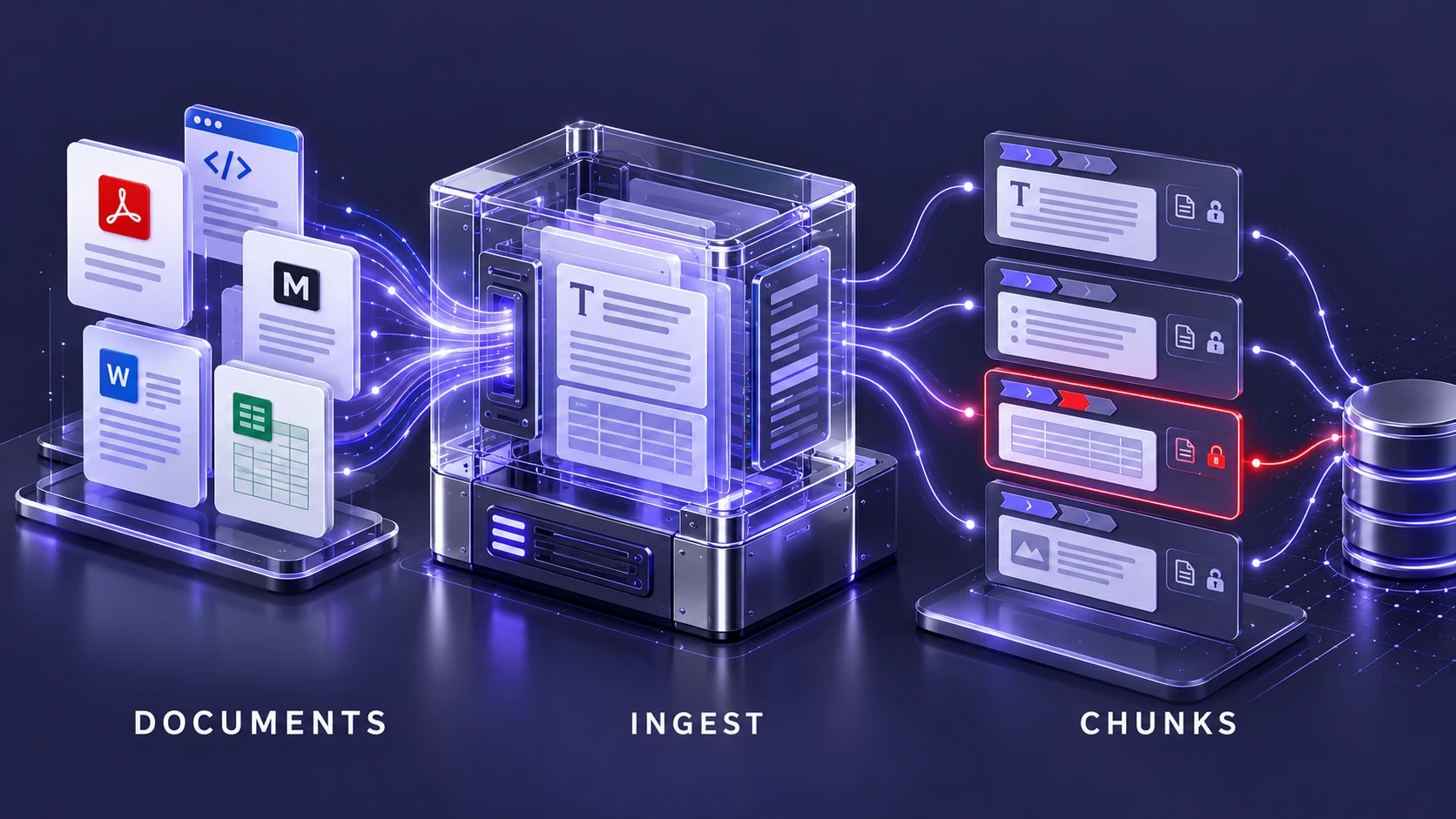
Ingestion converts source documents into text and structured fields that search can use. Parsing must handle HTML, Markdown, PDFs, office files, and help center exports without losing headings and tables. Retaining structure enables better chunk boundaries and better citations.
Chunking is where many systems succeed or fail. Overly large chunks dilute relevance, while overly small chunks lose context and cause fragmented answers. Choosing appropriate document chunking strategies, such as fixed-size, hierarchical, or semantic chunking, helps teams preserve useful context while making individual passages easier to retrieve and reference.
- Normalize Text: Remove repeated headers and footers, fix encoding issues, and standardize whitespace.
- Preserve Structure: Keep headings, lists, and table rows so retrieval returns coherent guidance.
- Chunk by Meaning: Split by sections and subsections where appropriate, then evaluate whether passage lengths work for actual questions.
- Add Context Fields: Store document title, section title, and breadcrumb text alongside each chunk.
- Attach Governance Metadata: Include permissions, effective dates, and content owner for filtering.
After chunking, indexing becomes more stable because each chunk maps cleanly to a source and a section. That makes citations and audits easier.
Search Indexing With Embeddings and Hybrid Retrieval
AI embeddings represent text as numerical vectors that allow search systems to compare semantic similarity even when documents and user questions contain different wording. This helps retrieval when users ask questions in their own words rather than matching exact phrasing. Keyword search still matters for part numbers, error codes, and exact policy terms.
Hybrid search combines vector-based similarity search with keyword matching to retrieve relevant information from both semantic and exact-term queries. A typical flow runs a vector query and a keyword query, merges results, and may rerank the candidates. This can reduce missed matches and improve relevance across varied question types.
| Method | Strength | Best Fit |
|---|---|---|
| Vector Search | Finds semantic matches across wording differences | How-to questions and concept lookups |
| Keyword Search | High precision on exact terms and identifiers | Error codes, SKU names, and policy clauses |
| Hybrid Retrieval | Combines semantic recall with exact-term matching | Mixed queries across different departments |
| Reranking | Promotes passages most relevant to the question | Answers that require precise source selection |
Index quality also depends on deduplication and consistent tokenization. When multiple versions of the same content exist, retrieval should prefer the latest approved version by default.
Grounded Answer Generation With Citations
Retrieving relevant documents does not automatically guarantee a correct or trustworthy AI response. The application should instruct the model to base factual answers on retrieved passages and acknowledge uncertainty when sufficient evidence is unavailable. Each citation should identify the document and specific passage supporting the corresponding claim. Because language models can still misunderstand sources or produce inaccurate citations, important answers should undergo additional validation rather than relying on prompting alone.
- Strict Grounding Instructions: Direct the assistant to use retrieved passages as evidence for factual statements and acknowledge unsupported requests.
- Citation Format: Include the original document title, relevant section, and source reference so users can verify important statements. AWS provides an implementation example of source citations in retrieval-based AI systems, including responses connected to specific retrieved passages.
- Refusal and Escalation: Provide a safe fallback when the knowledge base does not contain the answer.
- Answer Style Controls: Use concise formats such as checklists for procedures and bullet summaries for policies.
Even when a model receives relevant documents, unsupported claims and incorrect interpretations can still occur. Teams should therefore check whether individual statements are actually supported by retrieved passages rather than simply confirming that citations exist. Understanding the causes of AI hallucinations can also help organizations develop stronger grounding instructions, verification checks, and fallback responses when reliable information is unavailable.
Security and Access Controls for Internal Knowledge
Internal AI knowledge bases may contain confidential policies, employee information, customer records, pricing documents, and incident reports. Access control must therefore be enforced within the retrieval process, not only through the application’s user interface. Documents and their indexed passages should retain the appropriate permission metadata, while every search request must be checked against the authenticated user’s access rights. Permission changes and document removals should also be synchronized with the search index to prevent outdated access rules from exposing restricted information.
Common patterns include role-based access control, group-based permissions, and tenant isolation for multi-client environments. Filtering results by user identity helps prevent cross-team leakage and supports compliance audits.
Access permissions are only one part of securing a retrieval-based AI system. Retrieved documents may also contain hidden or malicious instructions designed to influence the assistant’s behavior. Organizations should treat retrieved content as untrusted data, separate source material from application instructions, restrict sensitive tool access, and test for indirect prompt injection. OWASP’s prompt injection guidance explains these risks and identifies defensive measures for applications that process external information.
- Permission Sync: Mirror source system permissions into the index and keep them updated.
- Least Privilege Retrieval: Enforce document-level access control so each user receives only search results they are authorized to access. Permission checks should occur before restricted passages are passed to reranking or answer-generation components.
- Logging and Audit Trails: Record relevant query activity, retrieved document identifiers, and user identity with appropriate retention and privacy controls.
Evaluation and Continuous Improvement Without Training
Without retraining, improvement comes from better retrieval and better content. Evaluation should focus on whether the right passages are retrieved and whether the final answer stays grounded. This is measurable with a repeatable test set of real user questions collected and handled appropriately from search logs and support tickets.
Measure retrieval performance using metrics such as recall at k and mean reciprocal rank, then evaluate generated answers for factual support, citation accuracy, and appropriate refusal behavior. Established RAG evaluation metrics also include context precision, context recall, and faithfulness, which help teams identify whether errors originate from retrieval or answer generation. Feedback tools that capture thumbs up or down, plus reason codes, can accelerate iteration.
- Build a Golden Set: Maintain a curated list of questions with expected source documents and sections.
- Run Retrieval Checks: Confirm the correct chunk appears in top results before judging the generated answer.
- Review Failure Modes: Classify misses into parsing, chunking, missing content, or ranking issues.
- Fix at the Right Layer: Update content, metadata, or ranking rules rather than automatically changing the model.
This loop helps maintain accuracy as documentation evolves. It also supports change management by showing why a behavior changed after an index update.
Common Mistakes That Make Search Fail

Most issues trace back to content inconsistency or weak retrieval design. Fixing them typically does not require new models. It requires discipline in ingestion, indexing, and monitoring.
- Indexing Raw PDFs Only: Poor text extraction reduces recall and breaks section-level citations.
- Chunks Without Context: Removing headings and breadcrumbs makes similar chunks indistinguishable.
- Ignoring Exact-Match Search: Relying exclusively on semantic retrieval can reduce accuracy for certain product codes, policy identifiers, and technical error messages. Evaluate keyword search alongside vector search and introduce hybrid retrieval when testing demonstrates better results.
- Ignoring Freshness: Old versions remain retrievable and can contradict current policies.
- No Permission Filtering: Restricted documents can appear in search results and expose confidential information to unauthorized users. Teams should also account for prompt injection, where malicious instructions hidden in retrieved content attempt to manipulate an AI assistant’s behavior.
Addressing these gaps often produces a larger quality improvement than fine-tuning for knowledge-retrieval problems. It also improves user trust because the assistant becomes more consistent and transparent.
Operational Playbook for Long-Term Reliability
Once the first version works, reliability becomes the main goal. Treat the knowledge base like a production service with service-level objectives, ownership, and scheduled maintenance. A small set of operational habits can prevent many regressions.
- Release Process: Use staged rollouts for index updates and prompt changes.
- Content Stewardship: Assign owners for each domain and require periodic reviews of critical documents.
- Incident Response: Define how to handle incorrect answers, including rapid content fixes and temporary query restrictions.
- Monitoring: Watch retrieval latency, error rates, and spikes in unsupported or low-confidence responses.
Conclusion
A searchable AI knowledge base without retraining a model is built by combining clean content, reliable ingestion, thoughtful chunking, effective search, and grounded generation. Hybrid retrieval can help when queries require both semantic matching and exact-term precision. Strong governance and access control protect sensitive knowledge while enabling useful automation. Continuous evaluation reveals where retrieval or answer generation fails and what to improve next.
When the system is designed this way, updates become routine documentation and indexing work rather than model-training work. That keeps the assistant easier to update, audit, and trust.
Frequently Asked Questions
Do I Need Fine-Tuning At All for A Searchable AI Knowledge Base?
Not for keeping knowledge current. Most teams should first improve retrieval quality, chunk structure, metadata, and grounding rules. Fine-tuning can help with tone, specialized behavior, and response formatting, but it should be considered separately from knowledge updates.
How Often Should the Knowledge Base Index Be Updated?
The update schedule depends on how frequently source documents change and how quickly users need access to new information. Frequently updated policies, inventory records, or incident procedures may require event-triggered or near-real-time indexing. More stable documentation can use scheduled synchronization. Regardless of the schedule, organizations should monitor indexing failures, remove obsolete content, and verify that updated documents are retrievable before considering the refresh complete.
How Can I Reduce Hallucinations Without Retraining?
Use grounding instructions, retrieve relevant and approved sources, and verify that citations support the claims being made. Limit the model context to useful passages, filter out low-relevance results, and test the assistant against questions with known answers. When retrieval is empty or uncertain, the assistant should acknowledge the gap and guide users to the appropriate internal owner or process.