
Terraform vs OpenTofu is an important comparison for teams that want reliable, secure, and repeatable cloud infrastructure. Both tools use Infrastructure as Code (IaC) to manage resources through configuration files, reducing the need for manual infrastructure setup.
Although Terraform and OpenTofu share similar commands, configuration patterns, and workflows, they differ in licensing, governance, and certain technical capabilities. Understanding these differences helps DevOps teams choose the right tool for their cloud environments, automation pipelines, and long-term infrastructure strategy.
This guide compares Terraform and OpenTofu across their features, compatibility, state management, security, and migration requirements.
What Infrastructure As Code Means?
Infrastructure as Code, often shortened to IaC, is the practice of defining and managing infrastructure through version-controlled configuration files. These files describe the intended infrastructure, including networks, virtual machines, security rules, and cloud services.
Instead of manually creating resources through cloud dashboards, teams use IaC tools to compare the declared configuration with existing infrastructure and determine which changes are needed. State files help these tools track managed resources, while configuration files document the desired setup.
IaC can reduce manual work and configuration drift when teams consistently manage infrastructure through reviewed and automated workflows. It also improves accountability by making changes easier to track through version history, approvals, and audit records.
Infrastructure automation is an important part of modern DevOps. Readers who want to understand the broader approach can explore our guide to DevOps principles and practices, which explains automation, collaboration, continuous delivery, and Infrastructure as Code.
How Terraform and OpenTofu Work?
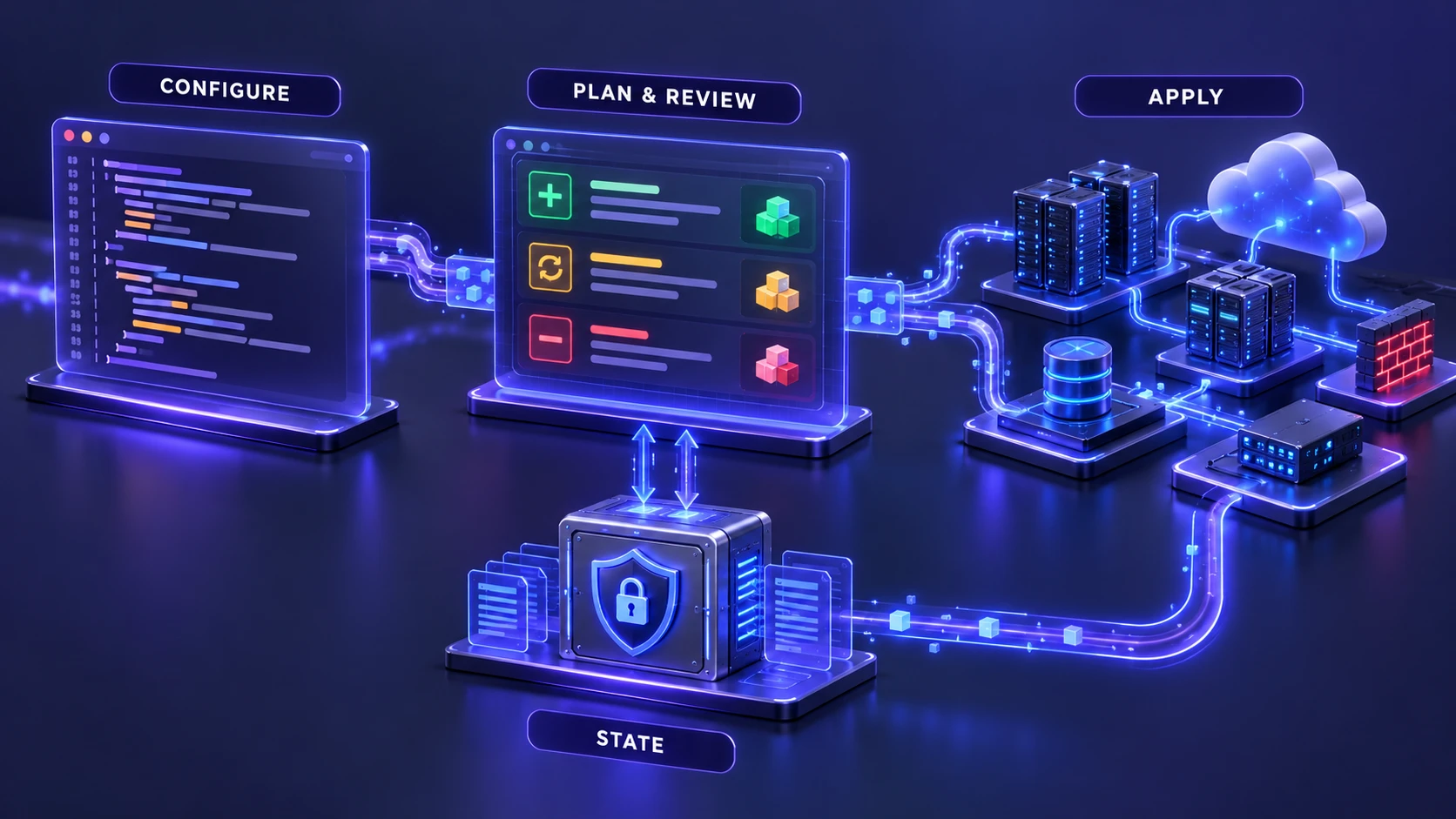
Terraform and OpenTofu are declarative IaC tools that use providers to talk to cloud and platform APIs. You write configuration describing resources such as networks, identities, compute, and managed services, then run a plan to preview changes before applying them.
Both Terraform and OpenTofu use state files to map managed infrastructure resources to their configuration. During planning, the tools normally query providers to refresh information about existing resources and calculate proposed changes.
State helps identify additions, updates, and deletions, but it does not guarantee that every change will be safe. Teams must review execution plans, protect sensitive state data, and use a backend that supports appropriate access controls and state locking. Not every backend provides the same locking capabilities.
Why the Terraform Vs OpenTofu Comparison Matters?
Many teams standardize IaC across their organizations, making tool selection an important decision for security, governance, and long-term maintenance. Terraform vs OpenTofu is not only about syntax and commands; licensing, ecosystem direction, and enterprise support also influence the decision.
The licensing difference became especially important after HashiCorp announced its move to the Business Source License in August 2023. Readers can review HashiCorp’s official licensing announcement to understand the background and purpose of this change.
Because both share similar workflows, migrations can be straightforward in some cases. Still, the details matter when teams depend on specific providers, modules, policy tooling, and CI integration.
Shared Concepts You Should Understand First
A fair Terraform vs OpenTofu evaluation starts with the common building blocks both rely on. These concepts guide how you structure code and how safely you roll out change.
- Providers: Plugins that translate configuration into API calls for AWS, Azure, Google Cloud, Kubernetes, and many other platforms.
- Modules: Reusable packages of configuration that standardize patterns such as VPCs, IAM roles, and clusters.
- State Management: A snapshot of deployed resources that enables planning and drift detection, often stored remotely for team use.
- Plan and Apply Workflow: A two phase approach that previews changes and then executes them with approvals.
- Variables and Outputs: Inputs and exported values that let modules compose cleanly across environments.
Once these fundamentals are stable, the differences between tools become easier to evaluate and govern.
Key Differences Between Terraform and OpenTofu
Terraform and OpenTofu share a common foundation, but their development models and licensing terms are different. Terraform is developed by HashiCorp, while OpenTofu is an open-source project operating under the Linux Foundation.
A major difference emerged in August 2023, when HashiCorp announced a licensing change from the Mozilla Public License 2.0 (MPL 2.0) to the Business Source License 1.1 (BSL 1.1) for future releases of its products, including Terraform.
OpenTofu was created as an open-source fork of Terraform and continues under the MPL 2.0 license. This distinction is particularly relevant to organizations that redistribute, embed, or build commercial products around IaC software.
For many organizations using the tools internally, both remain practical options. However, licensing requirements should be reviewed separately from technical capabilities because each tool also has its own release roadmap, registry ecosystem, and feature development.
| Comparison Factor | Terraform | OpenTofu |
|---|---|---|
| Core Licensing | Business Source License 1.1 for newer Terraform releases | Mozilla Public License 2.0 |
| Governance | HashiCorp-led development | Community-driven project under the Linux Foundation |
| CLI Commands | terraform init, plan, apply | tofu init, plan, apply |
| Configuration Language | Uses HashiCorp Configuration Language (HCL) | Supports familiar HCL-based configurations |
| Provider Registry | Terraform Registry | OpenTofu Registry |
| Modules | Extensive existing module ecosystem | Supports many similar modules; compatibility should be tested |
| State Management | Local and remote state with backend-dependent security and locking | Local and remote state, plus optional built-in state and plan encryption |
| Enterprise Automation | Integrates with CI/CD tools and HCP Terraform | Integrates with CI/CD and third-party automation platforms |
| Cross-Tool Compatibility | Depends on configurations, providers, and versions | Aims for Terraform compatibility but cannot guarantee parity with every release |
| Best Suited for | Teams prioritizing HashiCorp’s ecosystem and commercial platform integration | Teams prioritizing open-source licensing and community governance |
This table frames the most common evaluation topics without assuming one tool fits every organization.
Providers and Modules in Real Projects
Providers and modules determine how quickly teams can deliver consistent infrastructure patterns. A mature module library reduces duplication and makes security and operational standards easier to enforce across teams.
Terraform users can discover providers and modules through the Terraform Registry, while OpenTofu maintains its own registry. Teams evaluating compatibility can explore the OpenTofu provider registry to check available providers, versions, and documentation before adopting or migrating to OpenTofu.
When comparing Terraform vs OpenTofu, check the exact providers and modules used by your infrastructure. OpenTofu supports many providers familiar to Terraform users, but it uses a separate registry, and availability or behavior should not be assumed to match in every situation.
Review provider version constraints, source addresses, module dependencies, and the .terraform.lock.hcl dependency lock file. Teams using private registries, provider mirrors, or restricted networks should also test provider downloads and authentication before switching tools.
For production environments, run initialization and planning in a test environment before approving any migration. This helps identify compatibility problems before infrastructure changes are applied.
State Management and Security Considerations

State management is one of the most important security considerations when using Terraform or OpenTofu. State files may contain credentials, resource identifiers, configuration values, and other sensitive information about cloud infrastructure.
For team environments, use a remote backend with suitable encryption, restricted access, versioning or backups, and state locking where supported. Terraform’s official documentation on state locking explains how supported backends help prevent conflicting operations.
OpenTofu also supports built-in encryption for state and plan files. This provides an additional protection option beyond storage-level encryption, although encryption keys must be managed carefully. Its official state and plan encryption documentation explains the available methods and migration requirements.
Both tools still require strong credential management. Use short-lived credentials where possible, restrict pipeline permissions, protect state backups, and avoid placing long-lived secrets directly in infrastructure configuration. Encryption reduces exposure risks, but it does not replace access controls, backups, or secure operational procedures.
Policy, Compliance, and Guardrails
IaC is easier to govern when policy checks run before apply. Teams commonly enforce rules around tagging, network exposure, encryption, allowed regions, and identity boundaries.
Combine code reviews with automated validation and policy checks in CI/CD pipelines to detect infrastructure misconfigurations before deployment. Organizations that require stronger governance can also use approved modules, centralized templates, and mandatory reviews for high-risk changes.
Infrastructure automation is closely related to broader deployment practices, but IaC and GitOps serve different purposes. Our comparison of GitOps vs CI/CD explains how automated pipelines and declarative deployment workflows can work together.
- Standardized Modules: Use curated modules to enforce defaults such as logging, encryption, and naming conventions.
- Pre Apply Validation: Run formatting, static analysis, and policy checks before merges and deployments.
- Least Privilege Runners: Limit CI/CD credentials to the permissions needed for each environment and infrastructure workspace. Since Terraform and OpenTofu communicate with cloud APIs, teams should also protect authentication tokens, restrict credential access, and prevent secrets from appearing in logs or configuration files. Our guide to API security basics explains the risks associated with weak authentication and excessive permissions.
These guardrails reduce incidents while keeping delivery speed predictable.
Migration Considerations and Compatibility Checks
If you are evaluating a move between Terraform and OpenTofu, begin by reviewing your existing provider versions, modules, state backends, and automation requirements. Confirm that the chosen tool supports your configuration and that CI/CD pipelines use a consistent, approved version.
For teams moving from Terraform to OpenTofu, the official OpenTofu migration guide provides instructions for backing up infrastructure state, initializing the new tool, and validating compatibility before making production changes.
Plan for a controlled cutover where only one tool writes state at a time. Add change management steps such as approvals, drift checks, and rollback plans before modifying production environments.
Before migrating from Terraform to OpenTofu, or evaluating a move in the opposite direction, teams should follow a controlled process.
- Inventory Existing Infrastructure: Record the current CLI version, provider versions, modules, backend configuration, and dependencies between infrastructure projects.
- Back Up Configuration and State: Save recoverable backups of the infrastructure configuration and state before beginning the migration. Protect these backups because they may contain sensitive information.
- Check Version Compatibility: Review the selected tool’s documentation for state-format support, provider compatibility, module requirements, and features that may not work across both tools.
- Validate In Nonproduction: Initialize the chosen tool in a test environment, examine the proposed plan, and investigate unexpected resource changes before applying anything.
- Update CI/CD Pipelines: Pin the approved tool version, update runner commands, check credentials, and verify that required providers and modules can be downloaded.
- Perform A Controlled Cutover: Prevent simultaneous writes to the same state, use supported locking mechanisms, and monitor the first approved changes carefully.
- Prepare A Recovery Plan: Document how to restore configuration and state backups if the migration fails. Do not assume that state written by a newer tool version can always be read by an older version.
A successful migration should preserve the intended infrastructure without introducing unexpected resource creation, replacement, or deletion.
A disciplined migration reduces surprise diffs and prevents accidental resource replacement.
How to Choose Between Terraform and OpenTofu?
Start with organizational constraints, not personal preference. Legal and compliance teams may have requirements around licensing, redistribution, and vendor dependence that narrow the options quickly.
Next, evaluate operational fit by checking provider availability, module compatibility, state management, and integration with existing CI/CD pipelines. Teams already using HashiCorp’s enterprise platform may find Terraform a natural fit, while organizations prioritizing open-source licensing and community governance may prefer OpenTofu.
Neither tool eliminates the need for strong DevOps practices. Reliable infrastructure management still depends on tested configurations, secure credentials, clear ownership, and controlled deployment workflows.
- Team Skill and Hiring: Consider which tool your engineers already know and which skill sets are easiest to hire for.
- Governance and Audit Needs: Match the tool and surrounding process to your approval, logging, and compliance requirements.
- Platform Roadmap: Align with the ecosystem and governance model your organization trusts for long term stability.
When the choice is clear, document it and standardize templates so every team follows the same baseline.
Common Mistakes to Avoid With IaC Tools

Most IaC failures come from process gaps rather than tool limitations. Consistent workflows and strong guardrails prevent drift, outages, and costly rework.
- Using Local State for Shared Environments: Local state can be suitable for learning and isolated projects, but it creates coordination and recovery risks when multiple team members manage the same infrastructure. For shared environments, use secure remote state with appropriate access controls and locking support.
- Overusing Default Settings: Defaults may not meet security requirements for encryption, logging, and network controls.
- Skipping Plan Reviews: Unreviewed applies can introduce unintended deletes and replacements.
- Ignoring Drift: Console changes outside IaC create surprises and make future deployments risky.
Correcting these patterns early makes Terraform vs OpenTofu less risky because the surrounding engineering discipline is already strong.
Conclusion
Terraform vs OpenTofu is a practical decision about governance, ecosystem confidence, and how you want to manage IaC over the long term. Both follow a similar plan and apply workflow, rely on providers, and depend on secure state management.
Choose the tool that best matches your compliance constraints, operational model, and team capabilities, then standardize modules and CI guardrails. When executed well, Infrastructure as Code becomes a reliable foundation for secure, repeatable infrastructure delivery.
Frequently Asked Questions
Is OpenTofu A Drop in Replacement for Terraform?
OpenTofu is designed to support many familiar Terraform configurations and workflows, but it should not be considered a guaranteed drop-in replacement for every Terraform version or production environment. Differences may arise from provider availability, configuration features, backend behavior, and state formats.
Before switching, verify the installed versions, test provider initialization, review the execution plan, and confirm that existing state can be read safely. Organizations using newer features or interconnected infrastructure projects should perform additional compatibility testing.
What is the Biggest Risk in Terraform Vs OpenTofu Migrations?
The highest risk is state divergence when two tools write to the same state or when backend locking is misconfigured. Strong change control, exclusive state access, and drift checks reduce the chance of unintended replacements.
How Do I Keep IaC Secure in CI Pipelines?
Use short lived credentials, least privilege roles, and encrypted remote state with access controls. Add automated policy checks and require plan reviews so risky changes are caught before apply.